Image: Wikimedia Commons
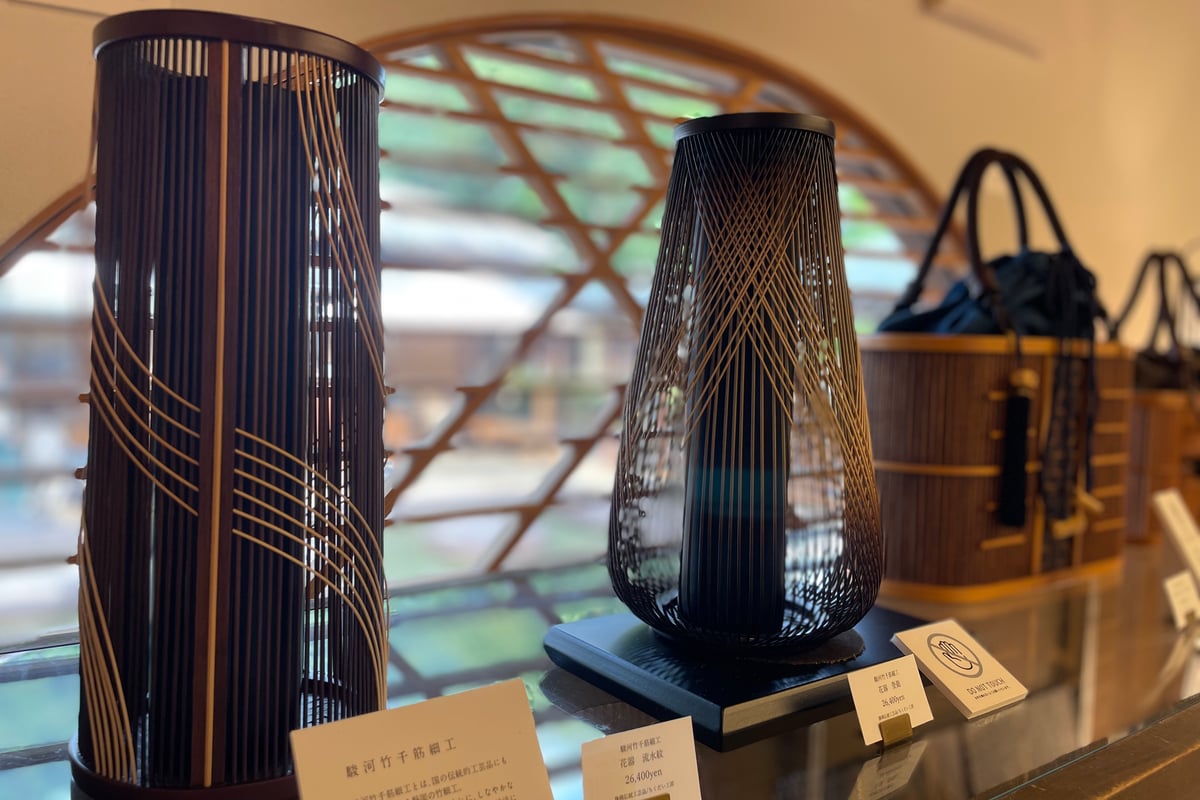
Suruga Bamboo Sensuji Ware (Suruga Take Sensuji Zaiku) is a bamboo craft made in Shizuoka City. Bamboo is split into thin pieces and finished into round bamboo strips (maru-higo), which are inserted one by one into holes drilled in bamboo rings to build up each piece. While most other production areas weave flat strips, this craft 'assembles' round strips, creating clean straight lines and graceful curves. In Shizuoka, traces of bamboo products have been found at the Yayoi-period Toro site, and bamboo work has long been rooted in daily life. In the Edo period it was called 'Suruga crafts' (駿河細工) and was popular with the daimyo and travelers who came and went along the Tokaido. In 1840 (Tenpo 11), Suganuma Ichiga, a samurai of the Okazaki Domain, passed on the technique of round bamboo strips, and this is said to have laid the foundation of today's delicate style. In 1976 it became a Traditional Craft Designated by the Minister of Economy, Trade and Industry. Besides flower vases, insect cages and confectionery containers, andon lanterns and wind chimes are also made.
Origin
The basins of the Abe River, which flows through Shizuoka City, and its tributary the Warashina River have long been a source of high-quality bamboo. Zaru colanders and baskets have been excavated from the Yayoi-period Toro site, and bamboo products have been used as everyday tools since ancient times. In 1840 (Tenpo 11), Suganuma Ichiga, a samurai of the Okazaki Domain who excelled in flower arrangement, the tea ceremony and weaving, stopped in Sunpu. During that stay, at the inn where Suganuma was lodging, the technique of round bamboo strips was passed on to Shimizu Ihei, and this is regarded as the beginning of Suruga Bamboo Sensuji Ware.
History
In the early Edo period, finely made basket pillows were popular with daimyo traveling for sankin-kotai, and in the Kan'ei era, takajo doshin (falconry retainers) living in the castle town are said to have made braided hats and cages for bell crickets. Suganuma Ichiga trained many disciples until Suganuma's death in 1856 (Ansei 3). In 1873 (Meiji 6) the work was exhibited at the Vienna World's Fair and won recognition overseas as an export product. In 1976 it became a Traditional Craft Designated by the Minister of Economy, Trade and Industry, and in 2018 it was registered as a regional collective trademark.
Features
Its greatest characteristic is that thin, round strips are assembled one by one and finished as sensuji ('a thousand lines'). The distinctive technique of bending strips into rings and the technique called tsugite (joints), used to connect the rings, are also unique to this production area. Another distinguishing point is that a single craftsperson handles almost every process up to the finishing. In a nod to the nodes (fushi) of bamboo, which echo fushime, the Japanese word for life's turning points, pieces are also chosen as gifts for milestones such as marriage, long life and retirement.
Techniques
Round bamboo strips (maru-higo)
Bamboo split with a nata hatchet is brought to an even thickness with a tool called 'せん台', then split finely and drawn out to make thin, round strips. To make strips 1.5 mm in diameter, the bamboo is said to be trimmed to a thickness of about 2 mm. These round strips create a soft, warm texture.
Bending and joints (tsugite)
Bamboo trimmed to about 9 mm wide and 5 mm thick is wrapped around a heated pipe (doran) and bent into a ring. A distinctive technique called tsugite is used for the joint of each ring. Holes for the strips are drilled into the ring one at a time, and slight differences in their angles change the expression of the finished piece.
Materials Used
Production Process
- 1
Splitting (hegi)
Split the bamboo with a nata hatchet and take out the strong part close to the skin.
- 2
Setting the thickness
Use a tool called 'せん台' to set the thickness to match the diameter of the strips.
- 3
Fine splitting
Make fine cuts with two blades and split the bamboo into thin pieces.
- 4
Drawing the strips
Draw out the split bamboo to make round strips as thin as thread.
- 5
Bending
Wrap the bamboo around a heated pipe and bend it into a ring.
- 6
Drilling
Drill the holes for the strips into the ring one at a time, checking the angle of each.
- 7
Assembly
Insert the round strips into the holes one by one to assemble the piece.
| Main Production Areas |
|
|---|
Artisans & Workshops
駿河竹千筋細工協同組合
The production-area association, with its office in 五番町, Aoi Ward, Shizuoka City. In June 2025 it changed its name from 静岡竹工芸協同組合. It is made up of 12 craftspeople who make Suruga Bamboo Sensuji Ware in the city, and certified traditional craftspeople are among its members. Its official website sells flower vases, lights, wind chimes and other items.
Official site →みやび行燈製作所
A Suruga Bamboo Sensuji Ware workshop in 四番町, Aoi Ward, Shizuoka City, in business since the Taisho period. Since its founding it has supplied lighting fixtures to major electrical manufacturers, and it has wholesaled lighting fixtures, tea utensils and flower vases to department stores across Japan. It also runs an online shop.
Official site →篠宮竹細工所
A workshop in 八幡, Suruga Ward, Shizuoka City. 篠宮康博, who established it in 1966, has been honored as a Shizuoka City Master of Traditional Craft Techniques (静岡市伝統工芸技術秀士). The workshop is known for works that fuse bamboo weaving techniques with the skills of bamboo sensuji work, and has a strong reputation for making large flower vases and special bamboo products.
Official site →How to Buy
- 駿河竹千筋細工協同組合 Online Shop
- On the association's official website you can buy flower vases, confectionery containers, lights, hand-carried baskets, insect cages, wind chimes and more. Prices range widely, from about 5,500 yen for a tabletop wind chime to large flower vases costing over 100,000 yen. Items that have passed the association's inspection bear a certificate label with the Traditional Craft mark.Where to buy →PR
- 駿府楽市
- A shop in the ASTY Shizuoka West Building at JR Shizuoka Station that carries Shizuoka's crafts and local specialties. It sells Suruga Bamboo Sensuji Ware along with lacquerware, dyed goods, wooden products and more, and exhibitions of bamboo sensuji work are also held there. It is open from 9:00 to 21:00.Where to buy →PR
- 伝統工芸 青山スクエア
- A shop in Akasaka, Tokyo, that exhibits and sells Traditional Crafts. The 駿河竹千筋細工協同組合 lists it, together with 'THE COVER NIPPON' in Tokyo Midtown, as a place where its work is permanently exhibited and sold.
Hands-on Experiences
駿府の工房 匠宿
静岡県静岡市駿河区丸子3240-1
At the '工房 竹と染' (Bamboo and Dyeing Workshop), you can try making Suruga Bamboo Sensuji Ware. Pen stands and small cases start from about 2,500 yen, insect cages and flower vases cost about 2,000 to 4,000 yen, and serving baskets and round trays about 5,000 to 9,000 yen. Many programs require reservations, and booking online in advance is recommended.
View details →FAQ
Q. What does 'sensuji' mean?
A. It is a word describing the appearance of this bamboo work, in which the thin round strips look as if a thousand of them are lined up. While bamboo crafts from other production areas are made by weaving flat strips, Suruga Bamboo Sensuji Ware is assembled by inserting round strips one by one into the holes of bamboo rings. As a result, neat straight lines and soft curves stand out.
Q. Is there a way to tell genuine Suruga Bamboo Sensuji Ware?
A. The 'traditional certificate label' bearing the Traditional Craft mark is a useful guide. The label is attached to Traditional Crafts Designated by the Minister of Economy, Trade and Industry that have passed inspections carried out by production-area associations and others. The 駿河竹千筋細工協同組合 urges buyers to beware of imitations and imported products.