Suruga Hina Doll Furnishings and Hina Dolls
Suruga Hinagu and Suruga Hina Ningyo (Suruga Doll Furnishings and Hina Dolls)
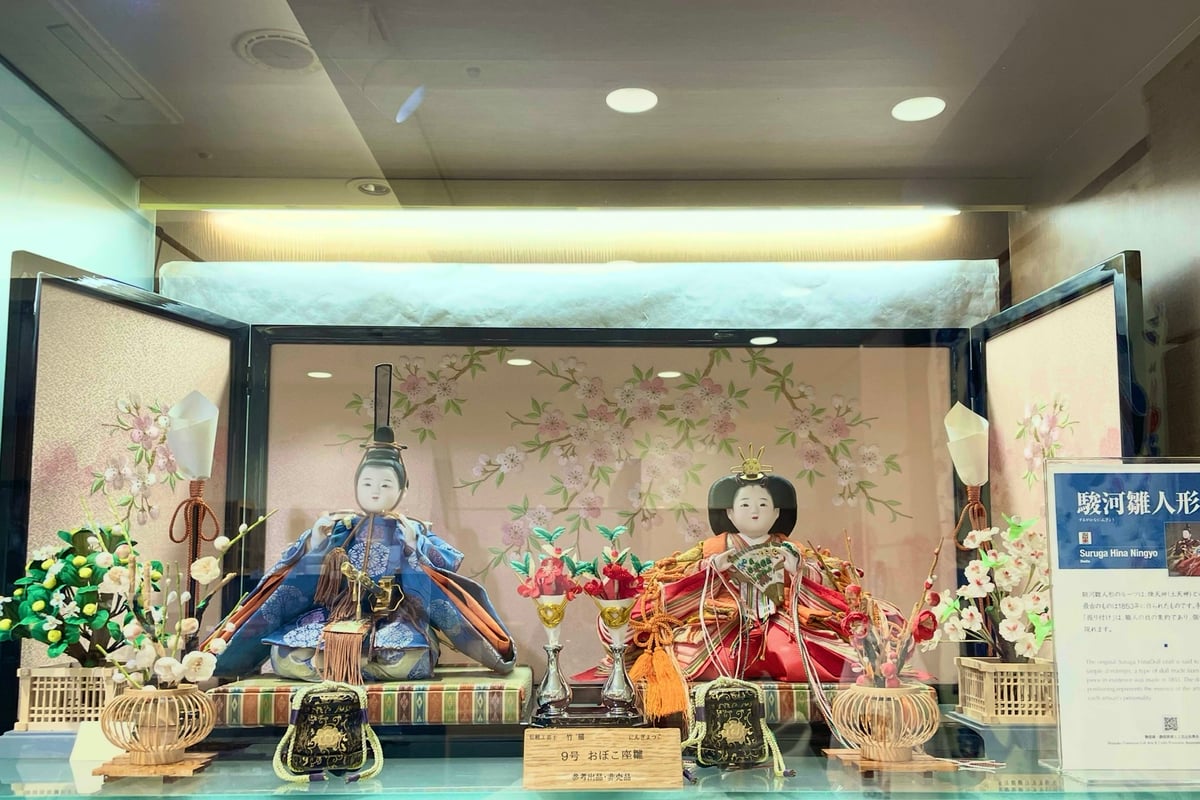
Image: Wikimedia Commons
Suruga Hinagu (Suruga hina doll furnishings) and Suruga Hina Ningyo (Suruga hina dolls) are decorations for the Hinamatsuri doll festival made mainly in Shizuoka City. Both became Traditional Crafts Designated by the Minister of Economy, Trade and Industry in 1994. Hina doll furnishings (hinagu) are the small furnishings displayed together with hina dolls, such as tansu chests, nagamochi trunks, mirror stands and goshoguruma ox carriages. There are about 40 kinds among the traditional items alone, and they are made with the same processes as real furniture. The joiners and wood turners who make the wooden bases work together with lacquerers, maki-e artists and metal-fitting makers, dividing the work to complete each piece. By the Showa 40s, hinagu had come to account for about 90% of the national market share. The hina dolls have their roots in the Tenjin dolls made in central Shizuoka Prefecture. They use a thick straw body (warado) made of tightly bundled rice straw, and the craftsperson's skill shows in furitsuke, the step in which both arms are bent to set the doll's pose. In doll bodies, the area came to account for about 70% of national production.
Origin
In Shizuoka, it is said that from the Muromachi period, following the customs of court nobles, hina play (hina-asobi), in which items such as 'hiina hariko' were given as gifts, had taken root. In the early Edo period, excellent craftspeople were gathered in Sunpu from all over Japan to build Kunozan Toshogu Shrine and Shizuoka Sengen Shrine. The craftspeople who remained after the construction passed on the techniques of joinery, wood turning, lacquering and maki-e, and these became the foundation of hinagu. The hina dolls are considered to have their roots in the Tenjin dolls made in central Shizuoka Prefecture.
History
Full-scale production of hinagu began around 1882 (Meiji 15), and from around Meiji 35 many lacquerware makers also joined in. After the Great Kanto Earthquake of 1923 (Taisho 12), craftspeople from Tokyo and elsewhere in the Kanto region moved to the area, and output grew. Full-scale production of hina dolls in Shizuoka City began around 1931 (Showa 6). In the Showa 40s, hinagu accounted for about 90% of the national market share and doll bodies for about 70%. In 1994, both items were designated together as Traditional Crafts Designated by the Minister of Economy, Trade and Industry.
Features
The greatest characteristic of Suruga Hinagu is that even items small enough to rest on the palm of a hand are made with the same processes as real furniture and furnishings. As with lacquerware, the wood is sealed and given a groundwork before lacquer and other coatings are applied, and everything down to the drawers is precisely assembled. The gorgeous maki-e depicting arabesques, flowers and birds, and landscapes is another highlight. Suruga Hina Ningyo are distinguished by straw bodies thicker than those of other production areas, which are shaved at an angle to match the curve of the chest, and by costumes tailored separately for the upper and lower halves.
Techniques
Division of labor among five crafts (goshoku)
Hinagu are made through a division of labor among specialist craftspeople: joiners (sashimonoshi), wood turners (hikimonoshi), lacquerers (nushi), maki-e artists (makieshi) and metal-fitting makers (kanagushi). For box-shaped items the wooden base is made by joinery that assembles boards, and for round vessels by wood turning on a lathe. Lacquering, maki-e and the attachment of metal fittings are then added to finish each piece.
Straw body (warado) and furitsuke
The body of a Suruga Hina Ningyo is made of tightly layered rice straw cut to size and shaved along the curve of the chest. Arms made of wire wrapped in wood wool (mokumen) are attached, the costume is put on, and the pose is then set by furitsuke, the bending of both arms. This step reveals each craftsperson's individuality so clearly that the maker can be identified from the shape of the bends.
Materials Used
| Main Production Areas |
|
|---|
Artisans & Workshops
静岡雛具人形協同組合
The production-area association for Suruga Hinagu, with its secretariat in 中野新田, Suruga Ward, Shizuoka City. Its members are seven companies, including folding-screen shops and hinagu manufacturers. It presents Suruga Hinagu as items that bring together techniques such as woodworking, lacquerware and maki-e.
Official site →白石雛具株式会社
A comprehensive maker of hina doll furnishings in 下島, Suruga Ward, Shizuoka City, established in 1979. Besides wholesaling its products to major wholesalers and specialty stores across Japan, it sells hina dolls and May dolls (gogatsu ningyo) at 'MAHOROBA,' the showroom on the third floor of its head office.
Official site →望月人形
A doll shop in Yui, Shimizu Ward, Shizuoka City, founded in 1936. It handmakes Suruga Hina Ningyo and Tenjin dolls using traditional techniques and materials, such as heads made of toso and bodies made of rice straw. 望月明, the second-generation owner, is a certified traditional craftsperson for Suruga Hina Ningyo.
Official site →How to Buy
- 望月人形
- Hina dolls and Tenjin dolls are displayed and sold at the shop, about a 15-minute walk from JR Yui Station. Besides accommodating requests to rearrange the combination of dolls in a hina set, the shop accepts custom orders and doll repairs. It is open from 10:00 to 18:00.Where to buy →PR
- MAHOROBA Showroom (白石雛具)
- A showroom on the third floor of the head office of 白石雛具株式会社. It reopened after renovation in 2015, and you can see hina dolls and May dolls in person before choosing. Products can also be bought from the company's sales website.Where to buy →PR
FAQ
Q. What kinds of hinagu are there?
A. There are goshoguruma (ox carriages), tansu chests, nagamochi trunks, mirror stands and more, with about 40 kinds among the traditional items alone. All are made with the same processes as real furniture and furnishings and are finished precisely, down to the drawers. Decorated with maki-e and gold leaf, they add splendor to the tiered displays of the Hinamatsuri festival.
Q. Why are Tenjin dolls displayed in Shizuoka?
A. In central Shizuoka Prefecture, until the beginning of the Meiji period there was a custom of giving Tenjin dolls to children celebrating their first seasonal festival (hatsu-zekku), whether boys or girls. When many former retainers of the shogunate moved to Sunpu after the Meiji Restoration, Edo's hina doll culture spread. As a result, it is said that people came to give dairi-bina (imperial couple dolls) to girls and Tenjin dolls to boys.
Q. Why is rice straw used for the bodies of Suruga Hina Ningyo?
A. It is thought to be because a lot of rice was grown around Shizuoka City, making rice straw easy to obtain. The use of straw bodies thicker than those of other production areas is said to be a feature found only in the central part of the prefecture, from the Oi River to the Fuji River. The straw bodies are shaved at an angle to match the curve of the chest before use.