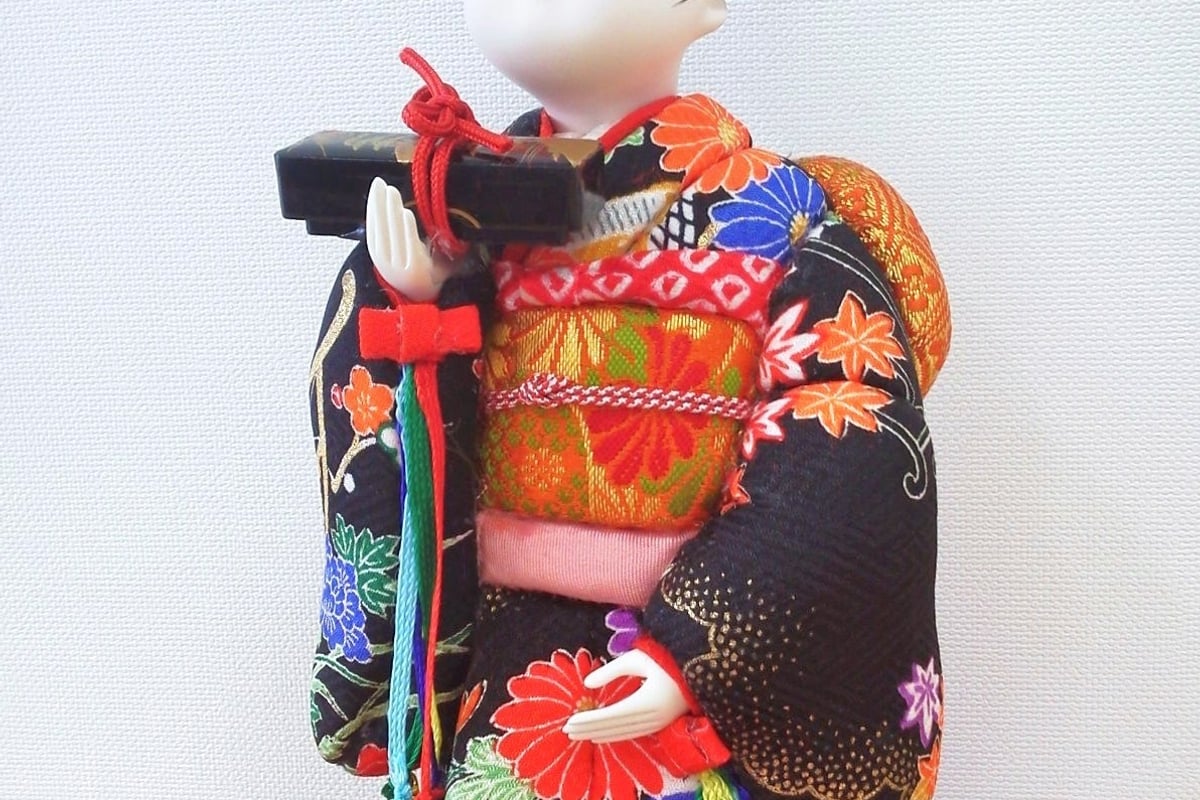
Image: Wikimedia Commons
Edo kimekomi ningyo are dolls made using a distinctive technique in which fine grooves are carved into a doll's base form—made of toso (paulownia-powder clay paste) or wood—and the edges of fabric are pressed, or 'kimekomi'-ed, into those grooves to dress the doll. The technique originates in Kyoto during the Genbun era (1736–1741), when Takahashi Tadashige, who served the priests of Kamigamo Shrine, is said to have carved a doll's base form from willow wood and pressed scraps of priestly robes into it, giving rise to what became known as 'yanagi ningyo' (willow dolls) or 'kamo ningyo' (Kamo dolls). This technique was later passed on to Edo, where it developed independently after the Meiji era in Tokyo and became established as 'Edo kimekomi ningyo.' While dolls made in Kyoto are characterized by plump, courtly faces, those made in Tokyo are known for a somewhat slender-faced, modern look with sharply defined features. Making a single doll involves many stages of handwork, from applying layer upon layer of finishing coats to a toso base, to pressing fabric into the grooves, to painting the face with a fine detail brush and finishing the hair. Still widely loved today as hina dolls and Boys' Day dolls, Edo kimekomi ningyo was designated a Traditional Craft Designated by the Minister of Economy, Trade and Industry in 1978.
Origin
The origin of Edo kimekomi ningyo dates back roughly 250 years, to the Genbun era (1736–1741) in Kyoto. Takahashi Tadashige, who served the priests of Kamigamo Shrine, is said to have carved a doll's base form from leftover willow wood and pressed scraps of the priests' robes into grooves to serve as clothing—this is considered the origin of the craft, initially known as 'yanagi ningyo' (willow dolls) or 'kamo ningyo' (Kamo dolls). The kimekomi technique used for these Kamo dolls was later passed on to Edo.
History
The kimekomi technique, born in Kyoto, was passed on to Edo, where it developed independently in Tokyo from the Meiji era onward and became established as 'Edo kimekomi ningyo.' Tokyo craftspeople refined their skills in areas such as shaping toso bases and delicate face painting, and a wide range of works came to be produced, centered on hina dolls and Boys' Day dolls. The craft was designated a Traditional Craft Designated by the Minister of Economy, Trade and Industry in 1978, and its techniques continue to be passed down today by craftspeople in Tokyo and Saitama.
Features
Kimekomi refers to a distinctive technique in which fine grooves marking the folds and seams of a garment are carved into a doll's base form, and the edges of fabric are pressed, or 'kimekomi'-ed, into those grooves to dress the doll. While dolls made in Kyoto are characterized by plump, courtly faces, Edo kimekomi ningyo made in Tokyo are known for a somewhat slender-faced look with sharply defined features. Craftspeople carefully finish many stages by hand, applying layer upon layer of coating to a toso base and finishing with face painting using a fine detail brush.
Techniques
Kimekomi
A technique in which fine grooves marking the seams of a garment are carved into a doll's base form, and the edges of fabric are pressed into them to dress the doll. The beauty of the garment's folds is expressed purely through the tension of the fabric, without using glue.
Face painting
Using a fine detail brush, the eyes, nose, and mouth are carefully painted stroke by stroke to complete the doll's expression. Dolls made in Tokyo are painted with a somewhat slender face and sharply defined features.
Materials Used
Production Process
- 1
Making the base form
Toso is packed into a mold to form the doll's body and head, which is then dried and finished into a base form.
- 2
Applying finishing coats
Layer upon layer of gofun (shell-based pigment) and similar materials are applied to the base to create a smooth foundation.
- 3
Groove carving and kimekomi
Fine grooves marking the seams of the garment are carved, and the edges of fabric are pressed into them to dress the doll.
- 4
Face painting and finishing
The face is painted with a fine detail brush, and the hair and accessories are arranged to complete the doll.
| Main Production Areas |
|
|---|
Artisans & Workshops
塚田工房 (Tsukada Kobo)
A long-established Edo kimekomi ningyo workshop founded in 1842, based in Mukojima, Sumida Ward. The workshop carries out every stage by hand, from carving the base form from toso to pressing fabric into the grooves, and its in-house 'Edo Kimekomi Ningyo Museum' displays historical works and tools.
Official site →How to Buy
- 塚田工房
- Customers can purchase hina dolls made using rare antique fabrics from the Edo to Meiji periods, as well as dolls themed around the Chinese zodiac, Noh theater, and Kabuki. Custom-made dolls using a customer's own cherished kimono are also accepted.Where to buy →PR
Hands-on Experiences
塚田工房(江戸木目込人形博物館)
東京都墨田区向島2-11-7
Reservation required; open to elementary school 4th graders and above. Visitors can choose from items such as a ball-shaped strap or a 'Fukuro' owl figure to try the kimekomi technique, starting at around 3,000 yen. The adjoining museum displays historical dolls and tools used in their production.
View details →FAQ
Q. What is the kimekomi ningyo technique?
A. It refers to a technique in which fine grooves marking the seams of a garment are carved into a doll's base form, and the edges of fabric are pressed into them to dress the doll. A key feature is that the beauty of the garment's folds is expressed through the tension of the fabric alone, without glue.
Q. What is the relationship between Edo kimekomi ningyo and the Kamo dolls of Kyoto?
A. Edo kimekomi ningyo developed from the technique of the Kamo dolls (also called willow dolls), which originated around Kamigamo Shrine in Kyoto during the Genbun era and was later passed on to Edo, where it developed independently in Tokyo from the Meiji era onward.