Image: Wikimedia Commons
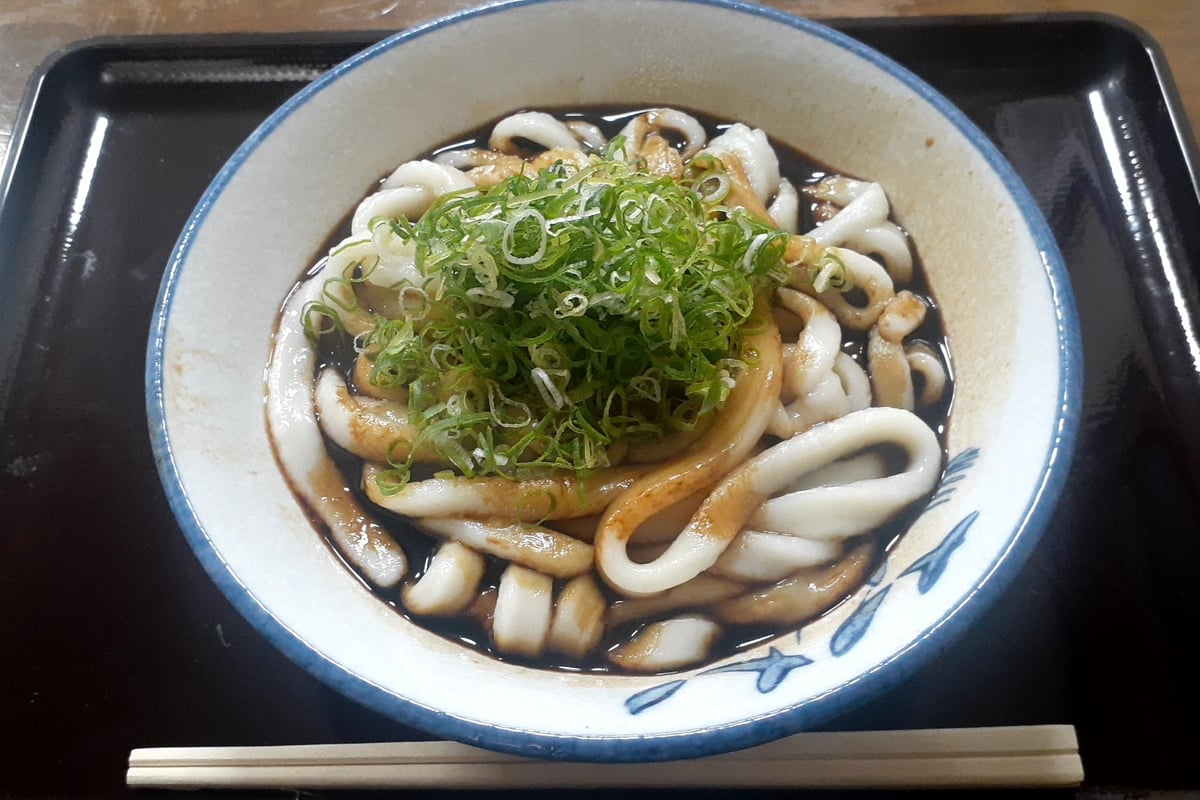
Ise udon is a local dish that has long been eaten in the Ise region, centered on Ise City. Extra-thick noodles, close to 1 cm in diameter, are boiled for about an hour until soft. They are eaten coated with just a small amount of a rich black sauce. The sauce combines tamari soy sauce (a rich soy sauce made mainly from soybeans) with dashi made from katsuobushi (dried bonito flakes), kombu, and other ingredients. Although it is jet black, it tastes surprisingly light. The noodles have almost no firmness (koshi), and their fluffy, soft and chewy texture is their greatest feature. When the Ise pilgrimage (Oise-mairi) flourished in the Edo period, it was served to pilgrims tired from long journeys as a food that is gentle on the stomach. Because it could be served quickly and eaten easily, it is said to have become known as a specialty of the shrine-front town. The name 'Ise udon' took hold relatively recently, from the Showa 40s onward. In fiscal 2024 (Reiwa 6), it was recognized as one of the Agency for Cultural Affairs' '100-Year Foods.'
Origin
The origins of Ise udon are unclear. It is said that since before the Edo period, people in the Ise region made thick udon without koshi, without taking the trouble to stretch the dough. They are said to have eaten it coated with 'tamari,' a liquid obtained from local miso. When the Ise pilgrimage flourished in the Edo period, shops appeared that served udon as a food to ease pilgrims' fatigue and give them energy. It is said to have been popular with pilgrims because it was simple and could be eaten quickly.
History
So as not to keep the many pilgrims waiting, shops in Ise kept boiling noodles constantly. This is also said to have led to the dish's distinctive soft texture. In the early Showa 40s, a famous lyricist is said to have remarked on the radio that 'since it is an unusual udon from Ise, it would be good to call it Ise udon.' This lyricist is said to have been Ei Rokusuke, and an anecdote remains that the lyricist spread the word about the taste of the udon eaten at Chitose (ちとせ), a long-established shop in Ise City. In 1972 (Showa 47), the Ise City noodle restaurant association (伊勢市麺類飲食業組合) unified the name as 'Ise udon.'
Features
The noodles are about twice as thick as ordinary udon and are finished by boiling for nearly an hour. The texture is fluffy, soft and chewy, with almost no koshi. The sauce is jet black, made by combining tamari soy sauce with dashi from katsuobushi, zatsubushi (shavings of dried fish such as mackerel), and kombu, along with mirin and sugar. A small amount of this sauce is mixed well into the noodles before eating. Some shops also offer menu items topped with egg, meat, or roast pork (yakibuta).
Main Ingredients
Food Culture
In the Ise region, it is a familiar taste that has long been eaten both at home and when dining out. Because the noodles need to be boiled for a long time, supermarkets and other stores sell boiled noodles packaged with sauce. It can also be enjoyed at shops around the Geku (Outer Shrine) of Ise Grand Shrine and in Oharai-machi in front of the Naiku (Inner Shrine).
How It Differs from Home Cooking
At home, it is made easily by heating store-bought boiled noodles and pouring the included sauce over them. Some specialty shops make their own noodles every day, only enough for that day, and boil them for about an hour. Each shop also puts its own care into the sauce, for example by combining dashi made from several kinds of dried fish shavings and niboshi (small dried fish), or by aging it for several days.
Famous Shops
ちとせ
三重県伊勢市岩渕1-15-11
A long-established shop said to have been founded in 1917 (Taisho 6), and also said to be the first shop to put up a sign reading 'Ise udon.' It is known for the anecdote that lyricist Ei Rokusuke introduced the shop's taste to the whole country. Its hallmark is a mellow sauce that uses plenty of tamari soy sauce and is aged for three days, and Ise udon costs about 600 yen.
名代 伊勢うどん 山口屋
三重県伊勢市宮後1-4-23
A shop founded in the early Showa period, about a 3-minute walk from Kintetsu/JR Iseshi Station. Its homemade noodles are made every day, only enough for that day, and boiled for an hour. They are eaten with a black sauce made by adding tamari soy sauce and other ingredients to dashi taken from several kinds of katsuobushi and niboshi.
| 山口製麺 Shelf-Stable Ise Udon, 3 Servings (with Sauce) | Ise udon that can be stored at room temperature, made by 山口製麺有限会社 in Ise City. It comes with a tamari soy sauce-based sauce, so you can enjoy Ise udon at home just by heating it for a few minutes. The price is about 864 yen (tax included). |
|---|
FAQ
Q. Why are Ise udon noodles so soft?
A. In Ise, shops are said to have kept boiling noodles constantly so as not to keep the many pilgrims waiting, and this led to the soft texture. It is also said that thick noodles without koshi were originally made without taking the trouble to stretch the dough. Even today, boiling them for nearly an hour is common.
Q. Is the black sauce salty?
A. The black color comes mainly from tamari soy sauce, and the sauce is not as salty as it looks. Because it is combined with dashi, mirin, and sugar, the taste is said to be surprisingly light. It is common to mix a small amount of sauce well into the noodles before eating.