Image: Wikimedia Commons
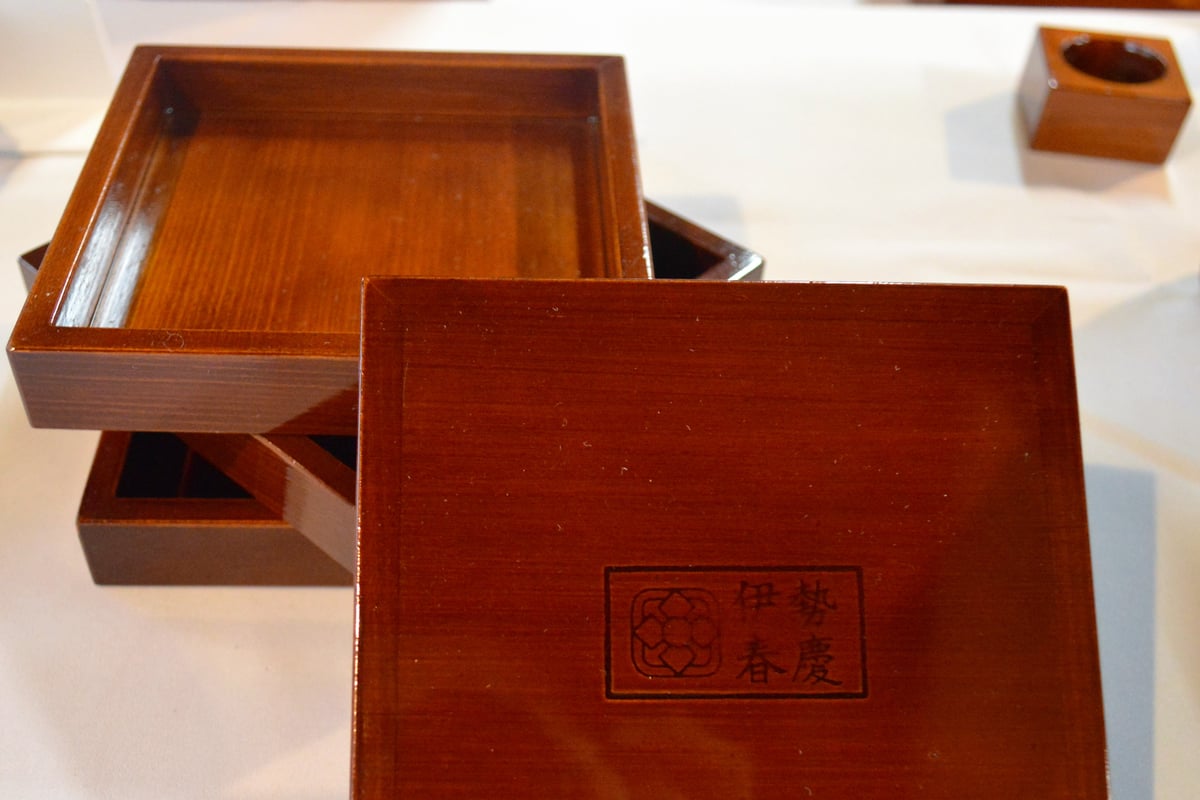
Ise Shunkei is lacquerware that has long been made in Ise City, Mie Prefecture. It is also called Ise lacquerware (伊勢漆器) or Yamada Shunkei (山田春慶). Box-shaped wares made from hinoki cypress boards are undercoated with bengara (red iron oxide pigment) and kakishibu (persimmon tannin), then finished with transparent lacquer. Its charm lies in the grain of the hinoki showing through a reddish-brown ground. Its origins are unclear, but it is said to have been started in the Muromachi period by craftsmen involved in building the Ise Grand Shrine, using leftover timber. In the Edo period it was traded as a souvenir of the Ise pilgrimage (Oise-mairi) and shipped to various regions from the wholesalers of Kawasaki. In the Meiji period it was described as 'crude but inexpensive and sturdy,' and was used throughout Japan for everyday vessels such as tiered boxes (jubako) and meal trays. However, war and the changes in postwar lifestyles brought production to a halt for a time. In 1994 (Heisei 6) it became a Mie Prefecture Designated Traditional Craft, and the Ise Shunkei Association (伊勢春慶の会), founded in 2004 (Heisei 16), is leading its revival.
Origin
There is no reliable record of how Ise Shunkei began, and there are several theories. The History of Uji-Yamada City (『宇治山田市史』), published in the 4th year of the Showa era, states that craftsmen of the shrine began making it as a side job, using timber left over from the shrine's construction. Mie Prefecture likewise states that it began at the end of the Muromachi period, when craftsmen received timber disposed of from the shrine's construction and applied Shunkei lacquer to plain wooden boxes. Documents from the late 1400s contain terms such as '大漆師屋,' which confirms that lacquer art existed in Ise at that time. However, it is not known whether that lacquerwork was Shunkei-nuri.
History
In the mid-Edo period, as the number of pilgrims to Ise grew, Ise Shunkei was traded as a local specialty of Ise. The wholesale district of Kawasaki along the 勢田川 River shipped the lacquerware by water to the Ise Bay coast and the Kansai region. At the 1873 (Meiji 6) Vienna World's Fair, the 片岡 family of 岡本町 exhibited pieces and received an award. The craft reached its peak in the Taisho era, but production stopped due to air raids during the war and the spread of plastic products after the war. From 2003 into the following year, the 'Homecoming Ise Shunkei Exhibition' (里帰り伊勢春慶展) was held at the Ise Kawasaki Merchant Hall (伊勢河崎商人館), and this led to the founding of the Ise Shunkei Association in May 2004.
Features
The wooden base is made of hinoki, and the main products are box-shaped wares such as tiered boxes, meal trays and bento boxes. In the inner corners at the bottom of box-shaped wares, a black filling called 'kokuso' is applied. Traditionally, kakishibu is used generously for the undercoat, and the wood is colored with bengara or food coloring. In reviving the craft, the color tones were determined using Meiji-period pieces, made before crude products became widespread, as models. The wooden base is dyed red with bengara, and the finishing lacquer used is also slightly reddish. Because relatively little lacquer and relatively few steps are used, it has been regarded as a sturdy, reasonably priced vessel for everyday use. The maker's brand is burned onto the underside of each product.
Materials Used
Production Process
- 1
Preparing the wooden base
The high-quality hinoki base is sanded with paper to smooth the surface. Each piece is carefully finished one by one to bring out the beauty of the wood grain to the fullest.
- 2
Coloring and grain filling
Bengara and whetstone powder mixed with water are brushed on, scraped off with a spatula and then wiped off with a cloth. The wooden base takes on a reddish tint, creating the foundation for Ise Shunkei's characteristic color.
- 3
Applying kakishibu
Kakishibu is brushed on and wiped off with a cloth, and after the piece has dried thoroughly, the process is repeated once more. The kakishibu undercoat supports the sturdiness of Ise Shunkei.
- 4
Wipe-lacquering and branding
Raw lacquer is applied thinly and wiped off, and the piece is dried in an urushi-muro (a drying room that maintains humidity); this is repeated three times. Partway through, a brand is pressed onto the underside of the base with a heated metal iron.
- 5
Corner kokuso (sumi-kokuso)
Using a kokuso spatula, kokuso is drawn in lines along the corners of box-shaped wares. Kokuso is an undercoat material that fills gaps, and this step, which gives the four corners a crisp black finish, is unique to Ise Shunkei.
- 6
Top coating
As a finish, a transparent lacquer called shuai-urushi is applied with a top-coat brush so that it develops a gloss. The piece is completed after drying thoroughly in the urushi-muro.
| Main Production Areas |
|
|---|
Artisans & Workshops
伊勢春慶の会
An organization founded in May 2004, growing out of the executive committee of the 'Homecoming Ise Shunkei Exhibition.' It has turned into products both the traditional 'Orthodox Shunkei' and the 'Casual Shunkei' developed jointly with the Kyoto Institute of Technology. It also works on relacquering old Shunkei pieces and passing on the techniques.
Official site →伊勢春慶デザイン工房
A production base for Ise Shunkei opened in 2008 in a renovated 150-year-old wooden house next door to the east of the Ise Kawasaki Merchant Hall. A lacquerer comes almost every day to do the lacquering, and this work is open to the public. New and old Ise Shunkei pieces are also exhibited and sold.
Official site →How to Buy
- 伊勢春慶デザイン工房
- At this workshop in Kawasaki, Ise City, bento boxes, tiered boxes, box trays (hakozen) and other items are exhibited and sold. Admission is free; it is generally open from 10:00 to 16:00 and closes on irregular days. Orders for original designs for wedding return gifts and commemorative gifts are also accepted. Visitors can also watch the lacquering work.Where to buy →PR
FAQ
Q. Where does the name 'Shunkei-nuri' come from?
A. It is said to derive from a lacquer finish devised by Shunkei, a lacquer craftsman of Sakai, during the Oan era (1368-1375) of the Nanboku-cho period. This technique spread to various regions and came to be called by the names of production areas, such as Hida Shunkei and Noshiro Shunkei. Ise Shunkei is one of them, and they share the feature of showing the wood grain through transparent lacquer. There are various theories about the origin of the name.
Q. Is it true that it was used at the Ise-Shima Summit?
A. At the Ise-Shima Summit in May 2016, Ise Shunkei bento boxes are said to have been used as vessels for the leaders' meals. This means that a lacquerware that had once died out in the Showa era appeared at an international conference just over ten years after the Ise Shunkei Association was founded.