Image: Wikimedia Commons
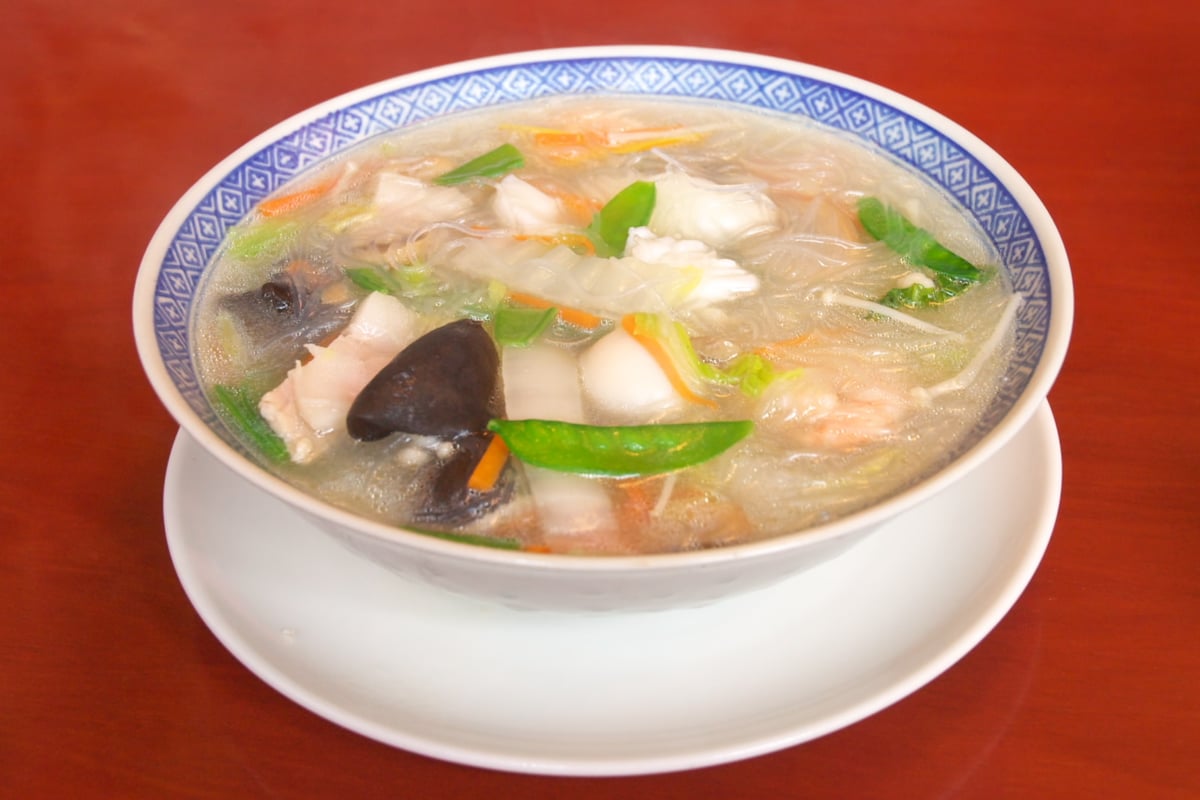
Taipien is a noodle dish of Kumamoto Prefecture in which glass noodles (harusame) are used like noodles and finished in soup together with vegetables, seafood, and pork. According to the Ministry of Agriculture, Forestry and Fisheries, it originated from a soup dish eaten on special days in households in Fuzhou, Fujian Province, China, and is said to have been brought to Nagasaki and Kumamoto by overseas Chinese in the late Meiji era. The Fuzhou dish is described as a soup containing duck eggs and wontons whose wrappers are made from pork and sweet potato starch. According to the ministry, in Kumamoto these were replaced by fried hen's eggs and glass noodles, and it became a noodle dish. Theories name Chukaen, Kairakuen, and Kourantei as the restaurant of origin, and the question has not been settled. As a light dish packed with ingredients, it is eaten for lunch, for dinner, and to finish off a night of drinking. It also appears in school lunches in Kumamoto City and the surrounding areas.
Origin
The Ministry of Agriculture, Forestry and Fisheries states that it originated from a soup dish eaten in Fuzhou at Bon, New Year, and other occasions, and was brought over by overseas Chinese in the late Meiji era. There is also a theory that it began with fried boiled eggs and glass noodles being used in place of bird's nest and shark fin. In Fuzhou, these eggs are called 'taiping eggs' (太平卵), and it is said that eating them brings a peaceful and secure life. On the other hand, Kourantei explains that it was created with modifications by overseas Chinese after they landed in Nagasaki, and that it is different from Fujian Province's 'yanpi' (燕皮).
History
The restaurant of origin in Kumamoto has not been determined. According to Wikipedia and Waraku Web, the most likely candidate is Chukaen, which opened in 1933 and closed in 2015. Other theories name Kairakuen, founded in 1933, and Kourantei, founded in 1934. It has also been adopted in school lunches, and Wikipedia gives examples from Uto City, Ogawa-machi in Uki City, and Nankan Town in addition to Kumamoto City. Today, many retort-pouch and instant products are also sold.
Features
The glass noodles are usually made from mung beans, though some restaurants and households choose domestic products made with potato starch. The soup varies by restaurant and household, including clear chicken-bone broth, paitan (white broth) that also uses pork bones, salt-based, and soy sauce-based versions. Common ingredients include pork, shrimp, squid, kamaboko (fish cake), napa cabbage, onion, and wood ear mushrooms. The fried boiled egg placed on top is eye-catching, but in some cases, as in the Ministry of Agriculture, Forestry and Fisheries' recipe, the egg is placed on top without frying.
Main Ingredients
Food Culture
According to the Ministry of Agriculture, Forestry and Fisheries, it is eaten for lunch, for dinner, or to finish off a night of drinking, and is served at Chinese restaurants and ramen shops. It is also often made at home, and in Kumamoto City and the surrounding areas it is familiar as an elementary school lunch menu item. It is also actively promoted to tourists.
How It Differs from Home Cooking
Kourantei explains that it uses 100% mung bean glass noodles, a soup of chicken bones and pork bones, and sea salt from Fujian Province. The vegetables, seafood, and meat are stir-fried over high heat before the umami is drawn out with the soup. The home recipe from the Ministry of Agriculture, Forestry and Fisheries uses Chinese soup stock base and light soy sauce.
Famous Shops
紅蘭亭 下通本店
熊本県熊本市中央区安政町5-26 2〜6F
A Chinese restaurant founded in 1934 by 葉菊華. Its official website describes it as one of the originators of taipien and states that it uses 100% mung bean glass noodles and a fried egg called 'hupidan' (虎皮蛋, tiger-skin egg). A tourism guide lists the lunch budget as from 1,000 yen. Prices are subject to change.
View details →会楽園
熊本県熊本市中央区新町2丁目7-11
A long-established restaurant in business since 1933, considered one of the restaurants where taipien originated. Diners can enjoy napa cabbage, slightly thick glass noodles, shrimp, and a fried boiled egg in a chicken-bone-based soup. A travel information site updated in 2024 listed it at 880 to 900 yen. According to a tourism guide updated in 2026, it is open from 11:30 to 15:00, and in the evening only course meals are served, by reservation. Prices are subject to change.
View details →| Taipien from Kourantei ONLINESHOP | An online shop run by Kourantei that offers taipien individually and in sets. The Kumamoto Nichinichi Shimbun reported that the restaurant developed a taipien made only with plant-based ingredients and sold an instant version at its Shimotori main store.Where to buy →PR |
|---|
FAQ
Q. Does taipien contain bird's nest?
A. No, it does not. According to the Ministry of Agriculture, Forestry and Fisheries, there is a theory that it began with fried boiled eggs and glass noodles being used in place of the luxury ingredients bird's nest and shark fin. It is said this is because the wrinkles on the surface of the fried egg resemble a bird's nest.
Q. What does the name 'taipien' mean?
A. According to Wikipedia, in the Fuzhou dialect the word for duck egg sounds like a phrase meaning 'to quell disorder,' which is linked to 'taiping' (太平, peace). The character 燕 (swallow) sounds like 宴 (banquet), giving the auspicious name 'banquet of peace,' and it is said to have been eaten at weddings as well.