Image: Wikimedia Commons
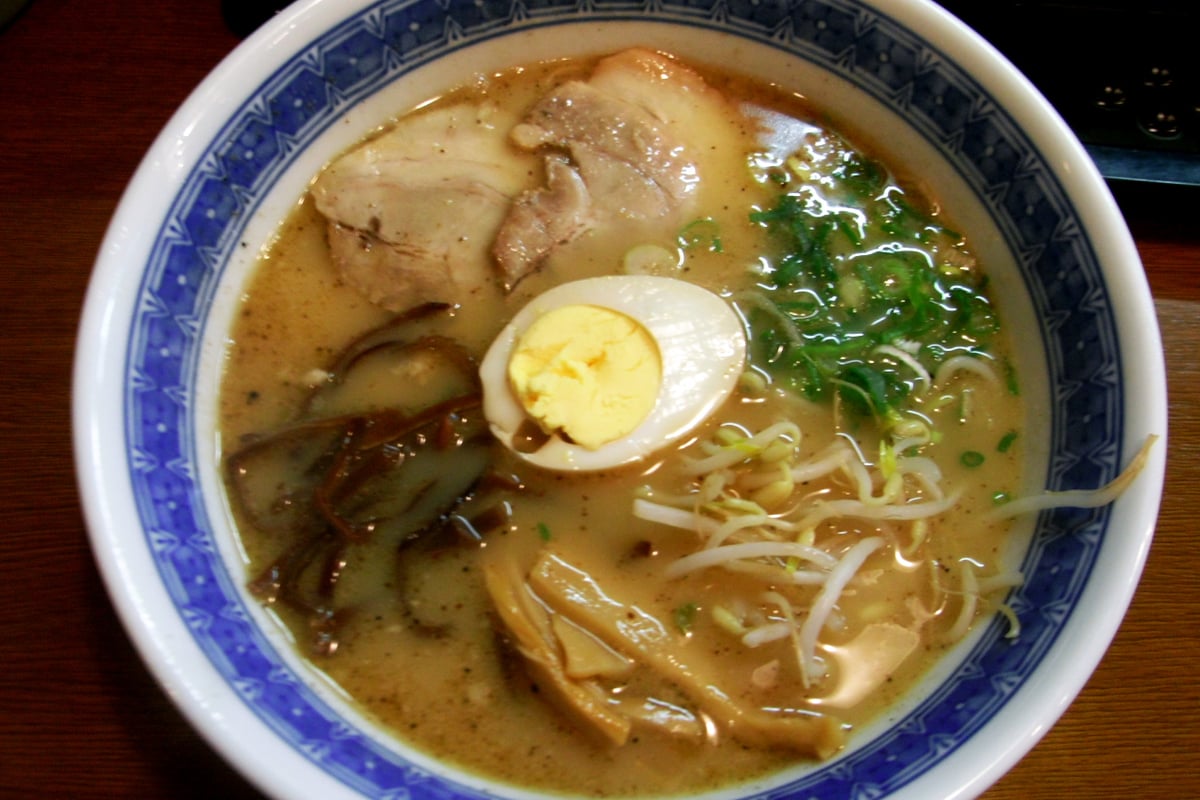
Kumamoto ramen is the local ramen of Kumamoto Prefecture, where many shops combine a pork-bone soup with added chicken bones and straight, low-hydration noodles. According to the Shin-Yokohama Ramen Museum, its roots lie in 'Sanku' of Kurume, and a shop that inherited that flavor and opened in Tamana City in 1952 (Showa 27) is regarded as the pioneer. Later, Matsubaken (松葉軒), Komurasaki (こむらさき), Keika (桂花), and others opened in Kumamoto City, and Ajisen Ramen (味千拉麺) spread it through chain expansion. Its greatest feature is the use of cooked garlic. The flavor comes from 'mayu,' an aromatic oil made from fried garlic, and from garlic chips. The noodles are thicker than those of Hakata ramen, and there is no kaedama (extra noodle serving); the basic way to adjust the amount is to order a large portion. Keika expanded to Tokyo and Ajisen overseas, making it a flavor known throughout Japan.
Origin
According to the Shin-Yokohama Ramen Museum, the Kurume food stall 'Sanku' began serving a cloudy white soup around 1947–48 (Showa 22–23). The shop that an owner who inherited that flavor opened in Tamana City in 1952 (Showa 27) was the pioneer of Kumamoto ramen. The museum explains that 'the roots of Kumamoto ramen are, in effect, in Kurume.' The Japan Tourism Agency's multilingual commentary also describes it as derived from Kurume ramen.
History
According to Wikipedia, three men whose businesses had stalled after the Shirakawa Great Flood of 1953 (Showa 28), Kimura (木村一), Yamanaka (山中安敏), and Shigemitsu (重光孝治, Liu Tanxiang/劉壇祥), were impressed by the flavor of Sanku. That same year Kimura opened Matsubaken, and the following year, 1954, Yamanaka opened Komurasaki, both in Kumamoto City. Shigemitsu is said to have handled the cooking at Keika, founded in 1955, before opening Ajisen Ramen in 1968. Keika expanded to Shinjuku, Tokyo, in the same year.
Features
According to the Shin-Yokohama Ramen Museum, whereas Hakata ramen is basically made with 100% pork bones, many Kumamoto shops add chicken bones, giving it a milder flavor. The noodles are straight with a low water content, and are thicker and chewier than Hakata's. Whereas Hakata uses raw garlic, Kumamoto cooks it and processes it into mayu or chips. The Japan Tourism Agency's multilingual commentary states that toppings of onion, wood ear mushrooms, nori seaweed, and braised pork belly are common.
Main Ingredients
Food Culture
According to the Shin-Yokohama Ramen Museum, there is no kaedama for Kumamoto ramen, and those who want more order a large portion. In 2024, the Kumamoto Nichinichi Shimbun reported that Ajisen Ramen took first place overall in the ramen general election held by its digital edition. In October 2026, the paper also revived its series 'Kumamoto Ramen Monogatari' (The Story of Kumamoto Ramen) in the digital edition, showing that the dish attracts strong local interest.
Famous Shops
こむらさき 上通中央店
熊本県熊本市中央区上通町8-16
Founded in 1954 (Showa 29), this shop proclaims itself the 'original Kumamoto ramen' (Ganso Kumamoto Ramen). Its signature Osama Ramen (King Ramen) combines a light pork-bone soup with medium-thin noodles, with an aroma added by roasted garlic chips. Closing days differ depending on the source, so please check before visiting.
View details →桂花ラーメン 本店
熊本県熊本市中央区花畑町11-9
Founded in 1955, it has had its main shop at the current location since 1979. It combines a pork-bone and chicken-bone soup with firm, medium-thick noodles, and its signature dish is taromen (太肉麺), topped with braised pork belly (kakuni). A travel site lists Keika Ramen at 900 yen and taromen at 1,200 yen. Prices are subject to change.
View details →味千ラーメン 水前寺本店
熊本県熊本市中央区水前寺6-20-24
The main shop of Ajisen Ramen, which opened its first shop in Kumamoto in 1968. The operating company, Shigemitsu Sangyo, is headquartered in Kikuyo Town. In a 2026 article, the Kumamoto Nichinichi Shimbun reported that the chain as a whole has more than 600 shops in Japan and overseas. The address is based on a listing on a restaurant information site, so please confirm it before visiting.
| Keika Ramen Online Shop | Keika Ramen also sells products on its official online shopping site. A 2026 survey article reported that the aroma of mayu was the most commonly cited thing people liked about Keika. The product lineup and prices may change, so please check the official website.Where to buy →PR |
|---|
FAQ
Q. What does the 'ma' in mayu mean?
A. According to a 2026 survey article about Keika Ramen, it is the character 'ma' (魔, magic), carrying the meaning of 'an oil that makes ramen delicious as if by magic.' The same article describes Keika as the first shop in Japan to develop mayu. Mayu is an aromatic oil made by frying garlic.
Q. Which shop is the originator of Kumamoto ramen?
A. It depends on how 'originator' is defined. The Shin-Yokohama Ramen Museum regards the 1952 shop in Tamana as the pioneer, while also describing Komurasaki as the originator of Kumamoto ramen. Wikipedia lists Matsubaken, opened in 1953, first among the shops opened in Kumamoto City. The Kumamoto Nichinichi Shimbun's series regards Komurasaki as the pioneer.
Q. How is it different from Hakata ramen?
A. According to the Shin-Yokohama Ramen Museum, Hakata ramen is basically made with 100% pork bones, while many Kumamoto shops add chicken bones, making it milder. Kumamoto's noodles are thicker, and there is no kaedama. Whereas Hakata uses raw garlic, Kumamoto processes it into mayu or chips.