Gomadashi Udon (Udon with Fish and Sesame Paste)
Gomadashi Udon (Saiki Udon with Grilled Fish and Sesame Paste)
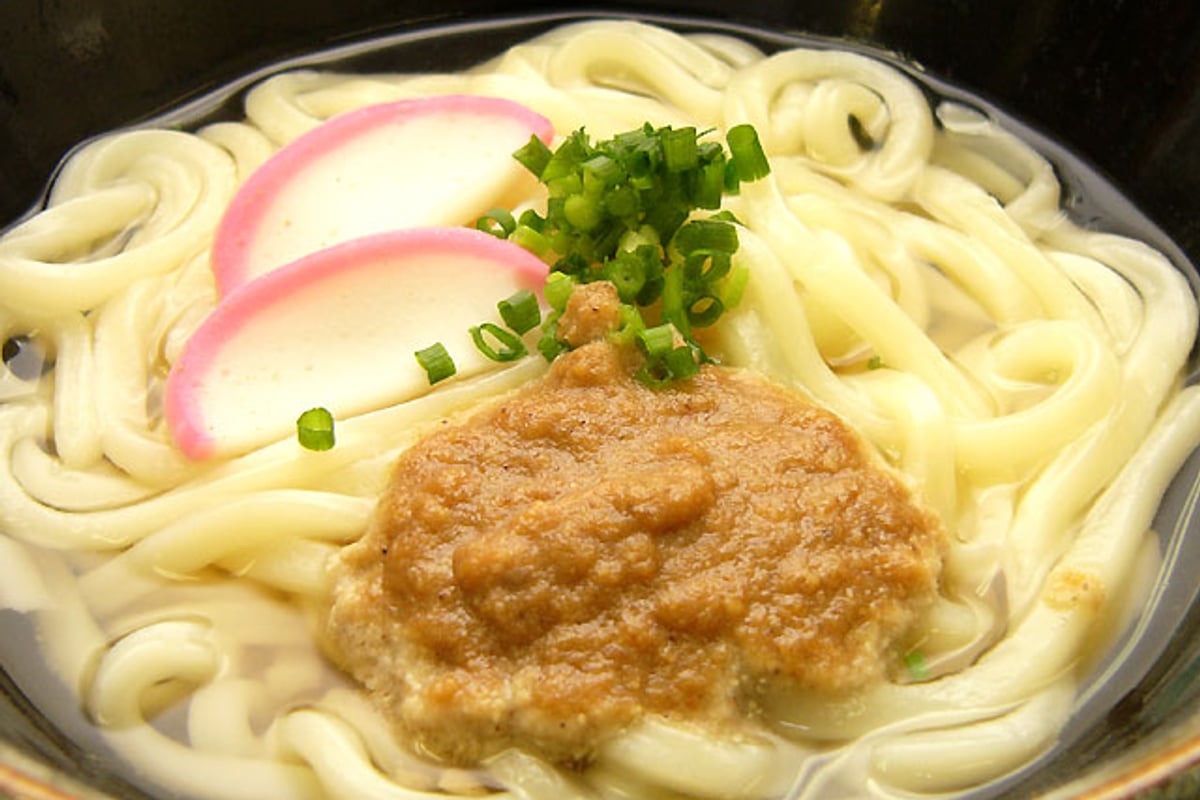
Image: Wikimedia Commons
Gomadashi udon is a local specialty dish of Saiki City, Oita Prefecture. A seasoning called 'gomadashi,' made by combining the grilled and flaked flesh of white fish with ground sesame, soy sauce, and other ingredients, is placed on boiled udon, and hot water is poured over it before eating. The fish traditionally used is eso (lizardfish), which is landed in Saiki City throughout the year, but in recent years gomadashi has also been made with horse mackerel, mackerel, barracuda, and other fish. Gomadashi was born as a preserved food in fishermen's households, and it is said to have been created to use up large catches of fish, or to save the trouble of making soup stock. In fiscal 2021 (Reiwa 3), it was certified as 'Saiki Gomadashi' under the Agency for Cultural Affairs' '100-Year Food' program. In 2007, it was selected as one of the Ministry of Agriculture, Forestry and Fisheries' (MAFF) '100 Local Dishes of Rural, Mountain, and Fishing Villages.' It can be eaten at eateries and izakaya in the city, and bottled gomadashi is sold at roadside stations (michi-no-eki), fish shops, and elsewhere.
Origin
According to MAFF, the origin of gomadashi is unclear. It is said to have been created to use up large catches of fish, or by fishermen's wives to save the trouble of making soup stock. The Saiki City Tourism Association explains that it was a home-cooked dish of fishing towns, first made as a preserved food when large amounts of eso were caught. The association describes it as a seasoning that has been handed down for well over a hundred years.
History
According to the Agency for Cultural Affairs' introduction under the '100-Year Food' program, gomadashi began to be served at eateries in the city more than 100 years ago. Bottled gomadashi for souvenirs went on sale around 1967 (Showa 42). In recent years, opportunities to make it at home are said to have decreased because of the effort needed to remove the bones and the difficulty of obtaining eso. Thanks to commercialization by Gyoson Josei Group Mebaru, a group launched by fishermen's wives in Tsurumi, Saiki City, it became available outside the prefecture as well.
Features
In MAFF's recipe, eso is grilled, its flesh is flaked, and the skin and small bones are carefully removed. Toasted sesame seeds are ground, the eso is added and ground further, and then soy sauce is added. Boiled udon, kamaboko (fish cake), and gomadashi are placed in a bowl, boiling water is poured over them, and condiments are added on top. Sesame is said to have strong antioxidant properties, which helps gomadashi keep well. The flavor differs by household and shop, with some adding mirin or sugar. Each diner can adjust the strength of the flavor with the amount of gomadashi.
Main Ingredients
Food Culture
According to MAFF, many restaurants in Saiki City serve gomadashi udon, and people eat it as casually as fast food. The Agency for Cultural Affairs' introduction describes it as 'slow food' when it is made and 'fast food' when it is eaten. Besides udon, gomadashi is also used for chazuke (rice with tea or hot water poured over it), as a dressing for tofu or boiled vegetables, and as a dipping sauce for somen.
How It Differs from Home Cooking
At home, using store-bought bottled gomadashi is the easy option. Many shops serve homemade gomadashi, and the Saiki City Tourism Association introduces shops that insist on using 100% eso. Some shops, such as Miyuki Shokudo (味愉嬉食堂), serve it in tsukemen style, with the gomadashi and udon served separately.
Famous Shops
味愉嬉(みゆき)食堂
大分県佐伯市中村南町7-25
A local cuisine restaurant run by a parent and child that makes its own gomadashi with local eso. According to a JAL article, the gomadashi is dissolved in hot water and the udon is dipped into it, and gomadashi udon costs 600 yen including tax. As listed by the Saiki City Tourism Association, it is closed on Tuesdays. Prices are subject to change.
View details →ゆうちゃん
大分県佐伯市内町4-3
An izakaya listed on the Saiki City Tourism Association's 'Saiki Gomadashi Norenkai Tabearuki Map' (food-hopping map). Wikipedia notes that its gomadashi udon made with two kinds of gomadashi is popular. As listed by the association, it is open from 19:00 to 3:00 a.m. and closed on Sundays.
道の駅やよい
大分県佐伯市弥生大字上小倉898-1
A roadside station (michi-no-eki) along National Route 10 that serves as a gateway to central Saiki. As listed by the Saiki City Tourism Association, udon is served from 10:00 to 16:30, and it is closed on New Year's Day. An anniversary information site says that 'gomadashi udon no moto' (gomadashi udon base) is also sold there as a souvenir.
| 漁村女性グループめばるのごまだし (Gomadashi by Gyoson Josei Group Mebaru) | A product of a seafood processing company launched by fishermen's wives in Tsurumi, Saiki City. MAFF notes that the group's commercialization made gomadashi available for purchase outside the prefecture. As listed by the Saiki City Tourism Association, it is located at 佐伯市鶴見大字沖松浦1395-4 (Okimatsuura, Tsurumi, Saiki City). |
|---|---|
| かわべのごまだし (Kawabe's Gomadashi) | Gomadashi made at a fish shop at 佐伯市中村南町8-2 (Nakamura-minamimachi, Saiki City). The Saiki City Tourism Association and Wikipedia report that it was featured in the manga 'Oishinbo' and the TV program 'Hanamaru Market.' As listed by the association, it is closed on Saturdays and Sundays. |
FAQ
Q. What kind of fish is eso?
A. It is a white-fleshed fish of the lizardfish family (Synodontidae), landed in Saiki City throughout the year. Its flesh is light in flavor, but it has many hard small bones, so it is considered a difficult fish to handle. For this reason, in Saiki it has been used not only for gomadashi but also for kamaboko and fried fish paste.
Q. When is 'Saiki Gomadashi Day'?
A. It is November 10. It was established by the Saiki Gomadashi Norenkai, whose secretariat is located at the Saiki City Tourism Association, and was registered with the Japan Anniversary Association in 2021. The date is said to come from reading 11 as 'ii' (good) and 10 as 'toto' (fish), and also from likening the numbers to a pestle and mortar.