Seki-aji and Seki-saba (Line-Caught Horse Mackerel and Mackerel)
Seki-aji & Seki-saba (Saganoseki Line-Caught Horse Mackerel and Mackerel)
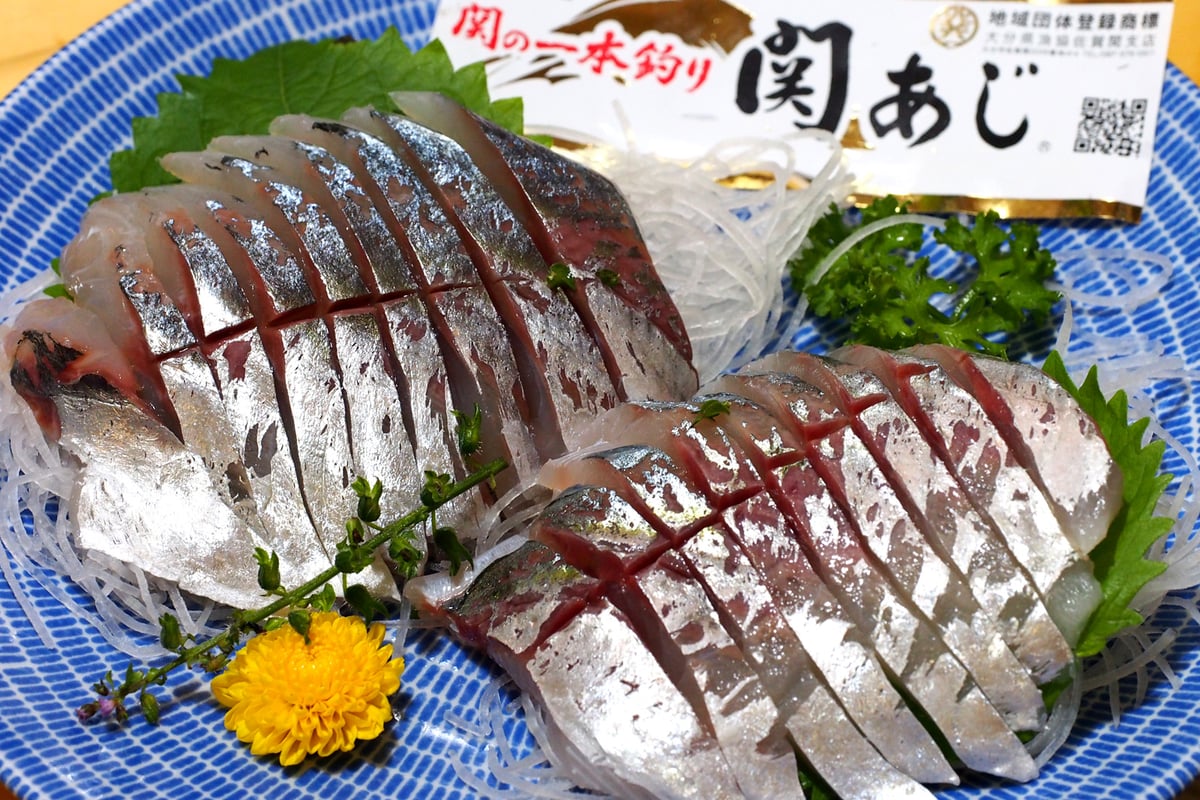
Image: Wikimedia Commons
Seki-aji and Seki-saba are the brand names for Japanese horse mackerel (maaji) and chub mackerel (masaba) caught by pole-and-line fishing off Saganoseki in Oita City. The fishing ground is the Hoyo Strait, also known as Hayasui-no-Seto. The Saganoseki Branch of the Oita Prefectural Fisheries Cooperative handles everything from landing to shipping, and genuine fish carry a dedicated tag sticker. Because they grow in fast currents where the waters of the Seto Inland Sea and the Pacific Ocean collide, their flesh is said to be firm. The cooperative maintains freshness through 'tsura-gai,' in which fish are purchased by visual estimate without being weighed, and through ikejime, performed on each fish one by one. In 1996 they became the first marine products to be registered as trademarks, and in 2006 they were registered as regional collective trademarks. They can be enjoyed as sashimi, sugatazukuri (sashimi arranged in the shape of the whole fish), sushi, rice bowls, and more, and can be eaten at the roadside station (Michi-no-Eki) in Saganoseki and at restaurants in Oita City.
Origin
According to the Saganoseki Branch of the Oita Prefectural Fisheries Cooperative, Saganoseki's pole-and-line fishermen have fished widely, from Tsushima in the west to Amami Oshima in the south. From that experience, they knew that the horse mackerel caught at Seki had a distinctive shape, with a small head, a well-fattened body, and a sturdy base of the tail. For this reason, they are said to have called Saganoseki's horse mackerel 'Seki-aji' and treated it as being in a class of its own. Because the waves at the fishing ground are high and the seabed is very uneven, it is unsuited to net fishing, and pole-and-line fishing has continued.
History
Saganoseki's horse mackerel and mackerel were once sent to market through brokers. According to research materials and other sources, aiming to create a brand, the fisheries cooperative bought up all of the catch and raised its profile by continuing to market it to high-end ryotei restaurants and to advertise it. As a countermeasure against imitations, the names were registered as trademarks in 1996, and in 2006 they were registered as regional collective trademarks. The Saganoseki Town Fisheries Cooperative became the Saganoseki Branch of the Oita Prefectural Fisheries Cooperative through a merger in 2002.
Features
According to the cooperative, Seki-aji and Seki-saba are regarded as 'setsuki-uo,' fish that do not migrate but stay resident in a single shoal (se), and it is said that they may be an independent population (stock). The sea at Saganoseki has little change in water temperature throughout the year, and in summer, upwelling currents bring up cold water, making food plentiful. It is reported that research by Oita University found that, unlike ordinary mackerel, the fat content of Seki-saba remained almost constant throughout the year. For this reason, it is said that they can be eaten as sashimi all year round.
Main Ingredients
Food Culture
Around Saganoseki, Seki-aji and Seki-saba are enjoyed as sashimi and sugatazukuri, as well as in sushi, rice bowls, and Ryukyu. The roadside station 道の駅 佐賀関 (Michi-no-Eki Saganoseki) serves Seki-aji-don and Seki-saba-don. The cooperative also sells processed products such as overnight-dried fish (ichiya-boshi) and fried fish, and lists the handling period for fresh Seki-aji as July to May of the following year.
Famous Shops
あまべの郷 関あじ関さば館
大分県大分市白木949
A complex along National Route 217 on the Saganoseki Peninsula, from whose second-floor restaurant you can view the Bungo Channel. According to a travel information site's listing, Seki-saba sugatazukuri is 3,456 yen and the Seki-saba gozen (set meal) is 3,024 yen, and sugatazukuri can also be ordered as a half portion. On the first floor, products such as overnight-dried Seki-saba are sold. Prices are subject to change.
View details →道の駅 佐賀関
大分県大分市大字大平989-6
According to the Kyushu Regional Development Bureau's guide, the restaurant serves aji and saba rice bowls and Seki-buri rice bowls, and the local products center sells local processed seafood. According to a travel information site's listing, the Seki-aji-don and Seki-saba-don are 1,100 to 1,400 yen, with prices differing between listings. It is listed as open every day of the year.
View details →郷土料理処 こつこつ庵
大分県大分市府内町3丁目8-19
A local cuisine restaurant about a 10-minute walk from JR Oita Station, serving ikizukuri (sashimi prepared from live fish) of Seki-aji and Seki-saba that the owner buys every morning. According to a travel information site's listing, sashimi is 1,680 yen each (one serving) and sushi is 2,200 yen each (8 pieces). It is listed as closed on Sundays. Prices are subject to change.
View details →| Processed products of the Oita Prefectural Fisheries Cooperative Saganoseki Branch (大分県漁協佐賀関支店) | The cooperative's official website offers items such as fried Seki-aji and Seki-saba (3 pieces, 650 yen including tax), overnight-dried Seki-saba, and Seki-aji and Seki-saba Ryukyu. There is also an online shop, and gift sets are sold depending on the season. Prices are subject to change.Where to buy →PR |
|---|
FAQ
Q. What is 'tsura-gai'?
A. According to the cooperative, it is a method of purchasing caught fish without weighing them, by judging their approximate weight from their size as seen from the water's surface. Because weighing would make the fish thrash about and rub their bodies, which could cause the flesh to split, experienced people do this by visual estimate.
Q. How can you tell genuine Seki-aji and Seki-saba?
A. Seki-aji and Seki-saba shipped from the Saganoseki Branch of the Oita Prefectural Fisheries Cooperative carry a tag sticker certifying the regional collective trademark. According to Wikipedia, the tags are attached to each fish's tail one by one. The cooperative explains that it attaches these tags as a countermeasure against counterfeits.
Q. What kind of processing is ikejime?
A. According to the cooperative, it is a process in which the spinal cord of a fish scooped up in a net is immediately severed with a knife, the blood is drained, and the fish is chilled with ice. It is always carried out for long-distance shipping and direct sales, and each fish is processed by hand one by one. Because fish on the day they are caught are agitated, they are left to calm down in a holding tank (ikesu) for a day before being shipped live.