Image: Wikimedia Commons
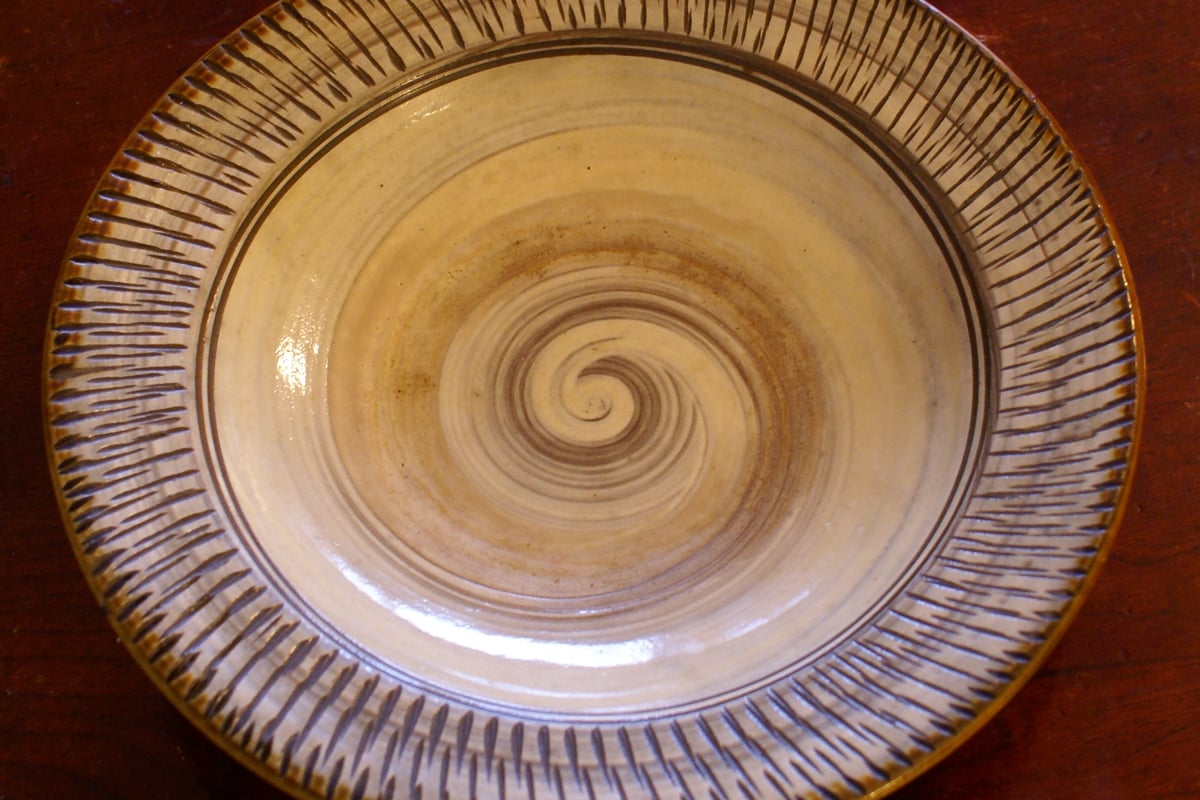
Onta ware (Onta-yaki) is pottery fired in the Sarayama district of Motoe-machi, Hita City, Oita Prefecture. It is said to have begun in 1705 (Hoei 2), when a kiln was opened after inviting Yanase San'emon (柳瀬三右衛門), a potter of Koishiwara ware. Clay dug in the village is crushed with a karausu (water-powered clay mortar) driven by river water, formed on a kick wheel and fired in a climbing kiln. Its hallmarks are patterns such as tobikanna (chatter-mark carving) and hakeme (brush marks). The techniques are handed down from parent to child, and the kilns are run as family businesses. In 1995 (Heisei 7) it was designated a National Important Intangible Cultural Property, and in 2008 the 'Onta Ware Village' (小鹿田焼の里) was selected as an Important Cultural Landscape. According to Oita Prefecture's introduction, there are currently nine kilns. Every October, the Onta Ware Mintosai (Folk Pottery Festival) is held, at which the kilns set out and sell their wares.
Origin
According to Cultural Heritage Online of the Agency for Cultural Affairs, the techniques of potters who came from the Korean Peninsula are thought to have reached Onta by way of Koishiwara in Chikuzen. The kiln is said to have been opened in Hoei 2. It is said that 黒木十兵衛 of Otsuru Village in Hita District provided the funds and invited Yanase San'emon of Koishiwara ware, and that the Sakamoto family provided the land. Wikipedia also cites a theory that it was 1737 (Genbun 2), so there are several theories about when the kiln was opened.
History
Until the end of the Meiji era, it fired everyday vessels for farm households, such as jars and bowls. According to the Agency for Cultural Affairs, in 1931 (Showa 6) Yanagi Soetsu of the Mingei (folk craft) movement visited and praised its traditional techniques and simple style. The British potter Bernard Leach also visited in 1954. In 1970 it was selected as an Intangible Cultural Property for which measures such as documentation should be taken, and in 1995 it was designated an Important Intangible Cultural Property.
Features
The 1995 designation is a group designation, with the Onta Ware Technique Preservation Society (小鹿田焼技術保存会) as the holding body. The Agency for Cultural Affairs lists requirements for the designation such as using raw clay from Sarayama crushed with a karausu on its own without blending, forming on a kick wheel, using handed-down patterns and glazes, and firing in a climbing kiln. Oita Prefecture describes how the makers' names are not put on the vessels and the nine kilns work with the same materials and techniques. The sound of the karausu has been selected as one of the '100 Soundscapes of Japan'.
Techniques
Tobikanna (chatter-mark carving)
A technique in which, while the wheel is turning, the tip of a thin metal blade is held against the surface of the vessel to carve a continuous series of fine marks. It is said that Leach visited after hearing that Onta had a technique similar to that of pottery from China's Song dynasty.
Hakeme, kushigaki and yubigaki
Hakeme (brush marks) is a technique in which a brush is struck against a vessel coated with slip to make a pattern. In kushigaki (comb drawing) a comb-like tool, and in yubigaki (finger drawing) the fingers, are used to scrape away the slip and draw patterns. All of these are among the decorations that the Agency for Cultural Affairs lists as handed-down techniques.
Uchikake and nagashikake
Techniques in which glaze is splashed onto a vessel with a ladle or similar tool, or poured over it, to create patterns. The Agency for Cultural Affairs explains that the glazes are set as furashi glaze, ame (amber) glaze, green glaze and others, and that namagake, applying glaze without bisque firing, is the basic method.
Materials Used
Production Process
- 1
Preparing the clay
Earth dug around the village is dried and finely crushed with a karausu driven by river water. According to Wikipedia, after being pounded in the karausu for about 20 to 30 days, it is mixed with water and strained, and it takes about two months to finish it into clay.
- 2
Suihi (elutriation) and drying
The crushed earth is dissolved in water and moved into tanks, and straining is repeated to collect only the fine particles. It is then dried in the sun to remove moisture and made into clay that can be formed.
- 3
Forming and decoration
Pieces are formed on a foot-turned kick wheel. Large vessels are made by beating out the base and adding more clay. While still half-dry, patterns are applied with tobikanna, hakeme, kushigaki and other techniques.
- 4
Glazing and firing
Namagake is the basic method of glazing. Pieces are fired in climbing kilns, and the communal kiln in the center of the village is used by several kilns. The firing continues for about two full days, and the whole family is described as taking turns watching the fire.
| Main Production Areas |
|
|---|
Artisans & Workshops
坂本工窯
A kiln at 176 Motoe-machi, Hita City. According to Oita Prefecture's introduction, the eighth generation, 坂本工, and his eldest son 創 make the pottery, and the kiln is known for vessels that speak through their form alone. In the JETRO listing, the kiln fires only with local clay and climbing kilns, and 8-sun hakeme plates were from 4,000 yen (excluding tax).
Official site →坂本浩二窯
A kiln at 174 Motoe-machi, Hita City, near the center of the village. Oita Prefecture describes how the sixth generation, 坂本浩二, excels at large plates and jars, and his eldest son 拓磨 received the Nihon Mingeikan Award (Japan Folk Crafts Museum Award) in 2025. 拓磨 is said to have begun his training at the age of 18.
Official site →柳瀬元寿窯
A kiln at 152 Motoe-machi, Hita City, descended from the founder Yanase San'emon. The 14th generation, 柳瀬元寿, and his father, the 13th generation 晴夫, make the pottery. According to Oita Prefecture's introduction, its smallish rice bowls are popular.
Official site →小袋道明窯
A kiln at 170 Motoe-machi, Hita City. Three generations, including the ninth generation, 小袋道明, and his eldest son 杏梓, work here. Oita Prefecture describes the kiln as known for delicate tobikanna and as having both a climbing kiln and its own individual kiln.
Official site →How to Buy
- The kilns of Sarayama
- You can buy vessels at the shopfronts of each kiln in the village. Opening hours differ from kiln to kiln, and they close irregularly. It has been announced that the Onta bus line will be discontinued at the end of September 2026 and is scheduled to be replaced by a shared on-demand taxi, so please check transportation in advance.
- Onta Ware Mintosai (Folk Pottery Festival)
- Held every year on the weekend of the second week of October, when all nine kilns set out their vessels in front of their houses for sale. In 2026 it was held for the 59th time on October 10 and 11. Oita Prefecture describes how temporary parking and a free shuttle bus were provided during the event.Where to buy →PR
- Life design shop Areas (Mamedamachi, Hita City)
- A shop at 7-20 Mamedamachi, Hita City, carrying Hita crafts and household goods. In a 2025 article, Onta ware ochoko (small sake cups) were on sale from 1,320 yen. It is listed as open from 9:30 to 19:00 and closing irregularly. Prices may change.Where to buy →PR
Hands-on Experiences
日田市立小鹿田焼陶芸館
大分県日田市源栄町138-1
The Hita City Onta Ware Pottery Museum, a facility that introduces the history and techniques of Onta ware through videos and panels, with free admission. According to Oita Prefecture's introduction, it is open from 9:00 to 17:00 and closed on Wednesdays and over the New Year holidays. From the outdoor pavilion you can look out over the scenery of Sarayama. It is not a facility for pottery experiences.
View details →FAQ
Q. What is the relationship with Koishiwara ware?
A. Onta ware is said to have begun by inviting Yanase San'emon, a potter of Koishiwara ware in Fukuoka Prefecture, and the two share many techniques such as tobikanna and hakeme. However, a researcher's report contrasts them, noting that while Koishiwara increased its number of kilns, Onta chose the path of preserving tradition.
Q. Aren't there ten kilns?
A. There were long said to be ten, but according to Wikipedia one closed in 2019. Oita Prefecture's 2026 introduction and the information for the Onta Ware Mintosai give nine. Older materials sometimes say ten.
Q. Are the makers' names put on the vessels?
A. According to Oita Prefecture's introduction, Onta ware does not carry the names of individual makers, and the nine kilns make vessels with the same materials and techniques. Since each kiln has its own tendencies in the vessels and patterns it is good at, you can also enjoy touring the kilns and comparing them.