Image: Wikimedia Commons
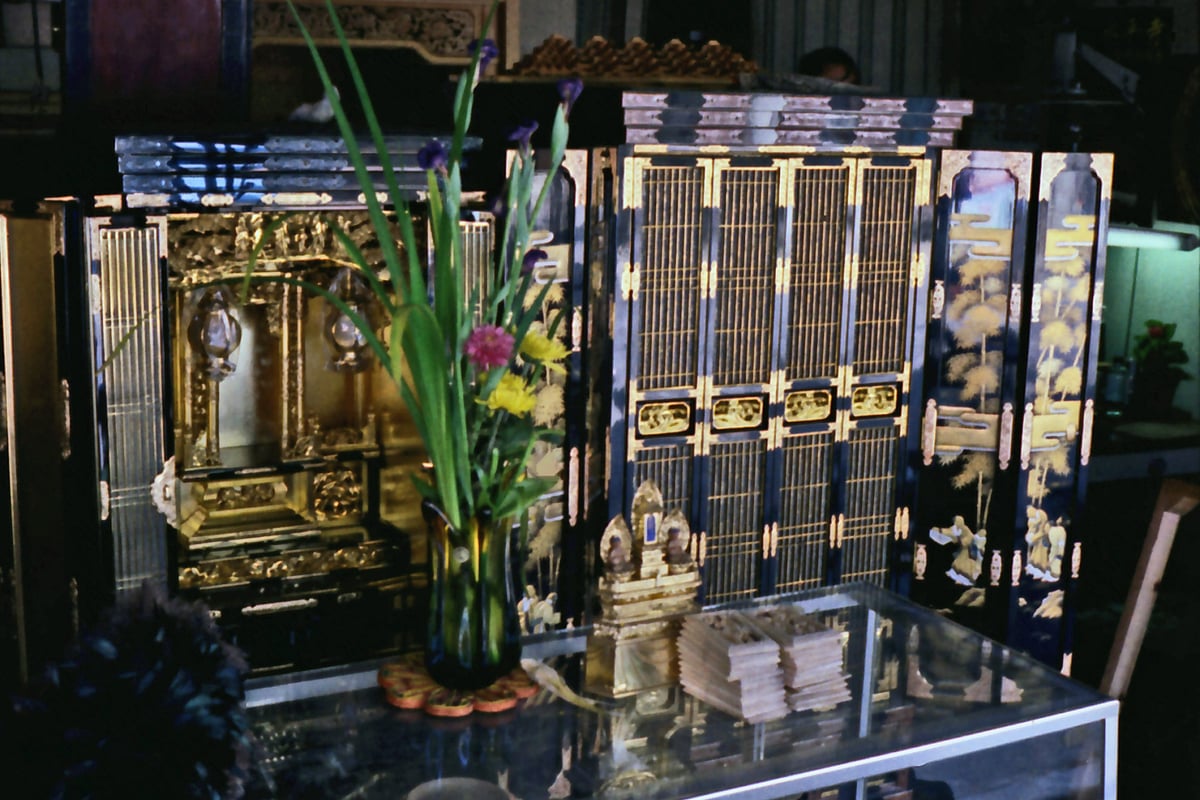
Iiyama Buddhist Altars are gilded Buddhist altars (kinbutsudan) made in Iiyama City, Nagano Prefecture. They are produced mainly in the Atago (愛宕町) area in the north of the city, and everything from making the parts to assembly and repair is carried out within the area. Jodo Shinshu Buddhism reached Iiyama from the Hokuriku region in the Muromachi period, and the city is known as a place of deep faith. Because of its townscape lined with many temples, it has also been called 'the Little Kyoto of the Snow Country.' The craft is said to have begun in Genroku 2 (1689), when 寺瀬重高, who had come from Koshu, made plain unlacquered altars. Its distinctive features are the technique of assembling the kuden (the palace-like structure inside the altar) with 'hijiki kumimono' (bracket assemblies), and the 'yuminageshi,' a lintel curved like a bow so that the kuden can be seen clearly. Through 'sentaku' (literally 'washing'), in which the altar is taken apart, washed and relacquered, it can be passed down and used over many generations. In 1975 it became a Traditional Craft Designated by the Minister of Economy, Trade and Industry. The street in Atago, lined with gangi (covered walkways that keep off the snow), is fondly known as 'Butsudan-dori' (Buddhist Altar Street), where altar shops stand side by side.
Origin
There are no reliable records of when altar making began in Iiyama. However, Jodo Shinshu Buddhism reached the area from Hokuriku in the Muromachi period and took deep root throughout the Hokushin region centered on Iiyama, and this is thought to have laid the groundwork for altar making. Local tradition holds that it began in Genroku 2 (1689), when 寺瀬重高, who had come from Koshu (Kofu), made plain unlacquered altars. Lacquered altars are said to have spread somewhat later through 鞘師屋佐七, who came from Echigo.
History
Iiyama was the castle town of Iiyama Castle, built by Uesugi Kenshin, and in the Edo period it prospered as the castle town of the Honda clan and as the starting point of river transport on the Chikuma River. At the end of the Edo period, the master altar carver 稲葉喜作 appeared. The ancestors of the 稲葉 family are said to have lived in Kyoto, and Iiyama Buddhist Altars are considered to follow the tradition of Kyo-butsudan (Kyoto Buddhist Altars). Their reputation rose from the time of 稲葉喜作, and production also became divided among specialized craftspeople. In 1975 it became a Traditional Craft Designated by the Minister of Economy, Trade and Industry, and in recent years small altars that suit Western-style rooms have also been made.
Features
Because Iiyama Buddhist Altars use thick wood generously, they are said to be heavy. The wooden body is assembled with 'hongumi' (full joinery), in which pillars and base frames, and pillars and panels, are fitted together with interlocking joints; when the wedges are pulled out, it can easily be taken apart in the reverse order. The kuden is assembled with hijiki kumimono, and the decoration includes carvings with a strong sense of depth and maki-e in which gofun, a powder made from shells, is built up in relief. Gold leaf is applied by 'tsuyadashi hakuoshi' (lustering gold-leaf application), in which it is wiped with silk floss to bring out its luster, so it keeps a quiet glow for a long time.
Techniques
Hijiki Kumimono (Bracket Assemblies)
A technique unique to Iiyama for assembling the kuden. Hijiki (bracket arms) are inserted into kumimono (bracket blocks) that have holes for the hijiki and decorative holes on each tier, and finally decorative hijiki are inserted to finish it. Because the hijiki and kumimono can be taken apart, the structure can go through 'sentaku' just as it is.
Yuminageshi (Bow-Shaped Lintel)
A nageshi (horizontal lintel) spanning the upper front of the altar that is curved like a bow. It was devised so that the kuden, assembled with Iiyama's unique bracket work, can be seen clearly. Together with the kuden, it is a feature included in the requirements for designation as a national Traditional Craft.
Gofun-mori Maki-e (Raised Gofun Maki-e)
A technique devised to give maki-e a three-dimensional look by building up gofun, made from crushed shells. Because gofun has fine, white particles, the lacquering after it is built up and the drawing of flower stamens become easier, and the result is a beautiful finish.
Tsuyadashi Hakuoshi (Lustering Gold-Leaf Application)
A method of applying gold leaf in which the leaf is laid on a lacquer surface that has been given a final wiping and is then wiped with silk floss to bring out its luster. Because Iiyama Buddhist Altars use this method for gold leaf, they can keep a beautiful luster for a long time.
Materials Used
Production Process
- 1
Kiji (Wooden Body)
The body of the altar is made from pine, cedar, cypress and other woods and fitted together with hongumi joinery.
- 2
Kuden (Inner Palace)
Using magnolia wood, the kuden inside the altar is assembled with hijiki kumimono.
- 3
Carving
Plants, flowers, birds and animals are carved, and a three-dimensional effect is created with tsukebori, in which carved parts are attached to one another.
- 4
Lacquering
The undercoat and middle coat are polished before the top coat is applied, building up three or more layers of lacquer.
- 5
Metal Fittings
Patterns are hammered into copper or brass sheets with a chisel (tagane), and the fittings are finished with plating or coloring.
- 6
Maki-e
Three-dimensional patterns are drawn on the doors and panels using techniques such as raised gofun.
- 7
Gold-Leaf Application
Gold leaf is laid on the lacquer surface and wiped with silk floss to bring out its luster.
- 8
Assembly
The parts made by each craftsperson are gathered and assembled into a single altar.
| Main Production Areas |
|
|---|
Artisans & Workshops
神仏の鷲森
An altar shop on Butsudan-dori in Atago. In addition to lacquering and gold-leaf application, it has woodworking, metal-fitting and maki-e craftspeople on staff, and makes Iiyama Buddhist Altars entirely in-house. Making use of these skills, it also produces items such as kagura pieces (御神楽) for shrines and shishigashira (lion-dance heads).
Official site →明石仏壇店
An altar shop that stands as the first shop on the gangi street in Atago. While carrying on traditional craft techniques, it works on making things suited to today's lifestyles, such as remaking large altars into smaller ones to fit the home.
Official site →岸田仏壇店
An altar shop that makes made-to-order altars one at a time while listening to customers' wishes. Its sixth-generation successor, who trained in Kyoto and Niigata, also makes and sells items familiar to younger generations, such as lacquered ballpoint pens and smartphone cases.
Official site →飯山仏壇事業協同組合
The production-area cooperative for Iiyama Buddhist Altars, with its office inside the Iiyama City Traditional Industry Hall. It shares information on the techniques and quality labeling of Iiyama Buddhist Altars and on member shops along Butsudan-dori, and works to promote the production area.
Official site →How to Buy
- Butsudan-dori (Buddhist Altar Street) in Atago
- Long-established altar shops line the gangi street in Atago, about a 10-minute walk from Iiyama Station. You can compare shop by shop, from top-grade altars designated as Traditional Crafts to modern altars that suit present-day homes.Where to buy →PR
- 藤澤蒔絵
- A workshop that carries on the maki-e techniques of Iiyama Buddhist Altars. Besides accessories and ornaments that make use of maki-e skills, it also makes and sells items such as a series of everyday tableware decorated with urushi-e (lacquer painting).Where to buy →PR
Hands-on Experiences
飯山市伝統産業会館
長野県飯山市大字飯山1436-1
A facility that introduces the processes and techniques of Iiyama Buddhist Altars and Uchiyama Paper and displays the finest works by craftspeople. Admission is about 300 yen for adults and about 200 yen for elementary and junior high school students. Closed on Mondays (or the following day if Monday is a public holiday) and during the year-end and New Year holidays.
View details →三ツ井金具製作所
長野県飯山市飯山1357
The workshop of a Traditional Craftsman in the metal-fittings field of Iiyama Buddhist Altars, where you can try metal chasing by hammering patterns into a copper plate with a chisel to make an incense dish. The fee is about 3,000 to 4,000 yen, and it takes about 2 to 2.5 hours. Reservations are required at least one week in advance.
信州うるし工房 彩(藤澤蒔絵)
長野県飯山市野坂田741-4
You can try maki-e, tracing a design with lacquer and sprinkling gold or silver powder over it to finish a small plate (mamezara). Raden (mother-of-pearl inlay) can also be added as a finishing touch. The fee starts from about 4,000 yen, and it takes about 2 hours. Reservations required.
View details →FAQ
Q. What is 'sentaku' for a Buddhist altar?
A. It is a repair in which an old altar is taken apart, its parts are washed and relacquered, gold leaf is reapplied, and it is assembled again. Because both the wooden body and the kuden of Iiyama Buddhist Altars are built to be taken apart, they can be revived through sentaku and continue to be used over several generations.
Q. Why did Iiyama become a 'town of Buddhist altars'?
A. Reasons include that it was a place of deep faith where Jodo Shinshu Buddhism had taken wide root, the temple and shrine policies of the castle town, and the fact that raw materials such as timber could be obtained locally. The clear air and moderate humidity suited to lacquering, and its location in an area of heavy snowfall, are also considered factors.