Image: Wikimedia Commons
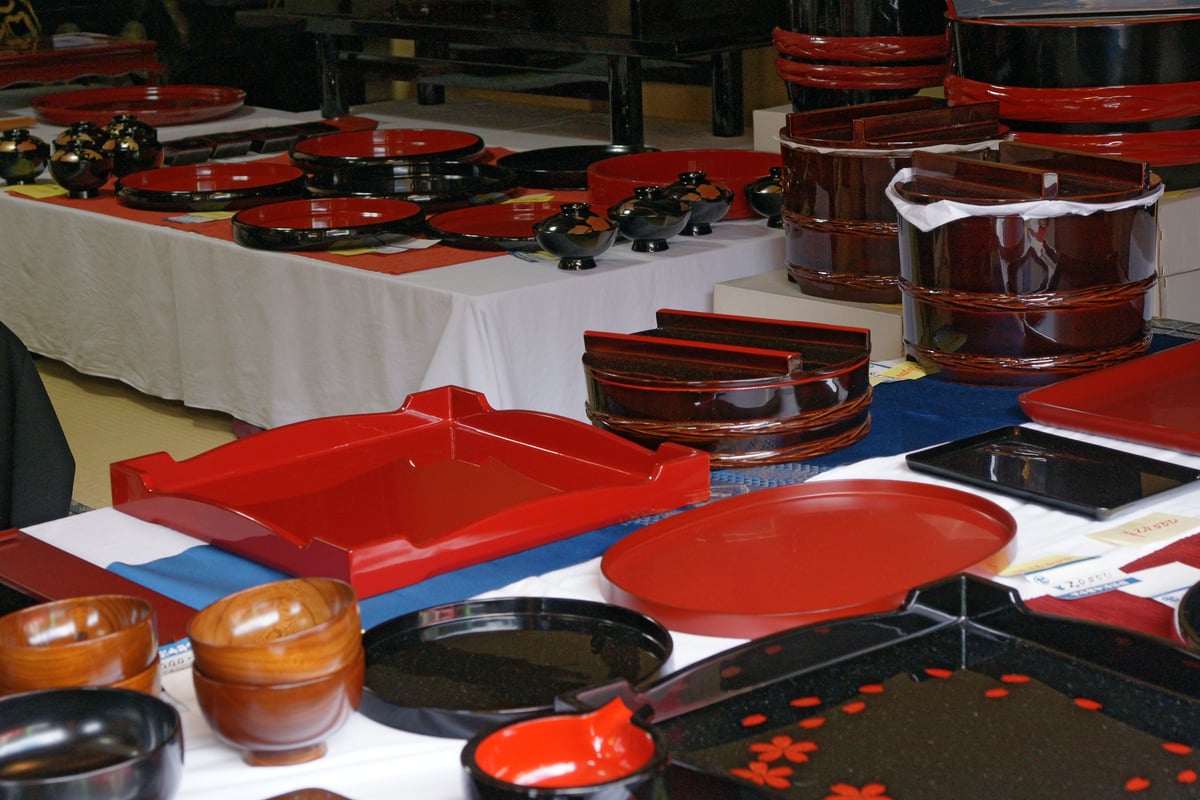
Kiso Lacquerware is lacquerware that has been made mainly in Kiso-Hirasawa and Narai in Shiojiri City, Nagano Prefecture. It is said to have begun in the early 17th century, when people applied urushi lacquer to plain woodwork made from the rich forest resources of the area, such as Kiso hinoki cypress, and sold it as souvenirs to travelers on the Nakasendo highway. Around the beginning of the Meiji period, a clay high in iron called sabitsuchi was found in Narai. Thanks to a groundwork technique in which this sabitsuchi is mixed into the lacquer, the area became renowned for sturdy lacquerware. The representative techniques are 'Kiso Shunkei,' which brings out the wood grain; 'Kiso Tsuishu,' which creates mottled patterns; and 'Nuriwake Roiro-nuri,' in which geometric patterns are painted with colored lacquers. In 1975 it became a Traditional Craft Designated by the Minister of Economy, Trade and Industry. The townscape of Kiso-Hirasawa has been selected as a national Important Preservation District for Groups of Traditional Buildings as a 'lacquer craftsmen's town.'
Origin
The Kiso Valley is a gorge area with little farmland, but it was blessed with rich forests, beginning with Kiso hinoki cypress. People applied lacquer to plain woodwork made from this wood and began selling it as souvenirs to travelers on the Nakasendo highway (the Kiso Road). This is said to be the beginning of Kiso Lacquerware. It is said that the sutra repository of a temple in Kiso Town once bore an inscription stating that a lacquer craftsman made an offering in the first year of Oei.
History
Around the Joo era (1652 to 1655), there are said to have been more than ten lacquering households in Kiso-Hirasawa. In the Edo period the craft enjoyed the patronage of the Owari Domain, and by the Kansei era it had grown to the point of having agents in Kyoto, Osaka and Edo. In the early Meiji period sabitsuchi was found in Narai, and the area established its position as a production area of sturdy lacquerware. After the war, lacquered furniture such as low tables became popular, and in 1975 it was designated a national Traditional Craft.
Features
A major characteristic of Kiso Lacquerware is the sturdiness that comes from a groundwork made by mixing sabitsuchi with raw lacquer. The climate, with cool summers and harsh winters, is said to be well suited to lacquering work. Hinoki, katsura, tochi (Japanese horse chestnut) and other woods are used for the wooden base, and many everyday items have been made, such as low tables, trays, meal trays, stacked boxes and soba utensils. Decoration with chinkin (gold inlay engraving) and maki-e is also done, and the craft was involved in making the medals for the Nagano Winter Olympics.
Techniques
Kiso Shunkei
A technique in which a Kiso hinoki base is tinted pale red and finished by rubbing raw lacquer directly into it about 6 to 8 times. Making the most of the beauty of the wood grain that shows through, it is used for bowls, chopsticks, bentwood lunch boxes and the like.
Kiso Tsuishu
A technique in which a raised and recessed pattern is laid down with a tampon soaked in plenty of lacquer, colored lacquers are applied in about 12 to 18 layers, and the surface is then polished flat. The overlapping layers of lacquer appear as a distinctive mottled pattern.
Nuriwake Roiro-nuri (Multicolor Polished Lacquering)
A technique in which, after the sabitsuchi groundwork and middle coats are applied, refined colored lacquers are painted separately to follow the pattern. With repeated sanding and polishing, it is finished as a geometric pattern with crisp boundaries between colors.
Materials Used
Production Process
- 1
Wooden Base Making
Hinoki and other woods are shaped into trays, low tables and other forms.
- 2
Groundwork Preparation and Application
A groundwork is made from rice flour, wood powder and raw lacquer, and lacquer mixed with sabitsuchi is applied.
- 3
Middle Coating
Raw lacquer is applied over the groundwork to prepare a base for the top coat.
- 4
Decorative Coating
Patterns are made by laying down raised patterns, applying layers of colored lacquer, or painting colors separately.
- 5
Sanding and Dozuri (Polishing)
The surface is sanded with whetstones and other tools, then polished with tonoko (polishing powder) and charcoal powder.
- 6
Rubbing Lacquer and Polishing
The process of rubbing in raw lacquer, wiping it off and polishing is repeated three or more times.
| Main Production Areas |
|
|---|
Artisans & Workshops
木曽漆器工業協同組合
The production-area association for Kiso Lacquerware, with its office in Kiso-Hirasawa, Shiojiri City. It holds the Kiso Lacquerware Festival every June and works on projects such as passing on traditional techniques, training successors and restoring cultural properties.
Official site →一丸勢漆器店
A lacquerware shop in Kiso-Hirasawa founded in the late Meiji period. Visitors can see the lacquerware production process in its workshop and try lacquerware making such as chinkin under the guidance of a Traditional Craftsman. It is about a 5-minute walk from Kiso-Hirasawa Station.
うるし工房石本玉水
A lacquer workshop in Kiso-Hirasawa, Shiojiri City. It offers a chinkin experience in which participants carve pictures with a chinkin knife into lacquered items such as sweets plates, for upper elementary school students and older, by reservation.
How to Buy
- 木曾くらしの工芸館
- A local products center in Kiso-Hirasawa with free admission. Besides Kiso Lacquerware and hinoki woodwork, it carries specialties of Shiojiri and Kiso such as wine and local sake. Products are introduced under a theme that changes from period to period.Where to buy →PR
- 木曽漆器祭・奈良井宿場祭
- A festival held every June in the Narakawa area of Shiojiri City. During the festival, a large lacquerware market is set up along the streets of Kiso-Hirasawa, where artisans' fine pieces and stock items are lined up at prices only possible in the production area. In 2026, the 57th festival was held on June 6 and 7.
Hands-on Experiences
木曾くらしの工芸館
長野県塩尻市大字木曽平沢2272-7
A Kiso Tsuishu polishing experience starts from about 1,800 yen, and a maki-e experience from about 2,000 yen. Polishing is for ages 5 and up if accompanied by a guardian, and maki-e is for elementary school students and older. A reservation is required at least two weeks in advance.
View details →一丸勢漆器店
長野県塩尻市木曽平沢1762
There is a chinkin experience workshop by reservation, with fees from about 3,240 yen. Visitors can also see the lacquerware production process. Reception is from 9:00 to 17:00.
うるし工房石本玉水
長野県塩尻市大字木曽平沢1692
An experience of carving pictures with a chinkin knife into lacquered items such as sweets plates, with fees from about 3,500 yen. It takes about 2 hours, and the experience covers only the carving. There are no regular closing days, but a reservation is required.
木曽漆器館
長野県塩尻市木曽平沢2324-150
It displays Kiso Lacquerware production tools and daily utensils designated as a national Important Tangible Folk Cultural Property, as well as works by Living National Treasures. Admission is about 300 yen for adults and free for junior high school students and younger.
FAQ
Q. What is sabitsuchi?
A. It is an iron-rich clay found around the beginning of the Meiji period in the mountains of Makiyazawa, across the river from Narai Station. A technique was devised in which this sabitsuchi is mixed with raw lacquer and applied as a groundwork, and Kiso Lacquerware became known as a production area of durable lacquerware.
Q. What kind of town is Kiso-Hirasawa?
A. It is a town of lacquerware artisans along the Nakasendo highway, and in 2006 it was selected as a national Important Preservation District for Groups of Traditional Buildings as 'Shikko-machi Kiso-Hirasawa' (the lacquer craftsmen's town of Kiso-Hirasawa). Lacquerware shops and workshops line the streets, and nearby is Narai-juku, which retains the atmosphere of a post town.