Takana-meshi (Rice with Pickled Mustard Greens)
Takana-meshi (Rice Mixed with Aso Pickled Mustard Greens)
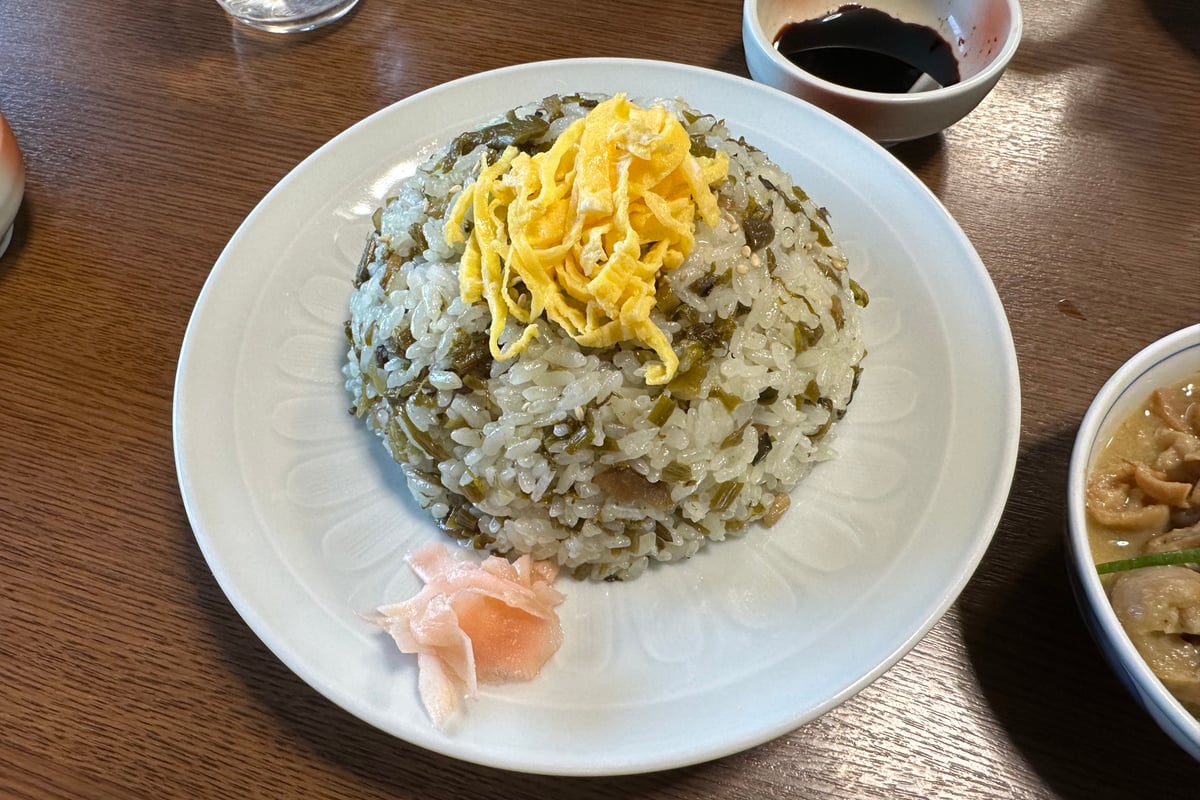
Image: Wikimedia Commons
Takana-meshi is a local dish of the Aso region of Kumamoto Prefecture in which pickled Aso takana (mustard greens) is mixed into rice. Aso takana is a type of leaf mustard (karashina), and according to the Ministry of Agriculture, Forestry and Fisheries (MAFF), it is currently cultivated only in the Aso area. The harvest takes place over a short period from mid- to late March, when the thin, tender bolting stalks are snapped off by hand one at a time. This work is called 'takana-ori.' The pickles come in two types: shin-zuke, lightly pickled during the harvest season, and furu-zuke, made with more salt and lactic-acid fermented; takana-meshi mainly uses furu-zuke. The sourness and umami deepened by fermentation are the key to its flavor. According to the official website of Asoji (あそ路), it was originally a home-cooked dish in Aso, and in the Showa 40s (1965–1974) the Aso City eatery 'Asoji' began selling it as a specialty. Today it also appears widely in school lunches across Kumamoto Prefecture.
Origin
According to MAFF, Aso takana is a type of leaf mustard said to have originated in Central Asia, and it is said to have come to Japan after spreading as a spice. In Aso's cool highland climate and volcanic ash soil, it grows with long stalks and leaves with a strong pungency. When takana-meshi began cannot be confirmed. The official website of Asoji introduces, as its roots, the takana mixed rice made by Iseri Saki (井芹サキ), grandmother of the second-generation owner, in an era when rice was precious.
History
According to the official website of Asoji, the takana-meshi served to entertain the Minister of Railways, who had come to inspect the Hohi Main Line, was well received. This led to it being launched as a new Aso specialty in the Showa 40s. In 2007, the pickles used as its main ingredient were registered as a regional collective trademark. Meanwhile, the Kumamoto Nichinichi Shimbun reported in 2023 that, due to aging and insect pests, the harvest of the raw material had fallen by 40% from the previous year.
Features
The ingredients of Aso takana-zuke (pickled Aso takana) are takana, salt, and chili pepper, and turmeric powder is sometimes added. According to MAFF, furu-zuke is made with plenty of salt, fermented for six months to a year, and appears on the market in autumn. In the recipe from Aso City's local cooking class, desalted takana pickles are stir-fried, seasoned with soy sauce, dashi, and sesame, and mixed into rice. The recipe finishes it with a garnish of kinshi tamago (thin shredded omelet) and beni shoga (red pickled ginger).
Main Ingredients
Food Culture
According to MAFF, takana-meshi is also a common menu item in school lunches within Kumamoto Prefecture. In Uchinomaki, Aso City, an event where visitors can experience harvesting and pickling is said to be held in late March. The Aso Takana-zuke Cooperative is made up of seven companies, including food businesses, and the Kumamoto Nichinichi Shimbun reported that in 2024 it offered the season's shin-zuke to Aso Shrine.
How It Differs from Home Cooking
The manager of Asoji told an interviewer that in the old days, in every household, the grandmother pickled takana for the family's own use. The recipe from Aso City's local cooking class uses desalted Aso takana pickles. At Asoji, homemade furu-zuke stored until it turns yellow is stir-fried with bamboo shoots and mixed in, and the rice is shaped to resemble Mt. Komezuka (米塚) when served.
Famous Shops
あそ路
熊本県阿蘇市的石1476-1
Said to have been founded in 1968, it is introduced as the first restaurant to serve takana-meshi. On the menu on its official website, Ganso Takana-meshi (original takana-meshi, regular size) is 680 yen and the takana-meshi set meal is 1,650 yen. Check the notices on the official website for closing days. Prices are subject to change.
View details →道中御食事処 山賊旅路
熊本県阿蘇市黒川2127
A shop whose signature is set meals centered on takana-meshi, known for its hearty dishes. A travel information site updated in 2024 lists the takana-meshi set meal at 1,375 yen. Closed on Wednesdays. Prices are subject to change.
View details →阿蘇料理 ひめ路
熊本県阿蘇市乙姫1732-1
A shop where you can enjoy takana-meshi made with Aso's specialty takana and pesticide-free rice. A travel information site updated in 2024 lists the takana-meshi set meal at 1,540 yen. According to its official website, it is closed on Tuesdays and closes once ingredients run out. Prices are subject to change.
View details →| Aso Takana-zuke from Tsukemono-dokoro Kenzo (つけもの処 健蔵) | A pickle shop in the Monzenmachi shopping street that leads to the approach to Aso Shrine, handling many varieties such as taru-dashi (taken straight from the barrel) and pickles containing spicy mentaiko (pollock roe). A 2023 article introduced a corner where you can choose three items for 1,100 yen, as well as 'Takana-meshi no Moto' (takana-meshi mix). Prices are subject to change.Where to buy →PR |
|---|
FAQ
Q. What is 'takana-ori'?
A. It is the harvesting work for Aso takana. According to MAFF, the thin, tender bolting stalks are snapped off by hand one at a time, without using machines. While takana from other growing areas is also used for its leaves, Aso takana is characterized by being used mainly for its stalks.
Q. Is takana-meshi different from fried rice?
A. The official website of Asoji explains that its roots are not the usual fried rice or pilaf but takana mixed rice. In the recipe from Aso City's local cooking class as well, the stir-fried takana is mixed into cooked rice with a cutting motion. It is finished with a garnish of kinshi tamago and beni shoga.
Q. What is the difference between shin-zuke and furu-zuke?
A. According to MAFF, shin-zuke is lightly pickled at harvest time, has a refreshing crunch, and appears on the market in spring. Furu-zuke is a sour pickle made with more salt and fermented for six months to a year, and appears on the market in autumn. It is eaten stir-fried in oil or made into takana-meshi.