Image: Wikimedia Commons
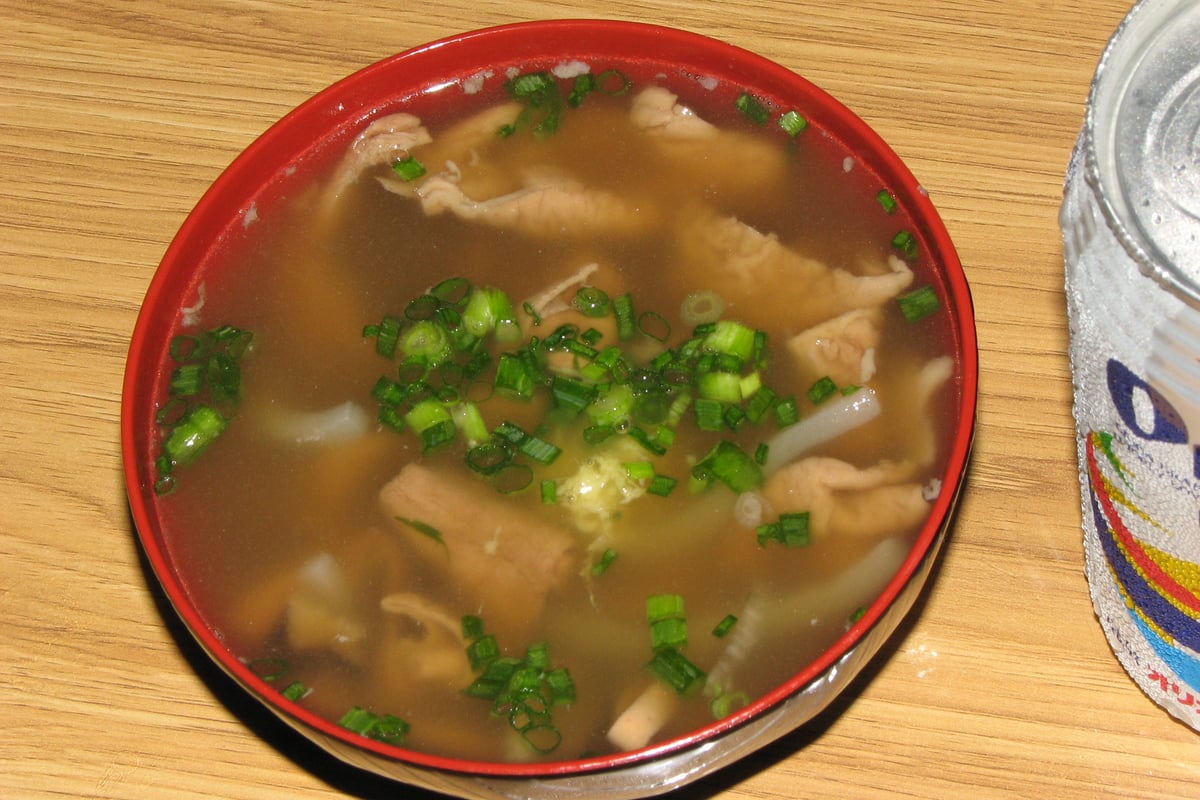
Nakami-jiru is a clear-broth local dish of Okinawa made with 'nakami' — pork offal such as the stomach, small intestine, and large intestine. Despite being an offal dish, it is notable for its refined flavor with no unpleasant odor: careful preparation removes excess fat and odor before the ingredients are simmered in a clear broth made from bonito and pork stock. Its roots lie in the court cuisine of the Ryukyu Kingdom, where it is said to have been served to entertain investiture envoys from China and officials from Satsuma. In old Okinawa, it was customary to slaughter a whole pig at the end of the year in preparation for the New Year, and nakami-jiru, made with fresh offal, became an indispensable feast dish for New Year celebrations, festive occasions, and memorial services — comparable to the mainland's zoni. It is still passed down today as a home-cooked dish, and is also enjoyed as 'nakami-soba,' in which nakami is used as a topping for Okinawa soba.
Origin
Nakami-jiru is said to have been one of the court dishes of the Ryukyu Kingdom, served to entertain investiture envoys from China and officials from Satsuma. In Okinawa, where pork is eaten extensively, a food culture developed of using every part of the pig without waste — so thoroughly that people say 'everything but the squeal is eaten' — and nakami-jiru developed as a representative dish of this tradition.
History
In old Okinawa, it was customary to slaughter a whole pig at the end of the year in preparation for the New Year, and nakami-jiru, made with fresh offal, was served as a feast dish comparable to the mainland's zoni. Because of its origins as a court dish, it is still handed down in households today as an indispensable dish for special occasions such as New Year, celebrations, and memorial services. 'Nakami-soba,' which uses nakami as a topping for Okinawa soba, is also widely enjoyed.
Features
The dish uses the pig's stomach, small intestine, and large intestine, and is characterized by careful preparation in which the offal is rubbed and washed with okara (soybean pulp) or flour and parboiled repeatedly to remove excess fat and odor. It is typically finished as a clear broth combining bonito and pork stock, served with grated ginger, resulting in a refreshing, refined flavor that belies its origins as an offal dish.
Main Ingredients
Food Culture
Because of its history as a court dish of the Ryukyu Kingdom, it is still handed down today as an indispensable dish for special occasions such as New Year, celebrations, and memorial services. The technique of careful preparation has been passed down through generations within families, making it a dish that symbolizes Okinawa's pork culture.
How It Differs from Home Cooking
At home, it is often prepared casually as an everyday side dish, whereas at long-established Ryukyu cuisine restaurants it is served as part of a course meal, presented in Okinawan lacquerware or Yachimun pottery — treated as a dish of considerable formality.
Famous Shops
琉球料理 美栄
沖縄県那覇市久茂地1-8-8
A Ryukyu cuisine restaurant founded in 1958. Its course menu includes a nakami clear soup, and all tableware is Okinawan lacquerware and Yachimun pottery. Budget approximately 6,000–12,000 yen.
FAQ
Q. What is the difference between 'nakami-soba' and 'nakami-jiru'?
A. Nakami-jiru on its own is served as a clear soup, while 'nakami-soba' is made by placing it on top of Okinawa soba — the difference is that it is served as a noodle dish.