Image: Wikimedia Commons
Tsuboya-yaki is a pottery representative of Okinawa, fired mainly in the Tsuboya district of Naha City and in Yomitan Village. Around the 14th-16th centuries, the Ryukyu Kingdom flourished as a hub for East Asian pottery through active overseas trade, but when trade declined following the Satsuma invasion (1609), the royal government invited Korean potters to introduce pottery-making techniques. In 1682, the royal government consolidated three kilns - the Chibana kiln in Misato Village, the Takarakuchi kiln in Shuri, and the Wakuta kiln in Naha - into the Tsuboya district of Naha, and this is considered the birth of present-day Tsuboya-yaki. It is characterized by thick-bodied vessels and a rustic, powerful style, and is broadly divided into two types: 'joyachi,' glazed and fired at high temperature, and 'arayachi,' fired without glaze. Joyachi centers on everyday vessels such as bowls, plates, and shisa lion-dogs, while arayachi centers on large storage vessels such as sake and water jars. In the 1970s, as it became difficult to fire the smoke-producing climbing kilns within Naha City, the late Living National Treasure Kinjo Jiro and others relocated to Yomitan Village, which subsequently became a major production area for Tsuboya-yaki as well. It was designated a Traditional Craft by the Minister of Economy, Trade and Industry in 1976.
Origin
Around the 14th-16th centuries, the Ryukyu Kingdom was a hub where East Asian pottery gathered as a center of entrepot trade. When overseas trade declined following the Satsuma invasion (1609), King Sho Tei invited Korean potters by way of Satsuma and focused on mastering pottery-making techniques. In 1682, by order of the royal government, three kiln sites - the Chibana kiln in Misato Village, the Takarakuchi kiln in Shuri, and the Wakuta kiln in Naha - were consolidated in the Tsuboya district of Naha, and this is considered the beginning of Tsuboya-yaki.
History
After the consolidation, Tsuboya developed as the Ryukyu Kingdom's sole official pottery-producing area, making a wide range of vessels from everyday bowls and plates to sake jars for storing awamori. In the 1970s, the smoke from climbing kilns became a problem as housing grew denser, prompting potters including the late Living National Treasure Kinjo Jiro to relocate to Yomitan Village. This gave rise to the 'Yachimun no Sato' (pottery village) in Yomitan, and today the craft is carried on across the two production areas of Tsuboya in Naha City and Yomitan Village. It was designated a Traditional Craft by the Minister of Economy, Trade and Industry in 1976.
Features
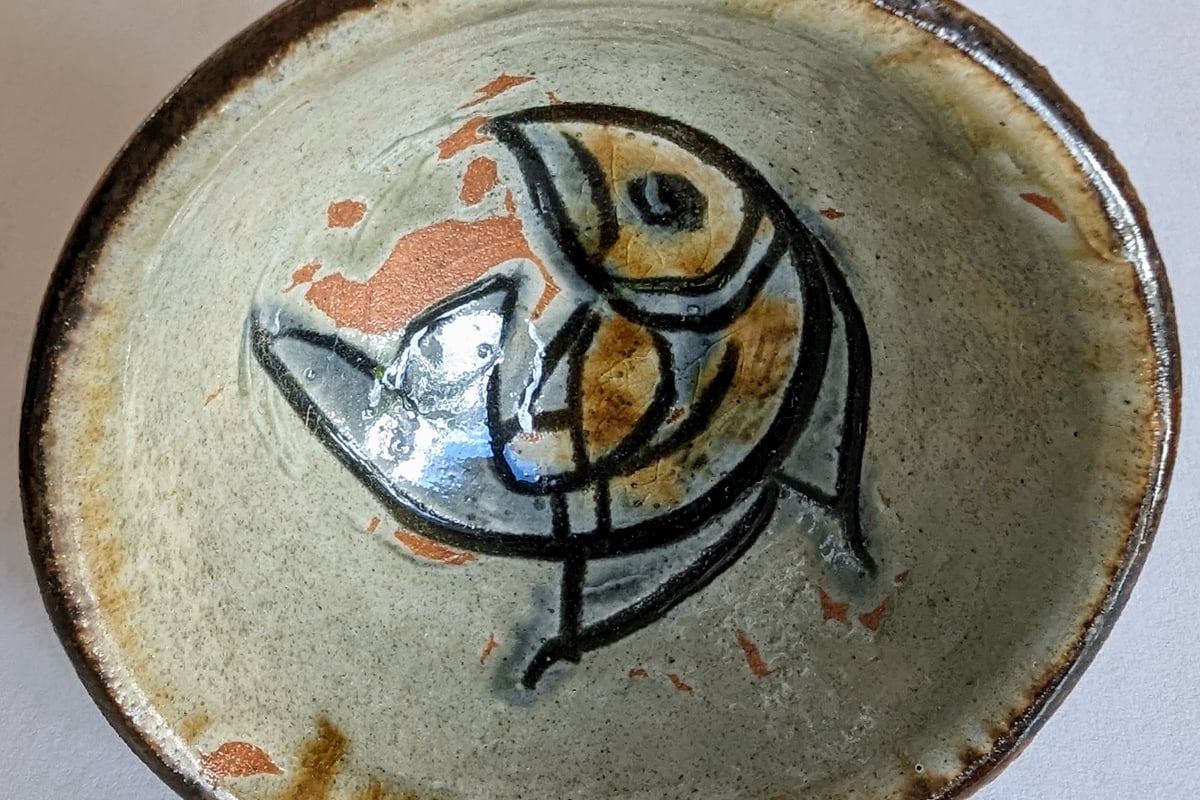
Thick-bodied vessels with a powerful, rustic style are the greatest characteristic of Tsuboya-yaki. 'Joyachi,' glazed and fired at high temperature, centers on everyday vessels such as bowls, plates, deep bowls, and shisa lion-dogs, and displays a variety of glaze effects, including amber glaze, the indigo tone of gosu, and white slip. 'Arayachi' (also called nanban-yaki), fired without glaze at high temperature, centers on large storage vessels such as sake and water jars. The incised 'gyomon' (fish motif) designs created by the late Kinjo Jiro using a wire-like tool are also known as a design emblematic of Tsuboya-yaki.
Techniques
Joyachi
A technique of glazing and firing at high temperature. It centers on everyday vessels such as bowls, plates, makai (rice bowls), and shisa lion-dogs, and represents the mainstream of Tsuboya-yaki today.
Arayachi
Also called nanban-yaki, this technique fires the ware without glaze. It has mainly been used for large storage vessels such as sake and water jars.
Materials Used
Production Process
- 1
Clay preparation and kneading
Air is removed from the clay and its texture made uniform.
- 2
Shaping
A potter's wheel or mold is used to shape bowls, plates, jars, and other vessels.
- 3
Bisque firing
Fired once at low temperature to stabilize the body.
- 4
Painting and glazing
Patterns are painted with gosu or pigments, then glaze is applied. This step is done only for joyachi.
- 5
Final firing
Fired at high temperature in a climbing kiln or gas kiln to complete the piece.
| Main Production Areas |
|
|---|
Artisans & Workshops
壺屋焼窯元 育陶園
A long-established Tsuboya kiln with a history of more than 300 years. The Takaesu family has passed down its techniques for generations, producing everything from traditional Tsuboya-yaki to everyday tableware.
Official site →How to Buy
- 壺屋やちむん通り祭り
- An annual event held around November, in which shops along the Tsuboya Yachimun-dori Shopping Street offer discount sales, wheel-throwing experiences, and a parade (michijunee). Many shops selling Tsuboya-yaki line the street for the occasion.
Hands-on Experiences
壺屋焼やちむん道場(育陶園)
沖縄県那覇市壺屋1-22-33
Both hand-forming and painting experiences take about 60 minutes and start at around 3,850 yen (painting a rice bowl or cup starts at around 4,400 yen). Reservation required.
View details →