Image: Wikimedia Commons
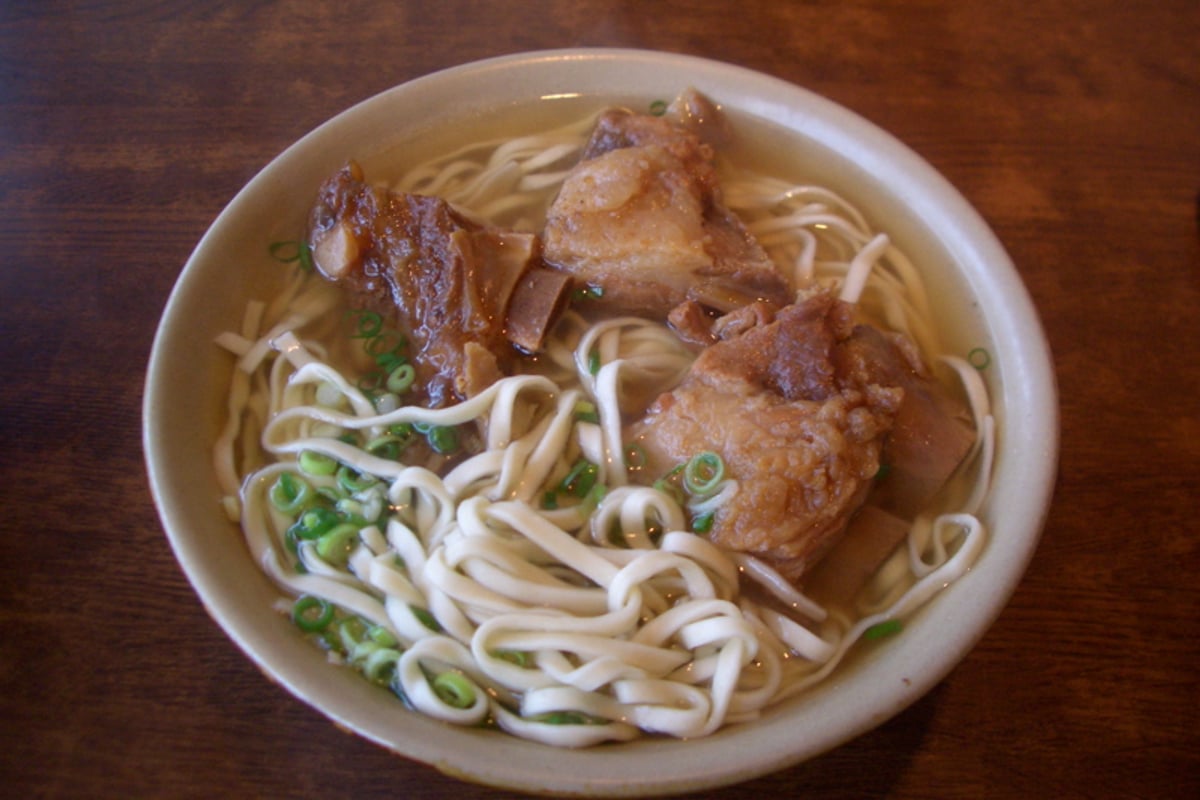
Okinawa soba is a beloved Okinawan noodle dish made with thick wheat noodles kneaded using kansui alkaline water — no buckwheat flour at all — served in a rich broth of pork bone and bonito, and topped with simmered pork belly, kamaboko fish cake, green onion, and red pickled ginger. It is said to have originated when a soba shop opened in Naha in the mid-Meiji era, when the dish was initially called 'suba' or 'Chinese soba' (shina soba). To distinguish it from Japanese soba, the name 'Okinawa soba' became established after Okinawa's reversion to mainland Japan in 1972, and in 1978 the Japan Fair Trade Commission approved the special designation 'Honba Okinawa Soba' (Authentic Okinawa Soba) for its use. The prefecture also has regional variants such as Miyako soba and Yaeyama soba, which differ in noodle thickness and broth preparation, and the dish has been selected as one of Japan's 100 Best Rural Dishes. Served not only at specialty shops but also at neighborhood eateries, it is eaten throughout the day from breakfast to late-night snacks, making it a noodle dish deeply woven into everyday life in Okinawa.
Origin
The roots of Okinawa soba are said to trace back to the mid-Meiji era, when a Chinese immigrant opened a soba shop in Naha. Later, shops run by Okinawan proprietors also appeared, gaining popularity through touches such as topping the noodles with hirayachi (a thin fried egg pancake), and the number of soba shops centered on Naha gradually increased. In this way, the dish is said to have spread little by little as a noodle dish beloved by ordinary people.
History
It was initially called 'suba' or 'Chinese soba' (shina soba), and in 1916 police guidance even attempted to rename it 'Ryukyu soba,' though the name never caught on. After Okinawa's reversion to mainland Japan in 1972, the name 'Okinawa soba' became officially established to distinguish it from Japanese soba, and in 1978 the special designation 'Honba Okinawa Soba' was approved for use. In the 1970s, soki soba emerged, diversifying the toppings, and in 1997, October 17 was designated 'Okinawa Soba Day.'
Features
Its defining feature is that it is made entirely from wheat flour with no buckwheat, kneaded with kansui or traditional wood-ash lye. The basic form combines a pork-bone and bonito broth with simmered pork belly, stick-shaped kamaboko, green onion, and red pickled ginger, and there are many variations with different toppings, such as soki soba. Noodle thickness and firmness vary from shop to shop, and many people enjoy comparing different shops' versions.
Main Ingredients
Food Culture
A staple eaten daily throughout the prefecture, Okinawa soba has regional variants such as Miyako soba and Yaeyama soba that differ in noodle thickness, toppings, and broth preparation. It remains a firm favorite not only at specialty shops but also as a standard menu item at everyday eateries.
Famous Shops
首里そば
沖縄県那覇市首里赤田町1丁目7
A long-established shop known for its hand-made noodles prepared fresh each morning and its well-regarded pork-and-bonito broth. Open 11:30 a.m. to 2:00 p.m., closing once sold out, it is loved for its reasonable prices — around 400 yen for a small bowl, 500 yen for medium, and 600 yen for large.
FAQ
Q. Why is it called 'soba' when it doesn't use buckwheat flour?
A. Okinawa soba is made only with wheat flour, using a method close to Chinese-style noodles, but it has customarily been called 'soba.' In 1976, the Japan Fair Trade Commission issued guidance regarding the use of the name, but through negotiations by the Okinawa Raw Noodle Cooperative, the trademark 'Honba Okinawa Soba' (Authentic Okinawa Soba) was approved.