Narezushi (Fermented Mackerel and Saury Sushi)
Narezushi (Fermented Mackerel and Saury Sushi)
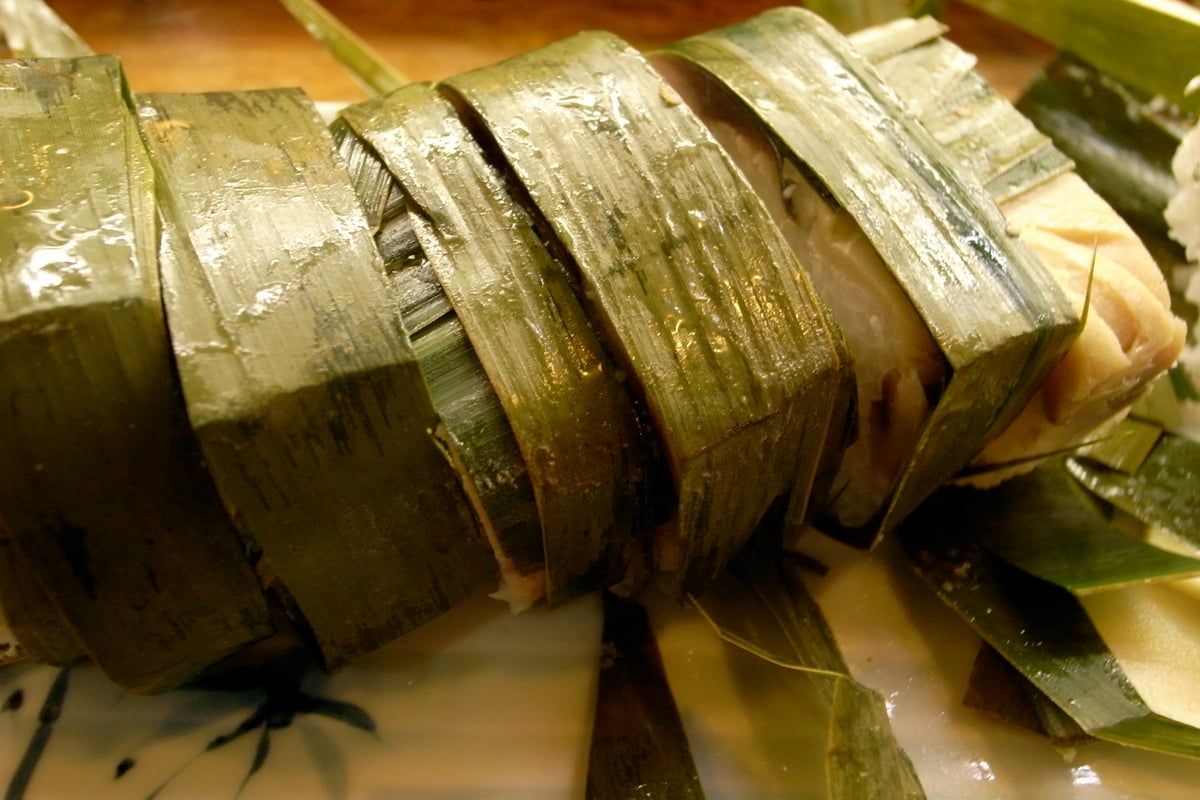
Image: Wikimedia Commons
Narezushi is a local dish of Wakayama Prefecture in which salted fish and rice are wrapped in leaves, packed into a wooden tub, and left to undergo lactic acid fermentation. Producing its sourness through fermentation rather than vinegar, it preserves to this day a way of eating regarded as the original form of sushi. Mackerel is typical in the Arida and Hidaka regions in the central part of the prefecture, while saury is typical in the Kumano region in the south, including Shingu City. The leaves used for wrapping differ from area to area; in Arida City and Hidaka District, leaves of ase (giant reed, known as danchiku, a plant of the grass family) have traditionally been used. According to the Ministry of Agriculture, Forestry and Fisheries, Wakayama's narezushi is said to be one of Japan's three great narezushi and to have a history of some 800 years or more. Households pickled it as a special dish for autumn festivals, and there was also a custom of packing it into tiered boxes (jubako) and giving it to relatives. There are two kinds: haya-nare (quick-fermented), which is pickled for a short time and is easy to eat, and hon-nare (long-fermented), which is fermented for a long time and has a strong aroma and sourness. At 東宝茶屋 in Shingu City, you can even taste saury narezushi aged for 30 years.
Origin
The Ministry of Agriculture, Forestry and Fisheries' 'Uchi no Kyodo Ryori' (Our Local Cuisine) introduces a legend about Taira no Koremori, a fugitive warrior of the defeated Heike (Taira) clan. When Koremori, who had been hiding in Arida, led soldiers out of the village, the villagers, though short of rice, gave them cooked rice and salted mackerel wrapped in leaves. When the bundles were opened a few days later, the contents had fermented, giving off a distinctive aroma, and had become very tasty. This is said to be the beginning of narezushi, but it remains just one legend.
History
Narezushi is a food that uses the fermentation of rice to preserve fish for a long time. One theory holds that it came from the Southeast Asia region along with rice cultivation, and the Heian-period Engishiki records narezushi delivered from various provinces. Later, hayazushi (quick sushi), which uses vinegar, spread and led to the sushi of today. In Wakayama it has been handed down as a festival dish, and it is said that one roll was served to each family member from the eve of the autumn festival (yomiya) through the following day.
Features
The mackerel is salted for more than a month and then desalted over the course of a day. For the rice, old rice (komai) is preferred because it is sticky and can be pressed firmly. Rice pressed into a bar is placed on top of the fish, wrapped in leaves, packed into a tub, and pickled under a weight. Today the mainstream is haya-nare, which can be eaten after a few days, and some versions use vinegar to tone down the strong flavor. Hon-nare, which is fermented for a long time with only salt and rice and no vinegar, is characterized by a strong sourness often likened to yogurt.
Main Ingredients
Food Culture
Narezushi has been made as a special dish for autumn festivals. Around the end of Obon, dozens of fish arrive in large fish crates (toro-bako), and each household pickles a large quantity. Once it was ready, it was packed into tiered boxes and given to relatives. Today it can also be bought at local restaurants and direct sales outlets.
How It Differs from Home Cooking
At home, the focus is on easy-to-eat narezushi pickled for a few days to about a week in time for the autumn festival. On the other hand, some restaurants, such as 東宝茶屋 in Shingu City, let you compare narezushi at different stages of fermentation, from versions pickled for several weeks to versions aged for 30 years.
Famous Shops
東宝茶屋
和歌山県新宮市横町2-2-12
A restaurant serving Kumano local cuisine, described as having been founded in 1947 (Showa 22). Its specialty is saury 'hon-nare zushi' (本馴れ鮓), which it has kept pickling since its founding, and you can even taste a 30-year-old version in which the rice has turned liquid. Saury, sweetfish (ayu), and mackerel narezushi cost about 1,080 to 1,300 yen. It is open only in the evening and closed on Thursdays.
View details →| 御菓子司 御寿司 つるや 'Narezushi' | Mackerel narezushi wrapped in ase leaves, from a shop in Yuasa that is said to have been in business for about 100 years. There is 'haya-nare' (早熟れ), which uses vinegar, and 'hon-nare' (本熟れ), which is fermented naturally with salt. It costs about 1,300 yen (tax included) per roll, and sales are limited to around May to November. Nationwide shipping is also available by phone or fax. |
|---|---|
| ふみこ農園 'Kishu Honba Narezushi' (Authentic Kishu Narezushi) | Mackerel narezushi sold by ふみこ農園 in Kinokawa City. You can choose from 'haya-nare,' 'naka-nare,' and 'hon-nare,' which differ in pickling time, and it is sold by mail order in packs of two rolls. The farm states that it uses no additives and ferments the narezushi naturally with salt and rice. |
FAQ
Q. What is the difference between 'haya-nare' and 'hon-nare'?
A. They differ in pickling time and method. Haya-nare is pickled for a short time, and some versions use vinegar to tone down the strong flavor, so it is easy to eat even for first-timers. Hon-nare uses no vinegar and is fermented for a long time with only salt and rice. Its aroma and sourness are strong, and it is favored by those accustomed to it.