Yamaga Toro (Paper Lanterns of Yamaga)
Yamaga Toro (Paper Lanterns of Yamaga)
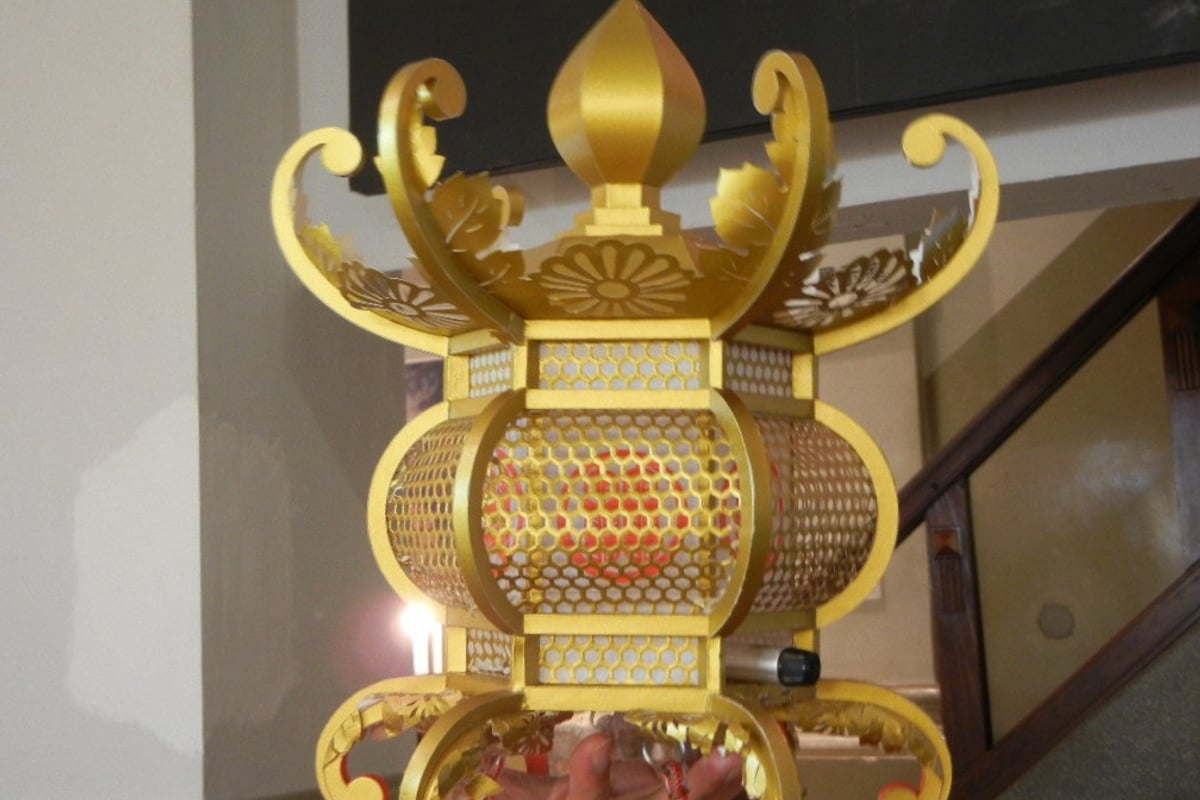
Image: Wikimedia Commons
Yamaga toro is a paper craft made in Yamaga City, Kumamoto Prefecture, assembled into three-dimensional forms from washi (Japanese paper) and paste alone, without using wood or metal fittings. It is made by hand by craftspeople called toro-shi (lantern makers), and even the finest parts are hollow inside. Besides the kin-doro (golden lanterns) that dancers wear on their heads, there are also works that reproduce famous buildings and shrine halls to scale. It is said to have begun about 600 years ago, in the Muromachi period, when paper craftwork imitating kin-doro was offered to Omiya Shrine. Every year on August 15 and 16, the lanterns are used for offerings and lantern dances at the Yamaga Toro Festival. In December 2013 (Heisei 25) it was designated a Traditional Craft by the Minister of Economy, Trade and Industry. Because of the Kumamoto earthquake, the Sennin Toro Odori (Lantern Dance of a Thousand Women) and the fireworks display were canceled at the 2026 festival, which was held on a reduced scale centered on Shinto rituals.
Origin
According to the Kumamoto Prefectural Traditional Crafts Center, there is an old tale that when Emperor Keiko was on an imperial tour, the people of Yamaga welcomed his party, which had been blocked by fog, with torches. Later, a ritual arose of presenting torches at the site of the temporary imperial lodging (now Omiya Shrine), and in the Muromachi period it is said to have changed into the offering of paper craftwork imitating kin-doro. This tale is a legend and has not been confirmed as historical fact. The washi was made in the Kamoto area, where technicians from Korea who came with Kato Kiyomasa passed on the papermaking method, and it became the raw material for the lanterns.
History
The oldest record that can be confirmed is an entry for 1674 (Enpo 2) in the 'Shimaya Diary' (嶋屋日記), which tells of a drowning accident on the way back from viewing the lanterns. In 1754 (Horeki 4), lanterns are recorded as having been presented to the domain lord Hosokawa Shigekata. An account of a visit from the Bunka era mentions the offering of 124 kin-doro; today about 30 are offered. After hereditary succession came into doubt, toro-shi emerged from classes run by the city starting around 1985, and the Yamaga Toro Promotion Association was formed in 2012.
Features
According to the Kumamoto Prefectural Traditional Crafts Center, works modeled on buildings are made at a scale of 1/20 or 1/30, and because they are viewed placed at a low height, their vertical dimensions are made 20 to 30 percent larger. For curved parts, a method called koguchi-tsuke is used, in which pieces are joined only along the thickness of the paper, without making paste margins. A finished kin-doro is described as weighing about as much as one egg. Large works take several months to complete.
Techniques
Koguchi-tsuke
A technique in which pieces are joined by applying paste only to the thickness of the paper, without making paste margins. It is used for curved parts such as the giboshi (onion-shaped finials). For parts such as the roof and the base, a method of joining with paste margins is also used.
Kone
A technique in which paper is placed on the palm of the hand and curved. Parts that must fit closely to curved surfaces are given their shape by kone, also using bamboo tubes. Hollow parts are also made by okiage, in which another sheet of paper is pasted around the sides of two sheets as if wrapping them.
Materials Used
Production Process
- 1
Backing (ura-uchi)
Toro paper, the material for kin-doro, is made. In this step, paste is applied to gold paper and washi is pasted onto it, making it thick and strong.
- 2
Cutting out parts
Using 歩紙 (perforated paper templates) and model patterns marked with traditional dimensions, marks are made on the toro paper. Parts such as the roof, pillars and warabite (curled bracket ornaments) are cut out with a small knife.
- 3
Pasting the parts
The cut-out parts are shaped by kone with the palm of the hand and made three-dimensional with koguchi-tsuke or okiage. Sokui paste is a paste made from cooked rice, but today water-based adhesive is used for reasons of strength and mold prevention.
- 4
Overall assembly
The parts are assembled in the order of the lantern body, windows, crests, legs, warabite, giboshi and roof. Finally, the heights of the upper and lower warabite and the legs are aligned, and the piece is checked for any misalignment of parts.
| Main Production Areas |
|
|---|
Artisans & Workshops
中島光代
A toro-shi who served as chair of the Yamaga Toro Promotion Association and is described as the first woman toro-shi. In the Ministry of Health, Labour and Welfare's 'Iimono' case studies, the eight current toro-shi are said to belong to the lineage of masters such as 中島清 (as introduced in fiscal 2020).
Official site →山鹿灯籠 中村制作所(中村潤弥)
The workshop of the toro-shi 中村潤弥. It is attached to the showroom shop Yamanote (ヤマノテ), run by his wife 京. It also makes items that draw on lantern-making skills, such as the mobile 'TouRou,' which sways in the wind.
Official site →坂本ゆかり
A toro-shi of Yamaga, also introduced in the Ministry of Health, Labour and Welfare's case studies. The Kumamoto Nichinichi Shimbun reported that she held an exhibition in Yamaga City of works elaborately reproducing Nikko Toshogu Shrine.
Official site →How to Buy
- 山鹿灯籠民芸館 (Yamaga City)
- The museum displays and sells crafts of Yamaga. The selection and prices of lanterns could not be confirmed, so please inquire in advance. Inquiries are directed to the Yamaga City Commerce, Industry and Tourism Division (0968-43-1152).Where to buy →PR
- Yamaga City furusato nozei (hometown tax donation)
- Yamanote's mobile 'TouRou' is listed as a thank-you gift from Yamaga City. A making kit that lets you experience the skills of toro-shi was also introduced, for donations of 11,000 yen or more. Available items change depending on the time.Where to buy →PR
Hands-on Experiences
山鹿灯籠民芸館
熊本県山鹿市山鹿1606-2
Housed in a former bank building built in 1925, it is a Registered Tangible Cultural Property of Japan. Lantern exhibits, viewing of production, and making mini lanterns are introduced. Admission is 300 yen for adults and 150 yen for elementary and junior high school students, and it is open from 9:00 to 18:00. Please check its status after the 2026 earthquake.
View details →FAQ
Q. Are they really made only of washi and paste?
A. No wood or metal fittings are used for the framework. However, according to the Kumamoto Prefectural Traditional Crafts Center, water-based adhesive is now used for bonding in place of sokui paste made from cooked rice, to address strength, insect damage and mold.
Q. When is the Yamaga Toro Festival held?
A. Every year on August 15 and 16. The highlights are the Sennin Toro Odori on the night of the 16th and the 'Agari Toro,' in which lanterns are offered to Omiya Shrine. In 2026, the Sennin Toro Odori and the fireworks display were canceled because of the earthquake, so please check the program in advance.
Q. How can I become a toro-shi?
A. Yamaga City holds lantern-making classes for residents, which marked their 40th year in 2025. The venue is the Yamaga Toro Folk Craft Museum (山鹿灯籠民芸館), and the classes also serve as an entry point for training successors. However, it is said to take more than 10 years of training to become a full-fledged toro-shi.