Image: Wikimedia Commons
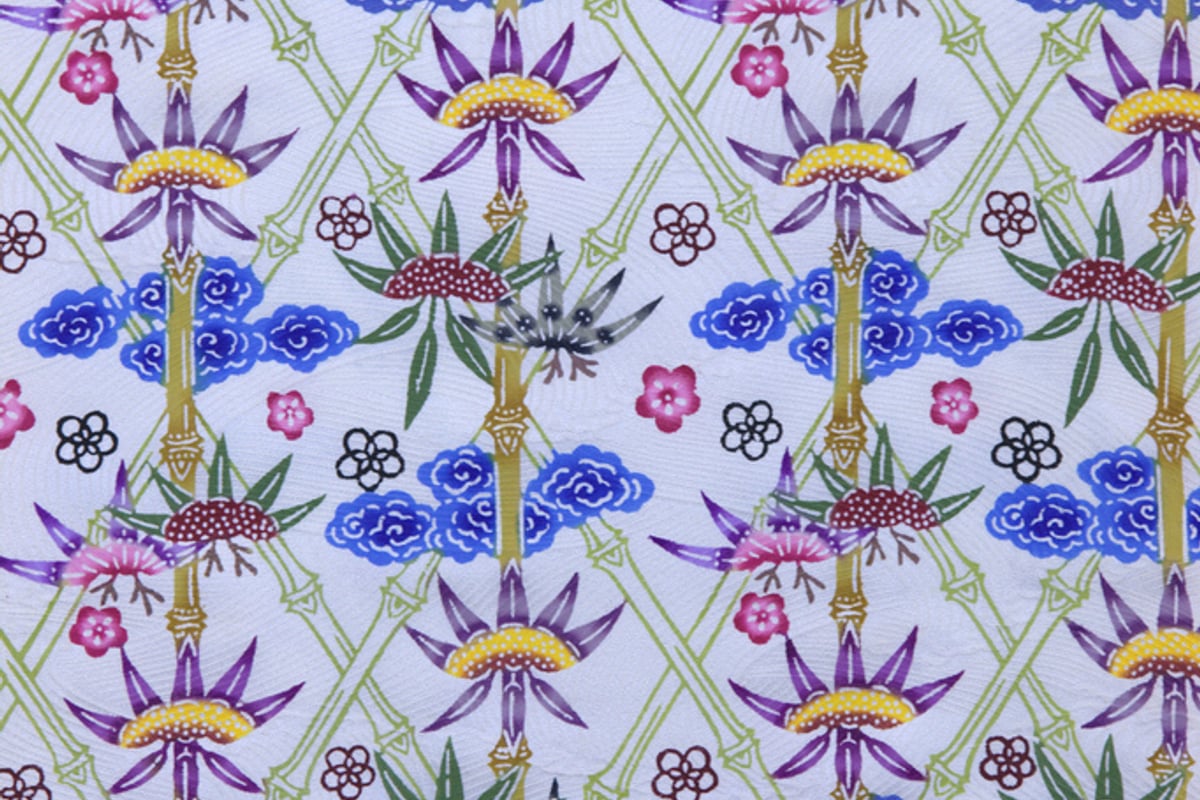
Ryukyu Bingata is a dyeing technique passed down mainly in Shuri, Naha City, Okinawa Prefecture, characterized by bold, vivid colors reminiscent of tropical sunlight - reds, yellows, blues, greens, and purples - and flowing patterns inspired by Okinawan nature such as deigo flowers, adan (pandanus), and fish. Its origins are said to date to around the 14th-15th centuries, when it is thought to have developed from dyeing techniques introduced through trade with China, India, and Java (sarasa/chintz dyeing), adapted in a uniquely Ryukyuan way. It developed under the protection of the Ryukyu royal government, worn as formal attire for royalty and the samurai class and as ritual costume, with the finest painters and stencil carvers of the day creating the underdrawings and stencils. It is broadly divided into the vividly multicolored 'Bingata' and the more subdued 'Aigata (e-gata)', dyed using only shades of indigo. Because processes such as stencil carving, paste-resist application, coloring, and shading are handcrafted, mostly divided among specialists within a single workshop, completing a single length of fabric takes considerable time and effort. It was designated a Traditional Craft by the Minister of Economy, Trade and Industry in 1984, and today it is used not only for kimono and obi but also for everyday items such as noren curtains and pouches.
Origin
The origins of Ryukyu Bingata are believed to date to around the 14th-15th centuries. At the time, the Ryukyu Kingdom prospered through relay trade linking China, Southeast Asia, and Japan, and the goods traded included Indian and Javanese chintz (sarasa) and Chinese stencil-printed flower cloth. These foreign dyeing techniques were brought to Ryukyu, and as they merged with the local climate and aesthetic sensibility, the dyeing technique known as 'Bingata' is thought to have been born.
History
Under the protection of the Ryukyu royal government, Bingata was valued as formal attire for royalty and the samurai class and as ritual costume, and a system was established in which dedicated painters and stencil carvers divided the work of creating underdrawings and stencils. Protection by the royal government continued even after the Satsuma invasion (1609), and the style continued to be refined. Many stencils and records were lost in the Pacific War, but after the war, artisans revived the techniques, and in 1984 it was designated a Traditional Craft by the Minister of Economy, Trade and Industry.
Features
It is broadly divided into 'Bingata', which layers bold, vivid colors based on red, yellow, blue, green, and purple, and 'Aigata', dyed using only shades of indigo. Patterns frequently feature Okinawan flora and fauna such as deigo flowers, adan, butterflies, and fish, with flowing compositions characteristic of the tropics. Another major feature is the unique technique called 'kumadori', in which shading is added to the pattern after coloring, giving depth to what would otherwise be a flat dyed surface.
Techniques
Katabori (Stencil Carving)
Dried shima-dofu (tofu, called rukujuu) is placed under the stencil paper, and the pattern is carved out with a small knife (shiigu). There are two types: shirajigata, in which the background is cut away, and someijigata, in which the pattern itself is cut away.
Kumadori (Shading)
After coloring and color arrangement are complete, this process adds gradated shading to the pattern. It is considered a technique unique to Ryukyu Bingata that gives dimensionality to what would otherwise be a flat dyed design.
Materials Used
Production Process
- 1
Stencil carving
Dried shima-dofu is placed under the stencil paper, and the pattern is carved out with a small knife.
- 2
Applying resist paste
The stencil is placed on the fabric, and resist paste is applied in layers to prevent dye from soaking in.
- 3
Coloring
Once the paste has dried, soybean juice is applied to prevent bleeding, and mineral pigments and dyes are used to color the pattern.
- 4
Shading
After coloring, shading is added to the pattern to create a sense of depth.
- 5
Steaming and rinsing
The fabric is steamed to fix the dye, then rinsed in water (mizumoto) to wash away excess paste and dye, completing the process.
| Main Production Areas |
|
|---|
Artisans & Workshops
城間びんがた工房
Counted as one of the three main lineages of Bingata, this long-established workshop has continued for over 300 years since the Ryukyu Kingdom era. It continues to produce work today while sharing its techniques and culture through events held several times a year.
Official site →知念紅型研究所
The workshop of the Chinen family, who have passed down Ryukyu Bingata for several hundred years. It creates works grounded in traditional techniques.
Official site →How to Buy
- 琉球びんがたオンラインストア
- An online shop offering accessories and items made with Bingata fabric. Shipping nationwide is free for purchases of 6,600 yen or more, and costs 990 yen (tax included) for smaller orders.Where to buy →PR
Hands-on Experiences
首里琉染
沖縄県那覇市首里山川町1-54
A coral-dyeing experience (3,850 yen for adults, 3,300 yen for children) where you can add color to a scarf, T-shirt, or similar item. Takes about 30-40 minutes; reservation required.
View details →