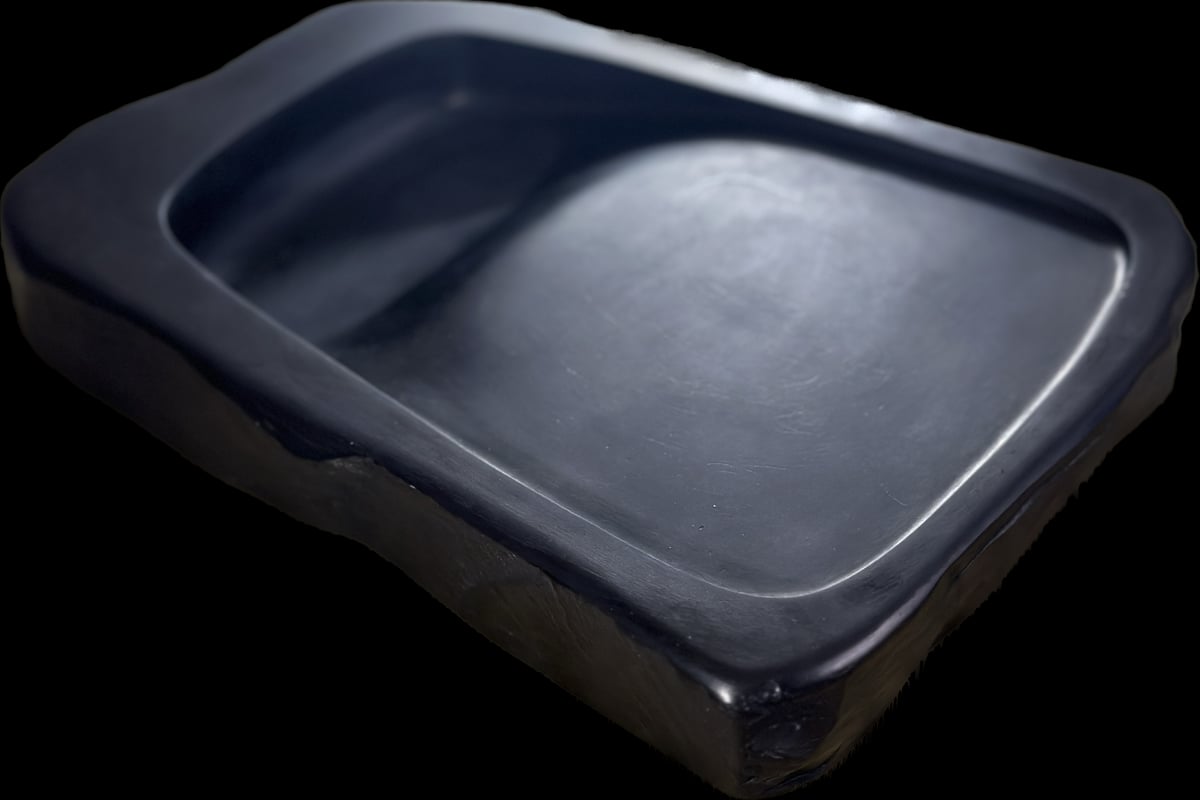
Image: Wikimedia Commons
Ogatsu Suzuri are inkstones (suzuri) made in the Ogatsu district of Ishinomaki City, Miyagi Prefecture. Their raw material, gensho-seki (Ogatsu stone), is a black hard clay slate quarried from strata roughly 230 to 500 million years old. Its grain is uniform and fine, and it resists compression and bending while absorbing very little water, so it changes little over time - qualities that make it among the finest inkstone stones available. Ogatsu is said to have already been producing inkstone material around 1396, in the Muromachi era, and by the Edo period the stone is said to have been presented to Date Masamune, giving the craft a history of over 600 years. It was designated a Traditional Craft by the Minister of Economy, Trade and Industry (METI) on May 22, 1985, and at its peak, Ogatsu Suzuri accounted for more than 90% of all inkstones produced in Japan. The Great East Japan Earthquake (2011) caused severe tsunami damage throughout Ogatsu, destroying craftsmen's homes, workshops, and quarries. Even so, craftsmen resumed production using inkstones and tools found amid the rubble, and today they continue rebuilding the industry while also developing new products such as tableware in addition to inkstones.
Origin
The raw material of Ogatsu Suzuri, gensho-seki (Ogatsu stone), is a black hard clay slate quarried from strata roughly 230 to 500 million years old, and Ogatsu is said to have already been producing inkstone material around 1396, in the Muromachi era. A document from 1772 describes it as 'truly an elegant object,' showing that it has long been prized as a fine inkstone, and it is said to have been presented to Date Masamune in the Edo period. Counting from the Oei era, it has a history of more than 600 years, making it one of Japan's leading inkstone-producing regions.
History
Ogatsu Suzuri was long passed down as a local industry, and on May 22, 1985, it was designated a Traditional Craft by the Minister of Economy, Trade and Industry (METI). At its peak, Ogatsu Suzuri accounted for more than 90% of the inkstones distributed in Japan, establishing itself as the country's leading inkstone-producing region. However, the tsunami caused by the Great East Japan Earthquake (2011) devastated Ogatsu, and many craftsmen lost their homes, workshops, and quarries. Even so, craftsmen resumed production relying on inkstones and tools found amid the rubble, and continue the region's history today.
Features
The appeal of Ogatsu Suzuri lies in the high quality of its raw stone, gensho-seki. The grain is dense and uniform, with excellent luster, and it resists compression and bending while absorbing very little water, so it changes little in quality even after years of use. From selecting and carving the stone to polishing it, every step is finished by hand by craftsmen, producing inkstones that grind ink well and offer a smooth feel. In recent years, development has expanded beyond inkstones to new applications that make use of the stone's properties, such as tableware and building materials.
Techniques
Stone selection (discerning eye)
The skill of identifying and cutting out fine, uniform, flaw-free sections from the layers of Ogatsu stone. It is considered the first, crucial step that greatly determines the quality of the finished inkstone.
Materials Used
Production Process
- 1
Quarrying
Raw stone is cut from the Ogatsu stone quarry.
- 2
Rough shaping
The stone is roughly cut down to form the general shape of the inkstone.
- 3
Carving
A chisel is used to carve the ink-grinding well and the flat land (oka) used for grinding.
- 4
Polishing
The surface is carefully polished to a smooth finish that grinds ink well.
- 5
Finishing
The overall shape and details are refined, and the piece is completed after final inspection.
| Main Production Areas |
|
|---|
Artisans & Workshops
遠藤弘行
An Ogatsu Suzuri craftsman born into a family that had quarried Ogatsu stone for generations. Although he lost his home and workshop to the tsunami of the Great East Japan Earthquake (2011), he resumed production that same June using an inkstone made by his father, which he found amid the rubble, and has since supported the recovery of the production area.
How to Buy
- 雄勝硯生産販売協同組合 楽天市場店
- An online shop run by the cooperative. In addition to inkstones, it handles items such as chopstick rests and plates made from Ogatsu stone, with small inkstones available from around 5,000 yen.Where to buy →PR
Hands-on Experiences
雄勝硯伝統産業会館
宮城県石巻市雄勝町下雄勝2-17(道の駅「硯上の里おがつ」内)
A facility displaying the history of Ogatsu Suzuri and the tools used by craftsmen. The exhibition room for traditional crafts charges admission (200 yen for adults), and there is also a sales corner for crafts made from Ogatsu stone.
View details →FAQ
Q. What share of the domestic market did Ogatsu Suzuri hold?
A. At its peak, Ogatsu Suzuri is said to have accounted for more than 90% of all inkstones produced in Japan, and it remains known today as one of Japan's leading inkstone-producing regions.
Q. What impact did the Great East Japan Earthquake have?
A. The tsunami caused severe damage throughout Ogatsu, and many craftsmen lost their homes, workshops, and quarries. Even so, craftsmen resumed production and continue rebuilding while also developing new products beyond inkstones.