Image: Wikimedia Commons
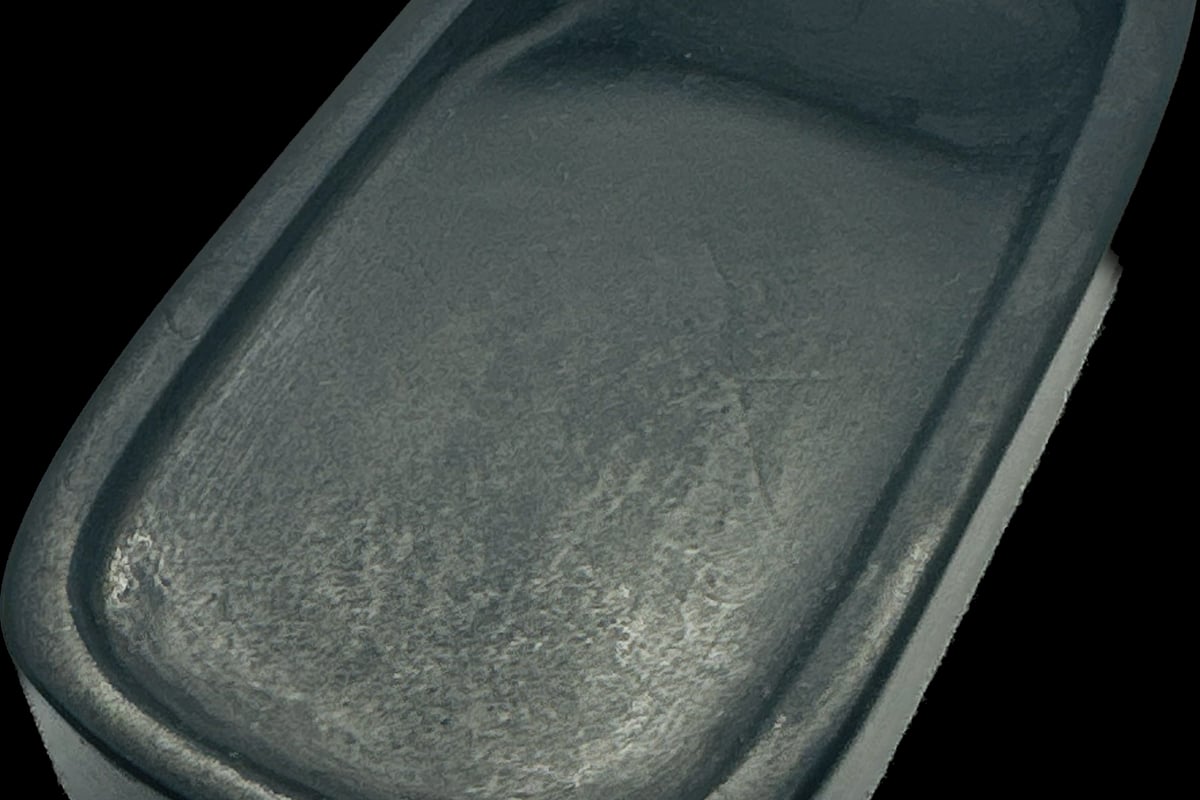
Koshu Amehata Inkstones are inkstones carved from 'Amehata Shinseki' (true Amehata stone), quarried in the Amehata district of Hayakawa Town, Yamanashi Prefecture. The stone is a black, dense slate (a rock formed from hardened mud that splits easily into thin layers) with no uneven patches. The fine, uniform particles on its surface, called 'hobo,' grind ink just right, and because it absorbs little water, it holds water well. It has long been regarded as a fine stone that surpasses even Chinese inkstones. The craft is said to have begun in Genroku 3 (1690), when Amemiya Magoemon, while traveling to worship at Mt. Minobu, picked up a black stone on the bank of the Hayakawa River and made it into an inkstone. Locally, an even older legend connected with Saint Nichiro, a disciple of Nichiren, has also been handed down. Today the production areas are Hayakawa Town and Fujikawa Town, and in Kajikazawa, Fujikawa Town, there are inkstone workshops that have continued for generations. In 1994 it was designated a Yamanashi Prefecture Designated Local Traditional Craft. At 'Amehata Suzuri no Sato Kenshoan' in Hayakawa Town, visitors can view renowned inkstones and try inkstone making.
Origin
According to prefectural and other sources, it began in Genroku 3 (1690), when Amemiya Magoemon, while traveling to worship at Mt. Minobu, picked up a solid black stone on the bank of the Hayakawa River, a tributary of the Fuji River, and made it into an inkstone. On the other hand, in Amehata, Hayakawa Town, there is also a legend that in Einin 5 (1297), Saint Nichiro, a disciple of Nichiren, found a bluish-black stone on the riverbank of the upper Amehata River on the way back from the founding (kaisan) of Mt. Shichimen.
History
When an inkstone was presented to Lord Hitotsubashi in Tenmei 4 (1784), the name Amehata Inkstone became widely known. For a time the shogunate banned the quarrying of the raw stone, but after an inkstone was presented to the 14th shogun, Tokugawa Iemochi, quarrying was permitted again. The craft reached its peak in the Meiji period, when the number of inkstone craftsmen in Amehata is said to have exceeded 100. In the Taisho period, the Amehata Inkstone Manufacturing and Sales Association was established to prevent the circulation of imitations, and craftsmen began carving 'Amehata Shinseki' on the back of the inkstones.
Features
Amehata Shinseki is a black slate that is dense and fine-grained, with no uneven patches. It grinds ink well and absorbs little water, and calligraphers even say it is the inkstone best suited to Japanese ink. The raw stone is dug out of mine tunnels, but only a layer about 40 to 50 cm wide inside the tunnels is suitable for inkstones. In addition to practical inkstones, craftsmen also put effort into making inkstones with a strong sense of design, and they are also valued as works of art.
Techniques
Carving with Chisels
The shape of an inkstone is carved out using many chisels with different widths and blade angles. Some inkstone craftsmen in Fujikawa Town decide the shape while facing the stone, without drawing plans. So as not to waste precious stone, they carve while discerning the stone's properties.
Polishing and Finishing
A carved inkstone is polished in stages: rough polishing, medium polishing and finish polishing. It is then completed after processes such as touch-up, and it takes at least several days to finish a single inkstone. Some craftsmen use urushi lacquer for finishing to broaden their range of expression.
Materials Used
Production Process
- 1
Ishidori (Quarrying the Stone)
Raw stone suitable for inkstones is extracted.
- 2
Cutting and Ishigoshirae (Shaping the Stone)
The raw stone is cut and trimmed to the size of the inkstone.
- 3
Kegaki (Marking Out)
The shape of the inkstone is drawn on the surface of the stone.
- 4
Fuchidate (Forming the Rim) and Rough Carving
The rim of the inkstone is determined, and the rough shape is carved with chisels.
- 5
Finish Carving
The surface for grinding ink and the well for collecting ink are carved and refined down to the details.
- 6
Rough, Medium and Finish Polishing
The inkstone is polished in stages to make the surface smooth.
- 7
Tsukuroi (Touch-up) and Finishing
The details are touched up, and the stone is finished as an inkstone.
| Main Production Areas |
|
|---|
Artisans & Workshops
雨宮弥太郎(甲斐雨端硯本舗)
The 13th-generation inkstone craftsman of Kai Amehata Suzuri Honpo, said to have been founded in Genroku 3 (1690). Amemiya studied sculpture at Tokyo University of the Arts. Amemiya says, 'An inkstone is a contemporary sculpture founded on tradition,' and creates shapes by facing the stone without drawing plans. The workshop is in Kajikazawa, Fujikawa Town.
雨宮正美(峯硯堂本舗)
The fourth-generation head of 峯硯堂本舗 in Kajikazawa, Fujikawa Town, whose artist name is 雨宮峯硯. Amemiya handles every step alone, from selecting the stone to finishing. In 2017 Amemiya was selected as a 'Contemporary Master Craftsman,' and in 2018 received the Medal with Yellow Ribbon.
How to Buy
- 雨畑硯の里 硯匠庵
- An exhibition and hands-on facility for Amehata Inkstones in Amehata, Hayakawa Town, which sells inkstones, washi and other items inside. Open from 9:00 to 17:00; closed on Tuesdays (the following day if Tuesday is a holiday) and during the year-end and New Year holidays.
Hands-on Experiences
雨畑硯の里 硯匠庵
山梨県南巨摩郡早川町雨畑709-1
Opened in 2000, it exhibits renowned inkstones, including Amehata Inkstones, and old documents. Admission is about 200 yen for adults. Experiences in carving an inkstone from raw stone, or in finishing and polishing one, start from about 4,000 yen (excluding tax) and require a reservation.
FAQ
Q. Where is the stone for Amehata Inkstones quarried?
A. Raw stone is still dug out today from mine tunnels along the Inamata River, a tributary of the upper Amehata River in the Amehata district of Hayakawa Town. The raw stone cannot be found just anywhere, and even inside the tunnels, only a layer about 40 to 50 cm wide is suitable for inkstones.
Q. What is the 'Amehata Shinseki' carved on the back of the inkstones?
A. In the Taisho period, as Amehata Inkstones grew in popularity and imitations began to circulate, the Amehata Inkstone Manufacturing and Sales Association was formed. As proof that an inkstone was made from stone quarried in Amehata and carved in Amehata, craftsmen began carving the name of the raw stone, 'Amehata Shinseki,' and their own names on the back.
Q. Are there still Amehata Inkstone craftsmen today?
A. At its peak in the Meiji period there are said to have been more than 100 craftsmen, but their numbers have declined due to aging and falling demand. According to prefectural sources, there are currently about 6 craftsmen. The skills are being handed down at workshops in Kajikazawa, Fujikawa Town, and at Kenshoan in Hayakawa Town.