Craft Genre
Writing Tools
A cross-regional look at Writing Tools from across Japan.
Region(multiple selection allowed)
9 items

Koshu Hand-Carved Seals
Koshu Hand-carved Seals
Koshu Hand-Carved Seals are hand-carved hanko (personal seals) made in Yamanashi Prefecture. Every step, from designing the characters on the seal face through jiwari (character spacing), jiire (writing the characters), rough carving and finishing, is done by hand with traditional tools. The craft began with the discovery of large, high-quality crystal veins in the Mitake mountains. Craftsmen who worked crystal and tenkoku (seal engraving) artists emerged, and their skills were passed on to seal making. The main production area, the Rokugo district of Ichikawamisato Town, is called 'Japan's No. 1 Hanko Village,' and businesses related to seals, from carving and wholesale to the manufacture of seal cases, are concentrated there. Besides crystal, seal materials include boxwood and water buffalo horn. Hand-carved crystal seals are hardly made anywhere outside Yamanashi Prefecture. They were designated a Yamanashi Prefecture Designated Local Traditional Craft in 1994 and a Traditional Craft Designated by the Minister of Economy, Trade and Industry in 2000. At the Seal Museum in Rokugo, visitors can learn about the history of seals and try tenkoku.
Koshu Amehata Inkstone
Koshu Amehata Inkstone
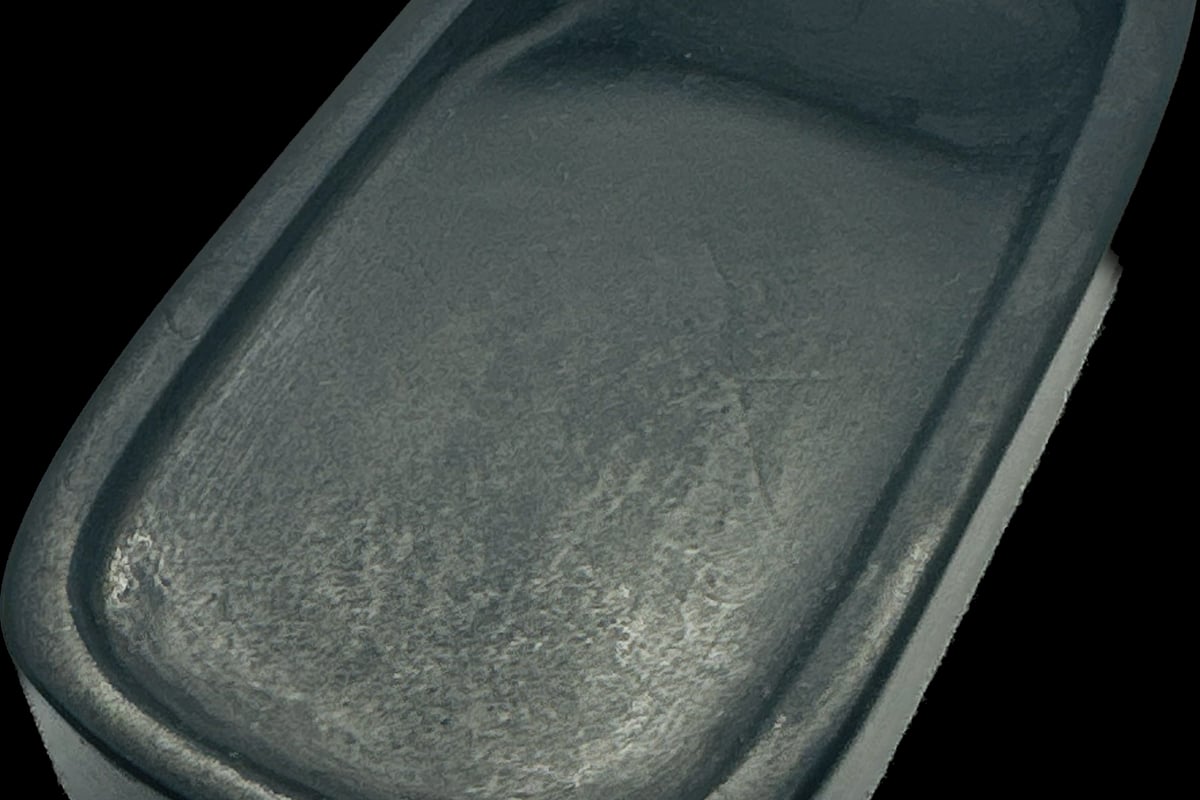
Koshu Amehata Inkstones are inkstones carved from 'Amehata Shinseki' (true Amehata stone), quarried in the Amehata district of Hayakawa Town, Yamanashi Prefecture. The stone is a black, dense slate (a rock formed from hardened mud that splits easily into thin layers) with no uneven patches. The fine, uniform particles on its surface, called 'hobo,' grind ink just right, and because it absorbs little water, it holds water well. It has long been regarded as a fine stone that surpasses even Chinese inkstones. The craft is said to have begun in Genroku 3 (1690), when Amemiya Magoemon, while traveling to worship at Mt. Minobu, picked up a black stone on the bank of the Hayakawa River and made it into an inkstone. Locally, an even older legend connected with Saint Nichiro, a disciple of Nichiren, has also been handed down. Today the production areas are Hayakawa Town and Fujikawa Town, and in Kajikazawa, Fujikawa Town, there are inkstone workshops that have continued for generations. In 1994 it was designated a Yamanashi Prefecture Designated Local Traditional Craft. At 'Amehata Suzuri no Sato Kenshoan' in Hayakawa Town, visitors can view renowned inkstones and try inkstone making.
Ogatsu Suzuri
Ogatsu Suzuri
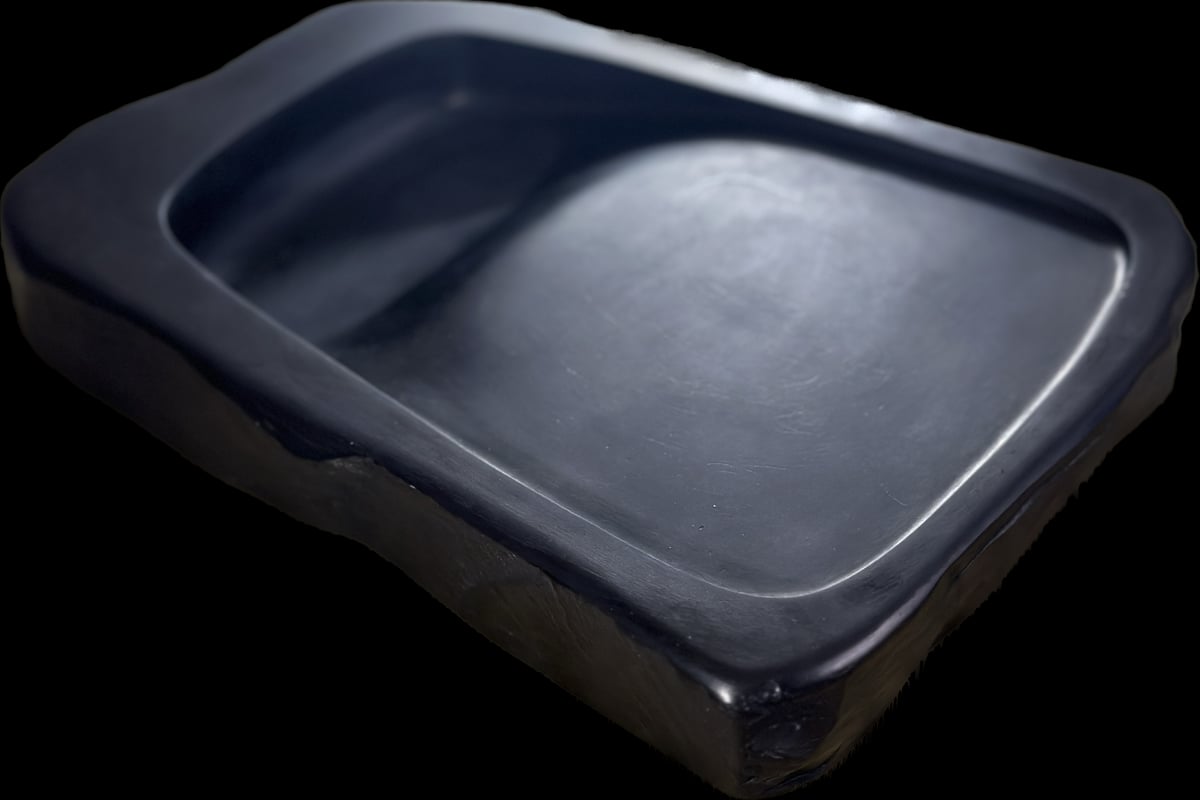
Ogatsu Suzuri are inkstones (suzuri) made in the Ogatsu district of Ishinomaki City, Miyagi Prefecture. Their raw material, gensho-seki (Ogatsu stone), is a black hard clay slate quarried from strata roughly 230 to 500 million years old. Its grain is uniform and fine, and it resists compression and bending while absorbing very little water, so it changes little over time - qualities that make it among the finest inkstone stones available. Ogatsu is said to have already been producing inkstone material around 1396, in the Muromachi era, and by the Edo period the stone is said to have been presented to Date Masamune, giving the craft a history of over 600 years. It was designated a Traditional Craft by the Minister of Economy, Trade and Industry (METI) on May 22, 1985, and at its peak, Ogatsu Suzuri accounted for more than 90% of all inkstones produced in Japan. The Great East Japan Earthquake (2011) caused severe tsunami damage throughout Ogatsu, destroying craftsmen's homes, workshops, and quarries. Even so, craftsmen resumed production using inkstones and tools found amid the rubble, and today they continue rebuilding the industry while also developing new products such as tableware in addition to inkstones.
Suzuka Sumi (Suzuka Ink Sticks)
Suzuka Sumi (Suzuka Inksticks)
Suzuka Sumi is solid ink (ink sticks) for calligraphy made in Suzuka City, Mie Prefecture. Soot (susu) is kneaded and hardened with animal glue (nikawa: an adhesive made from animal hides and bones), formed in wooden molds, and finished by drying over a long period. Its origins are said to go back to the Enryaku era (782-806), and it is said to have begun with collecting soot by burning pine from the mountains of Suzuka. In the Edo period, it received the protection of the Kishu Domain, and demand grew with the writing of daimyo family crests and the spread of terakoya (private elementary schools). With good color development and an elegant depth, it is used by many calligraphers as an ink in which the core of the line and the bleed harmonize well. In 1980 (Showa 55), it became the first sumi ink to be designated a Traditional Craft Designated by the Minister of Economy, Trade and Industry. Today, 進誠堂 in Jike, Suzuka City, is said to be the only maker of Suzuka Sumi. The certified traditional craftsperson 伊藤亀堂 and 伊藤晴信, the son of 伊藤亀堂, carry on the techniques.
Umpei-fude (Umpei Calligraphy Brushes)
Umpei-fude
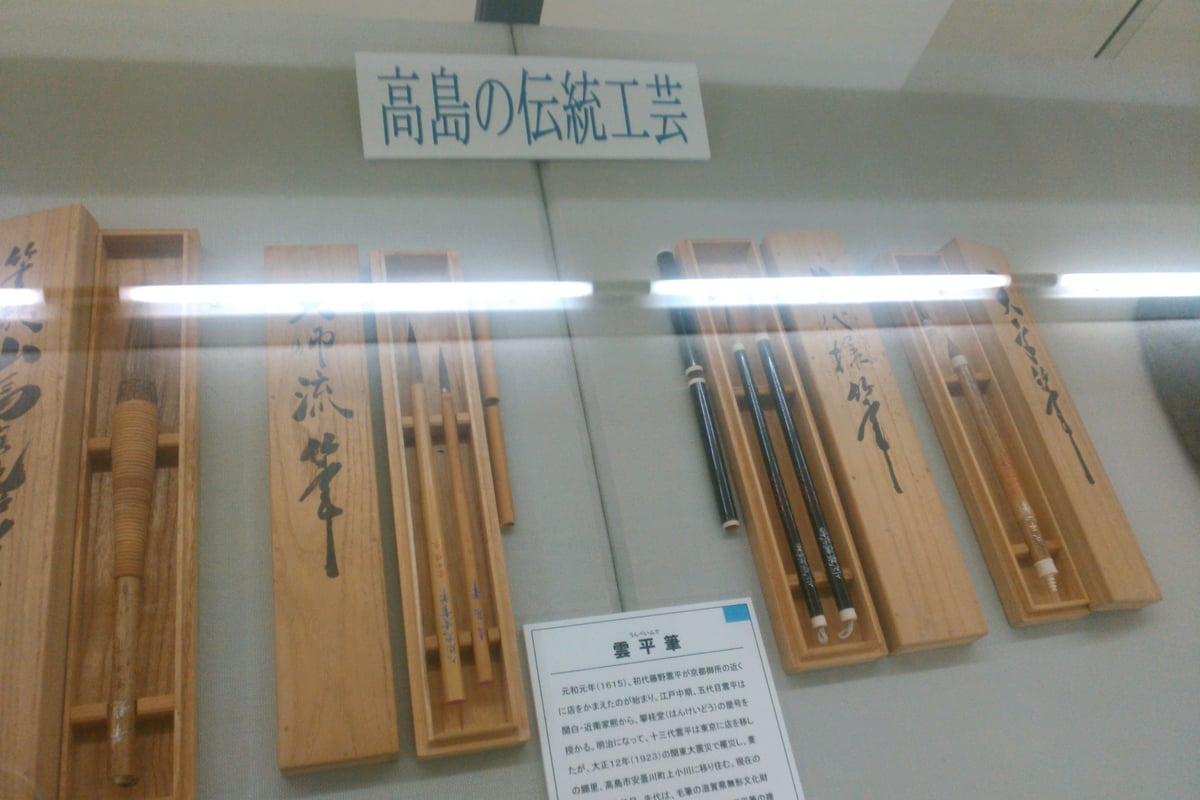
Umpei-fude are calligraphy brushes that carry on the technique of 'makifude' (wrapped brushes), in which the brush tip is formed by wrapping washi paper around the hair core. The craft's founder is said to be Fujino Umpei, a brush maker who established his workshop in Kyoto during the Genna era (around 1615); he served the imperial court and is said to have had close ties with the Arisugawa-no-miya family, known for its devotion to calligraphy. In the Shotoku era, the fifth-generation Umpei received the title 'Hankeido' from the then-regent Konoe Iehiro, and successive brush makers have carried on the technique under this name ever since. Today the workshop is located in Adogawa, Takashima City, Shiga Prefecture, where the fifteenth-generation Fujino Umpei and his child are known as the only makers in Japan of makifude brushes, whose tips are wrapped and fixed with washi paper. The brush tips, made using a combination of animal hairs such as raccoon dog, sheep, and weasel, hold ink well and are said to produce powerful lines, and have long been cherished by calligraphers and many enthusiasts. In 1966 the fourteenth generation was recognized as a holder of Shiga Prefecture's Intangible Cultural Property, and Umpei-fude itself has been designated a Traditional Craft by the Governor of Shiga Prefecture.
Otsu-e (Otsu Folk Paintings)
Otsu-e
Otsu-e are folk paintings that were sold as souvenirs to travelers at the Otsu post station on the Tokaido road (around Oiwake and Otani) in the early Edo period. They are said to have begun around the Kan'ei era (1624-1644) as Buddhist paintings depicting religious subjects, and are also known from Matsuo Basho's haiku 'What Buddha did the brush of Otsu-e begin with?' Over time the subject matter broadened to secular themes, and during the Bunka-Bunsei era (1804-1829), ten representative subjects — the 'Ten Otsu-e Themes' — including 'Oni no Nembutsu' (Demon's Prayer) and 'Fuji Musume' (Wisteria Maiden), became established. Each painting carries a moral verse and a talismanic meaning: Oni no Nembutsu is cherished as a charm against children's night crying, while Fuji Musume is valued as an auspicious image for good marriage. Today, near Otsu City's Miidera Temple, the Takahashi Shozan family, who run the 'Otsu-e no Mise' shop founded in the early Meiji era, continue to carry on the traditional technique and paint Otsu-e as holders of an Otsu City-designated Intangible Cultural Property.
Toyohashi Fude (Toyohashi Writing Brushes)
Toyohashi Fude
Toyohashi Fude are calligraphy brushes made primarily in Toyohashi City, Aichi Prefecture, along with Tahara City and Toyokawa City, with hundreds of varieties produced for calligraphy as well as Japanese painting and cosmetic use. Its origins are said to trace back to 1804 (Bunka 1), when Suzuki Jinzaemon was invited from Kyoto to the Yoshida domain (present-day Toyohashi) and introduced the craft of brush-making. Its defining feature is a unique technique called 'nerimaze,' in which animal hair such as raccoon dog and weasel fur is softened with water and blended together, skillfully combining hair of different types, thicknesses, and lengths to achieve a smooth writing feel and excellent ink retention and release. About 36 processes -- from selecting and kneading the hair to cutting, blending, mounting, finishing, and engraving the maker's name -- are all done by hand. In production volume it ranks second nationwide after Kumano Fude (Hiroshima Prefecture), but as a production area for high-grade brushes for calligraphers it holds one of the leading positions in Japan, with roughly 1.8 million brushes distributed nationwide each year. It was designated a Traditional Craft (designated by the Minister of Economy, Trade and Industry) in 1976.
Nara Fude (Nara Writing Brushes)
Nara Fude
Nara Fude are calligraphy and cosmetic brushes made mainly in Nara City, designated a Traditional Craft by the Minister of Economy, Trade and Industry. Tradition holds that during the Nara period, Kukai (Kobo Daishi), who traveled to Tang China as an envoy to Tang China (kentoshi), mastered brush-making techniques there and, upon returning to Japan, transmitted them to Sakanai Kiyokawa of Imai in Yamato Province. For more than 1,200 years since, the technique has been passed down as Japan's birthplace of brush-making. Its defining feature is a technique called 'nerimaze-ho' (kneading and blending method), in which more than a dozen types of animal hair—including squirrel, weasel, raccoon dog, sheep, and horse—are carefully proportioned and blended according to hair quality to complete a single brush. This process is considered the most difficult step, and it is said to take many years for a craftsperson to master. In 1977, Nara Fude was designated a Traditional Craft by the Minister of International Trade and Industry, earning high acclaim not only for calligraphy brushes but also in the field of cosmetic brushes.
Nara Sumi (Nara Ink Sticks)
Nara Sumi
Nara Sumi is calligraphy ink produced mainly in Nara City, and Nara is said to be Japan's largest ink-producing region, accounting for roughly 90% of domestic production. It is said to have originated in the early Muromachi period, when ink-making using yuen (soot collected from burning oil) began at Kofuku-ji temple's Nitai-bo hall. This ink came to be called 'Nanto yuen' after Nara's old alternative name, and became widely known as synonymous with fine-quality ink. Around 40 ink makers are said to have operated in Nara City during the Edo period, and although the number has fallen to fewer than 10 today, the traditional method — collecting soot, blending it with animal glue (nikawa), kneading, molding, drying, polishing with shells, and coloring — is still carried out entirely by hand at every stage. In November 2018 (Heisei 30), it was designated a Traditional Craft by the Minister of Economy, Trade and Industry, and it remains highly regarded among calligraphers and enthusiasts.