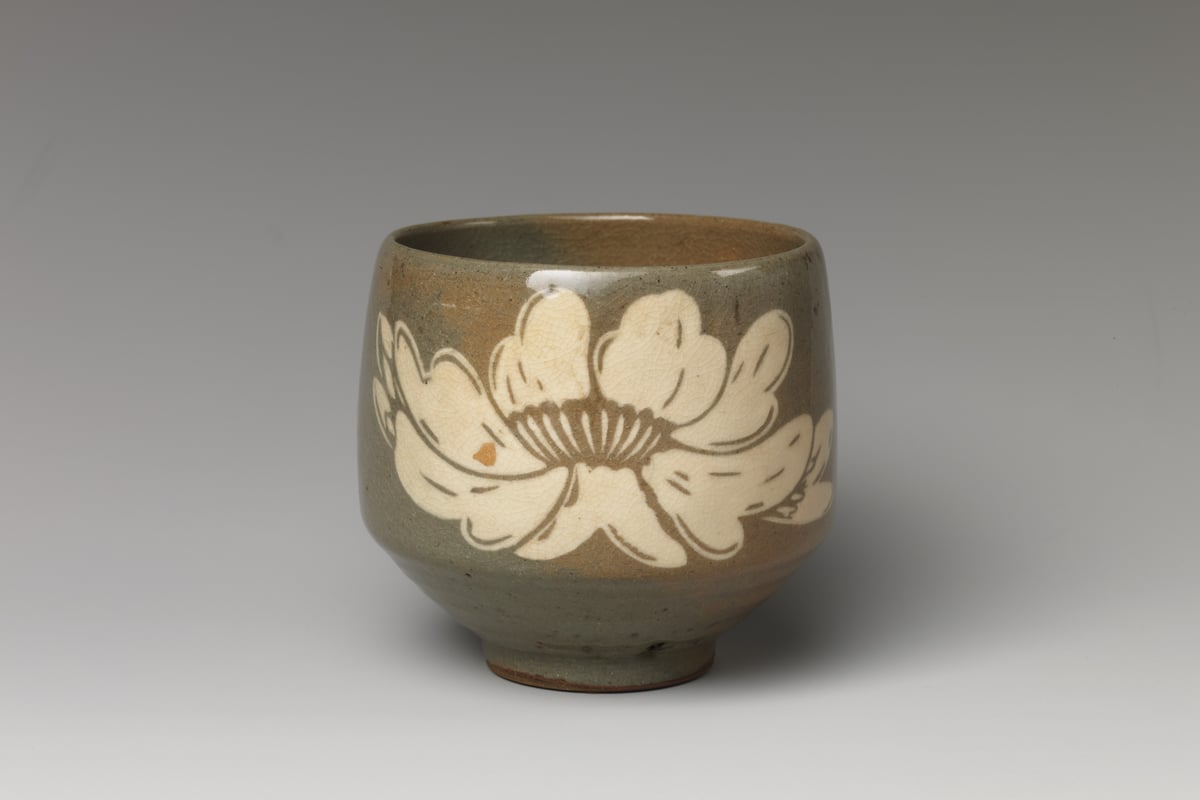
Image: Wikimedia Commons
Koda ware (Koda-yaki) is pottery made in Yatsushiro City and Hikawa Town, Kumamoto Prefecture, and is also called Yatsushiro ware (Yatsushiro-yaki). Its hallmark is the inlay (zogan) technique, in which patterns are carved into the half-dry clay body, filled with white clay, and the excess is shaved away. When it is fired with a clear glaze, the iron in the clay brings out a pale bluish-green color. It is said that Agano Kizo, who moved from Buzen following the Hosokawa clan's transfer of domain in 1632 (Kan'ei 9), built the kiln, and for generations it served as an official kiln of the Hosokawa clan. It is not a nationally designated Traditional Craft but a Kumamoto Prefecture Traditional Craft. Today it is carried on by kilns such as 宗家上野窯, 肥後高田焼伝七窯 and 高田焼竜元窯. The kilns suffered severe damage in the July 2026 Kumamoto earthquake, and moves toward reopening have been reported.
Origin
According to the Kumamoto Prefectural Traditional Crafts Center, in 1632, when the Hosokawa clan was transferred from Buzen to Higo, Agano Kizo moved from Agano in Buzen Province to Koda Village in Yatsushiro District and built a kiln. Exhibition information from the National Art Center, Tokyo states that Kizo, also known as Sonkai, opened the kiln in 1633 (Kan'ei 10), during the period when Hosokawa Tadaoki resided at Yatsushiro Castle. It is linked to Agano ware of Fukuoka Prefecture through the same potter.
History
The kiln is said to have begun at Naragi in Koda and moved to Hirayama in 1658 (Manji 1). Its other name, Hirayama ware, comes from this place name. In the Meiji era it moved to Hinagu, and the name Koda ware spread from works stamped with the seal '高田' (Koda). The present 宗家上野窯 is in its 12th generation. In the July 2026 Kumamoto earthquake, 90 percent of 宗家上野窯's works were reported to have broken, and it is making a fresh start.
Features
Patterns are carved into a clay body that has been burnished (migaki), and white clay is inlaid into them. A distinctive feature is that patterns are expressed with clay rather than painting. When fired with a clear glaze, the iron in the body produces a bluish-green color. The Kumamoto Prefectural Traditional Crafts Center cites its refined coloring and neat, well-proportioned forms as characteristics. It is said that Edo-period literature also praised it as 'elegant and refined' (都雅なるもの). Works are held by the Yatsushiro Municipal Museum (未来の森ミュージアム) and other institutions.
Techniques
Inlay (zogan)
A technique in which patterns are carved into the half-dry clay body, filled with white clay, and the excess is shaved away. Patterns are expressed through the contrast in color between the body and the white clay. It is a different ware from the Takata ware (高田焼, read 'Takata-yaki') of Gifu Prefecture.
Coloring with clear glaze
After the inlay is finished, the body is coated with clear glaze and fired. The iron in the clay body is described as producing a calm ground color ranging from pale green to bluish green. It is a coloring unique to inlay, different from painted decoration.
Materials Used
| Main Production Areas |
|
|---|
Artisans & Workshops
高田焼宗家上野窯
A kiln in Hinagu-higashimachi, Yatsushiro City, carrying on the lineage of Agano Kizo. The 12th generation, 上野浩之, carries on the inlay work. Most of its works broke in the July 2026 earthquake, but it was reported to have held an exhibition in Tokyo in October of the same year.
Official site →肥後高田焼伝七窯
A kiln in Hikawa Town, described as having been opened in the early 1960s. 青木修 and 青木克裕 make pottery there, creating vessels and flower vessels that rework traditional patterns. In the 2026 earthquake, works on display fell and broke.
Official site →高田焼竜元窯
A kiln in Hikawa Town, where the father and son 江上元 and 江上晋 make pottery. Both are full members of the Japan Kogei Association. In June 2026, they held a pottery exhibition at the Kumamoto Prefectural Traditional Crafts Center, showing about 100 pieces including inlaid flower vessels and tableware.
Official site →How to Buy
- Kumamoto Prefectural Traditional Crafts Center '工芸ショップ匠' (Kogei Shop Takumi)
- A museum shop on the first floor of the center at 3-35 Chibajo-machi, Chuo Ward, Kumamoto City, carrying crafts from across the prefecture. The center also holds pottery exhibitions by kilns. Please check the stock of Koda ware in advance.Where to buy →PR
- café & gallery 伝七 (Hikawa Town)
- According to a 2024 broadcast feature, it is a cafe and gallery attached to the 伝七 (Denshichi) Kiln, located at 229 Ima, Hikawa Town. Its business status after the 2026 earthquake could not be confirmed, so please check before visiting.Where to buy →PR
Hands-on Experiences
肥後高田焼伝七窯
熊本県八代郡氷川町今
It is listed on Jalan as a pottery class and pottery experience facility, with plans for hand-building (tebineri) or tatara (forming with slabs of clay). Fees could not be confirmed. Please check with the kiln whether it is accepting participants after the 2026 earthquake.
View details →FAQ
Q. Is Koda ware a nationally designated Traditional Craft?
A. It is not nationally designated. Kumamoto Prefecture's nationally designated crafts are four: Shodai ware, Amakusa ceramics, Higo zogan and Yamaga toro. Koda ware is designated as a Kumamoto Prefecture Traditional Craft, and 上野才助 and others are named in the first round of designations in 1979.
Q. Is it different from Yatsushiro ware or Hirayama ware?
A. These names refer to wares of the same lineage. Hirayama ware comes from the place name where the kiln moved, and Koda ware is said to be a name that spread after the Meiji era. The Takata ware (高田焼, read 'Takata-yaki') of Gifu Prefecture is a different ware, with a different reading and production area.
Q. Can I visit the kilns now?
A. It was reported that several kilns in Yatsushiro City and Hikawa Town suffered severe damage in the July 2026 Kumamoto earthquake. Reopening times differ from kiln to kiln, so be sure to check before visiting or booking an experience.