Image: Wikimedia Commons
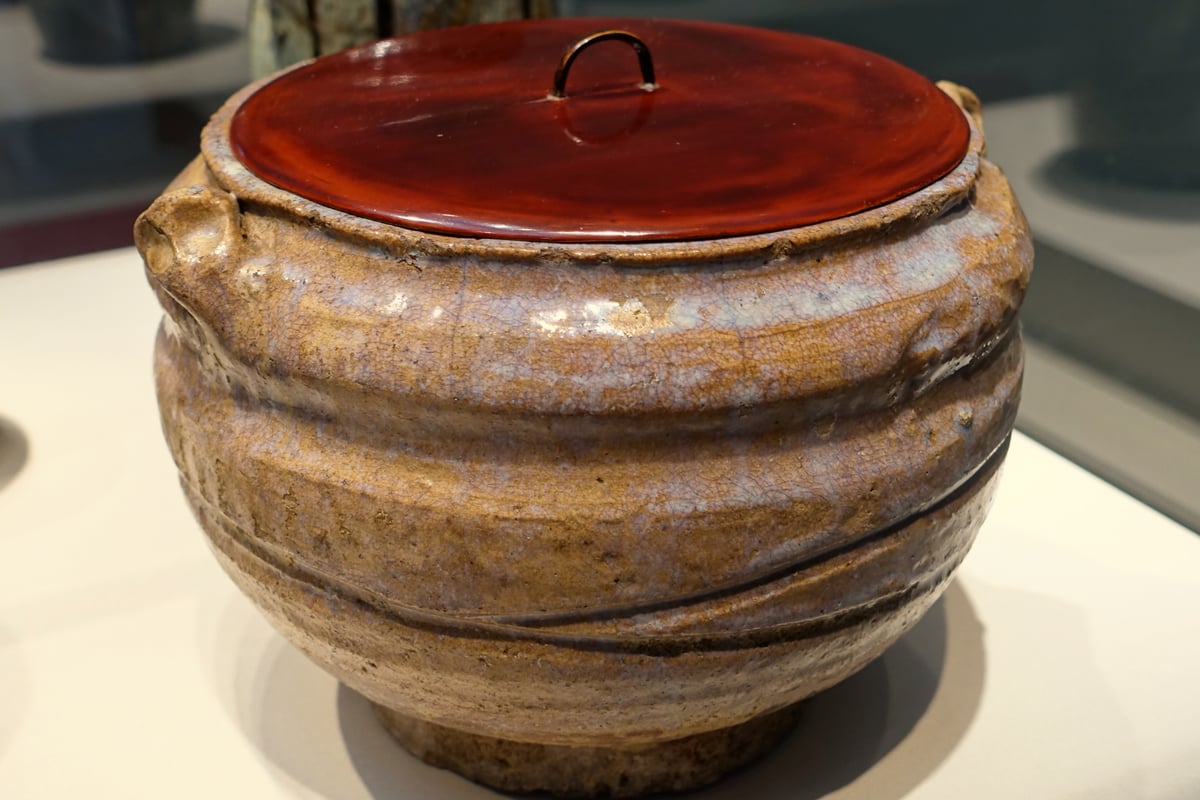
Agano ware is a type of pottery fired across a region centered on Fukuchi Town, Fukuoka Prefecture, and spanning also Kawara Town and Oto Town in Tagawa District, and is a Traditional Craft Designated by the Minister of Economy, Trade and Industry. It is said to have begun in 1602, when Hosokawa Tadaoki, lord of the Buzen Kokura domain, invited the Korean-born potter Sonkai to open a kiln at the foot of Mt. Fukuchi, in the village of Agano. The kiln subsequently developed as an official domain kiln under the patronage of successive lords—first the Hosokawa clan, then the Ogasawara clan—and by the Edo period it was so prized by tea masters that it was counted among the 'Enshu Seven Kilns.' Its defining characteristic is an extremely light, thin-walled construction; the ware is rarely painted, and instead is known for the beauty of its kiln transformations produced by a wide range of glazes, from the deep bluish-green 'ryokusho-nagashi' that streams down over a thin white body to iron, ash, straw-white, and sansai (three-color) glazes. Designated a national Traditional Craft in 1983, around 20 kilns still carry on the tradition today, centered on the Agano district of Fukuchi Town.
Origin
The opening of the Agano kiln is said to date to 1602, when Hosokawa Tadaoki, the first lord of the Buzen Kokura domain, invited the Korean-born potter Sonkai (Agano Kizo) to open a kiln at the foot of Mt. Fukuchi, in the village of Agano. Tadaoki, known as a daimyo well versed in the tea ceremony, is said to have personally guided the potter in making tea wares at Agano. The kiln was subsequently protected through successive changes of lord, and after the Hosokawa clan was transferred elsewhere, the Ogasawara clan continued to patronize it as the domain kiln.
History
During the Edo period, Agano ware developed as the official kiln of successive Kokura domain lords, producing mainly tea utensils, and was so prized by tea masters that it was counted among the 'Enshu Seven Kilns.' It temporarily declined after losing the domain's patronage at the Meiji Restoration, but local kilns worked to preserve the techniques, and the craft was revived in the Showa era. In 1983, it was designated a national Traditional Craft, and today around 20 kilns centered on the Agano district of Fukuchi Town produce a wide range of works, from tea wares to everyday tableware.
Features
The defining feature of Agano ware, compared with other pottery, is that it is extremely light and thin-walled, and tea masters have long loved the lightness and refinement of holding a piece in hand. It uses little decorative painting, instead expressing character through the glazes themselves—including 'ryokusho-nagashi,' in which a deep bluish-green glaze streams down over a white body, as well as iron, ash, straw-white, and sansai glazes (a blend of copper and iron glazes)—offering an unusually varied and beautiful range of kiln transformations.
Materials Used
Production Process
- 1
Preparing the clay
The clay is refined and its plasticity evened out so it can withstand being thrown thin.
- 2
Forming
The clay is thrown on a wheel into the extremely thin body characteristic of Agano ware.
- 3
Bisque firing
The piece is fired once at low temperature to stabilize the body for glazing.
- 4
Glazing
Copper, iron, ash, straw-white, and other glazes are layered and applied in sections, producing color through kiln transformation.
- 5
Main firing
The piece is fired at high temperature, completing the distinctive effects created by the glazes, including the ryokusho-nagashi streaking.
| Main Production Areas |
|
|---|
Artisans & Workshops
宗家渡窯
The head-family kiln, in continuous operation since the opening of the Agano kiln in 1602. The current head, Watari Hitoshi, upholds traditional techniques while also creating vessels suited to contemporary life.
Official site →熊谷本窯
An Agano ware kiln revived after the Meiji Restoration by Kumagai Kyushichi and others. The current head is Kumagai Yasuoki, the 16th-generation potter, who studied at Kanazawa College of Art and later trained under ceramic artist Tsuji Seimei in Tokyo.
Official site →How to Buy
- Agano Ware Ceramics Hall
- A display and sales facility bringing together about 1,200 works from 13 kilns. Visitors can compare and purchase Agano ware in a wide range of colors, from ryokusho-nagashi to iron, ash, and straw-white glazes, all under one roof.Where to buy →PR
Hands-on Experiences
上野焼協同組合 陶芸体験
福岡県田川郡福智町上野(要予約・電話0947-28-5864)
A pottery experience where visitors can choose between an electric wheel and hand-building. The fee is from around ¥3,000 per person (about 800g of clay), and finished pieces are shipped one to two months after firing.