Image: Wikimedia Commons
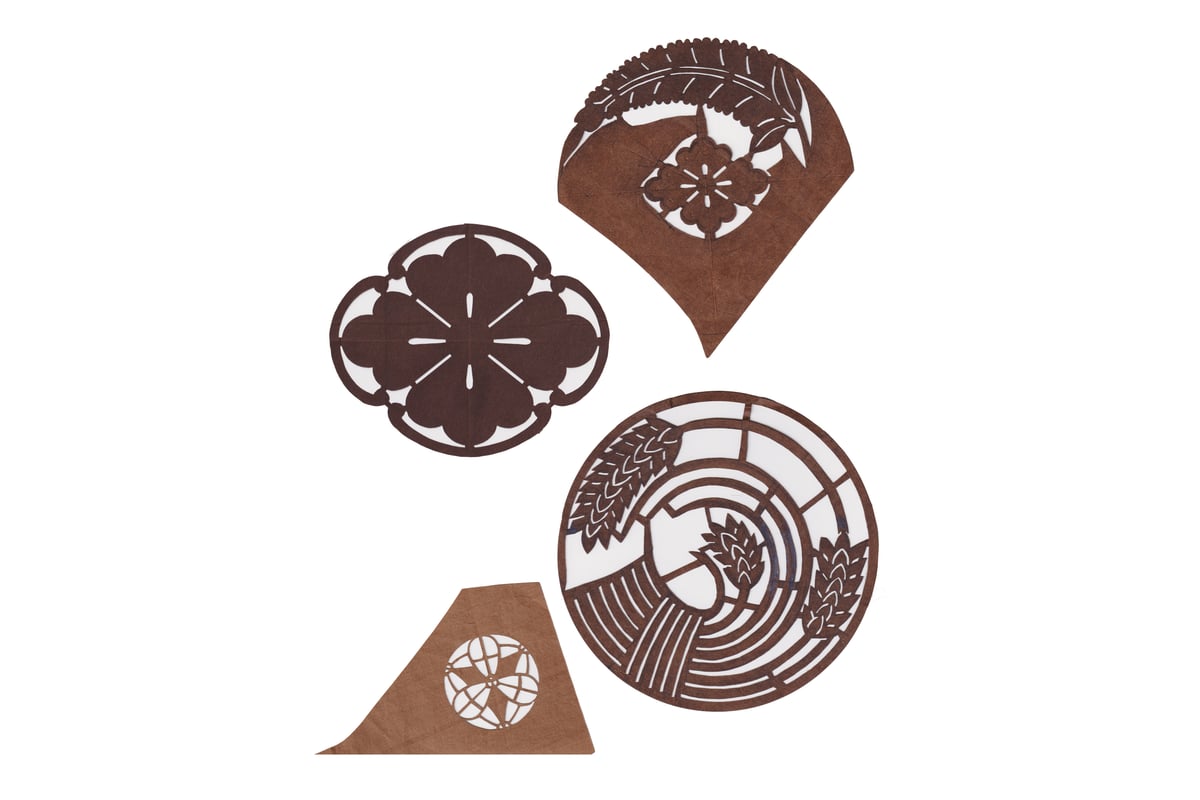
Ise Katagami are stencils used to dye patterns and designs onto kimono fabric, made mainly in the Shiroko, Jike and 江島 districts of Suzuka City, Mie Prefecture. The name is also written '伊勢型紙.' They are made by cutting designs with fine-tipped carving knives into katajigami (stencil base paper), which is Mino washi laminated with kakishibu (persimmon tannin). They are used for dyeing yuzen, komon (fine-patterned kimono), yukata and more, and it is said that almost all komon are dyed with Ise stencils. There are various theories about their origins, but stencils are thought to have been in use by the end of the Muromachi period. In the Edo period, they received the protection of the Kishu Domain, and stencil merchants spread their name by peddling them throughout the country. There are four carving techniques: kiribori, tsukibori, dogubori and shimabori. In 1955 the techniques were designated a national Important Intangible Cultural Property, and in 1983 the stencils were designated a Traditional Craft Designated by the Minister of Economy, Trade and Industry under the name '伊勢形紙.' In recent years, their use in interiors, such as lighting, framed pieces and fittings, has also been spreading.
Origin
There are several legends about the origin of stencils, and it has not been determined. One story says a person named 孫七 began it in the Nara period; another says a monk of 子安観音寺 came up with the idea upon seeing a worm-eaten leaf. It is also said that craftspeople who fled Kyoto during the Onin War passed on the techniques. Because Shiroko originally had neither washi nor stencil dyeing, many theories are said to consider its origins in terms of connections with other regions such as Kyoto and Kishu. Since a dyer using stencils is depicted in shokunin-zukushi-e (職人尽絵: pictures of various trades and their craftspeople), stencils are thought to have existed by the end of the Muromachi period.
History
In Genna 5 (1619), the villages of Shiroko and Jike became part of the domain of Tokugawa Yorinobu, the first lord of the Kishu Domain, and the stencils received the domain's protection. Stencil merchants obtained privileges such as the oefu (御絵符) and peddled their wares throughout the country, and in Horeki 3 (1753), 138 of them were officially recognized as a merchant guild (kabunakama). The komon used for samurai kamishimo gradually became finer, and the carving techniques were refined as well. The guild was dissolved in the Meiji period, but improvements continued, such as the invention of 室枯らし, a method of smoking the katajigami. After the war, production reached its peak in the Showa 40s.
Features
Ise Katagami are stencils for applying resist paste to fabric. The paste goes onto the cut-out areas, and when dyeing is finished, those areas remain white as the pattern. Katajigami is made by laminating three sheets of Mino washi with kakishibu so that the paper grain runs vertical, horizontal, vertical. After being dried in the sun and smoked in a smoking chamber (muro) for about a week, the paper is soaked in kakishibu again to finish it. This makes a strong paper that resists stretching and shrinking, and it is said to take about 45 days to complete.
Techniques
Kiribori (awl carving)
A technique of holding an awl with a semicircular tip upright against the katajigami and rotating it to carve small holes. It is used for komon such as 鮫 (sharkskin), 行儀, 通し and arare (hailstones), and some stencils have about 100 holes carved within a 1 cm square.
Tsukibori (thrust carving)
Five to eight sheets of katajigami are stacked on a board with a hole, and a small knife with a 1-2 mm blade is thrust vertically as the carving advances forward. A slight wavering arises in the lines, which is said to give the patterns a distinctive warmth.
Dogubori (tool carving)
A technique of cutting out patterns with carving knives made in the shapes of flowers, fans, diamonds and so on. The work begins with making the blades, and the quality of the tools determines the result. Its strength is the ability to express uniform patterns, and it is widely used for Edo komon.
Shimabori (stripe carving)
A technique of carving uniform stripes by pulling a small knife toward oneself along a ruler; it is also called 引彫. Each stripe is traced three times in the same place, and as many as 11 stripes may be carved within a width of 1 cm.
Thread insertion and gauze backing
Techniques for reinforcing stencils that tear easily, such as stripe patterns. In the past, thread insertion, in which threads were sandwiched between two stencils, was used. In 1921, gauze backing, in which silk gauze (紗: a coarsely woven silk fabric) is stretched over the stencil, was devised and spread in place of thread insertion.
Materials Used
Production Process
- 1
Hozukuri (cutting the paper)
About 200 to 500 sheets of Mino washi are stacked and cut to the standard dimensions of stencils.
- 2
Laminating
Three sheets of washi are laminated with kakishibu so that the paper grain runs vertical, horizontal, vertical.
- 3
Drying and smoking
On a sunny day, the paper is stretched out and dried in the sun, then placed in a smoking chamber and smoked for about a week. It is soaked in kakishibu again and the drying and smoking are repeated; after inspection, the katajigami is complete.
- 4
Carving
Following the design, the pattern is cut out using kiribori, tsukibori, dogubori and shimabori as appropriate.
- 5
Reinforcement
As needed, gauze backing or thread insertion is applied to reinforce the stencil.
| Main Production Areas |
|
|---|
Artisans & Workshops
大杉型紙工業(伊勢型紙おおすぎ)
A stencil business in Shiroko, Suzuka City. It handles everything from making the base paper to design, carving and coloring, and creates interior items and gifts that make use of Ise Katagami techniques. It also accepts custom orders for commemorative items and for fittings such as fusuma sliding doors.
Official site →オコシ型紙商店
A stencil dealer in 江島本町, Suzuka City. Its strength is said to be its stock of already-carved Ise Katagami, accumulated over about 100 years since its founding. It also sells designs for kimono, takes custom carving orders and makes goods featuring stencil patterns.
Official site →島栄型紙
A maker in Jike, Suzuka City, producing katajigami from washi laminated with kakishibu. Katajigami is the paper that serves as the base for carving, and it must be strong and resistant to stretching and shrinking.
How to Buy
- 鈴鹿市伝統産業会館 Gallery
- It carries everything from small items such as bookmarks and mini dyeing stencils to postcard- and shikishi-sized pieces and full-scale large framed dyeing stencils. Framed stencils carved by certified traditional craftspeople and kits for LED stencil lanterns are also available.Where to buy →PR
- 伊勢形紙協同組合 Online Shop
- The cooperative sells kits online for enjoying carving and dyeing at home, such as pouch dyeing, LED stencil lanterns and mini shikishi boards. It has also released videos explaining how to make them.Where to buy →PR
Hands-on Experiences
鈴鹿市伝統産業会館
三重県鈴鹿市寺家3-10-1
Carving experiences cost 200 yen for a bookmark (15-30 minutes), 300 yen for a postcard, 450 yen for a mini shikishi and 850 yen for a shikishi. Groups of fewer than 10 people do not need a reservation; reception is closed from 12:00 to 13:00. Dyeing experiences, such as a handkerchief from about 1,500 yen, require a reservation. Ise Katagami demonstrations are held every Sunday.
View details →伊勢型紙資料館
三重県鈴鹿市白子本町21-30
Opened in 1997 (Heisei 9) in the restored late-Edo-period residence of the 寺尾斎兵衛 family, one of the leading stencil wholesalers in Shiroko. It houses and displays stencil-related materials. Admission is free; open 10:00-16:00, closed on Mondays, Tuesdays and the third Wednesday of the month. A 5-minute walk from Shiroko Station on the Kintetsu Line.
FAQ
Q. Which is the correct spelling, '伊勢形紙' or '伊勢型紙'?
A. Both are used, and both are read 'Ise Katagami.' Historically the character 形 was used, and after the war usage was gradually unified to 型. Because the Important Intangible Cultural Property was designated in 1955 under the name '伊勢型紙' and the Traditional Craft was designated in 1983 under the name '伊勢形紙,' both are still used today. Within the industry, there is a movement to standardize on the character 型.
Q. How are stencils used in dyeing?
A. The stencil is placed on the fabric, and resist paste is applied through the cut-out areas. When the paste is removed after dyeing, those areas remain white and form the pattern. For komon, the stencil is shifted along and repeated about 60 times to dye one tan (about 13 m) of fabric, so it is important to carve the joins accurately.