Image: Wikimedia Commons
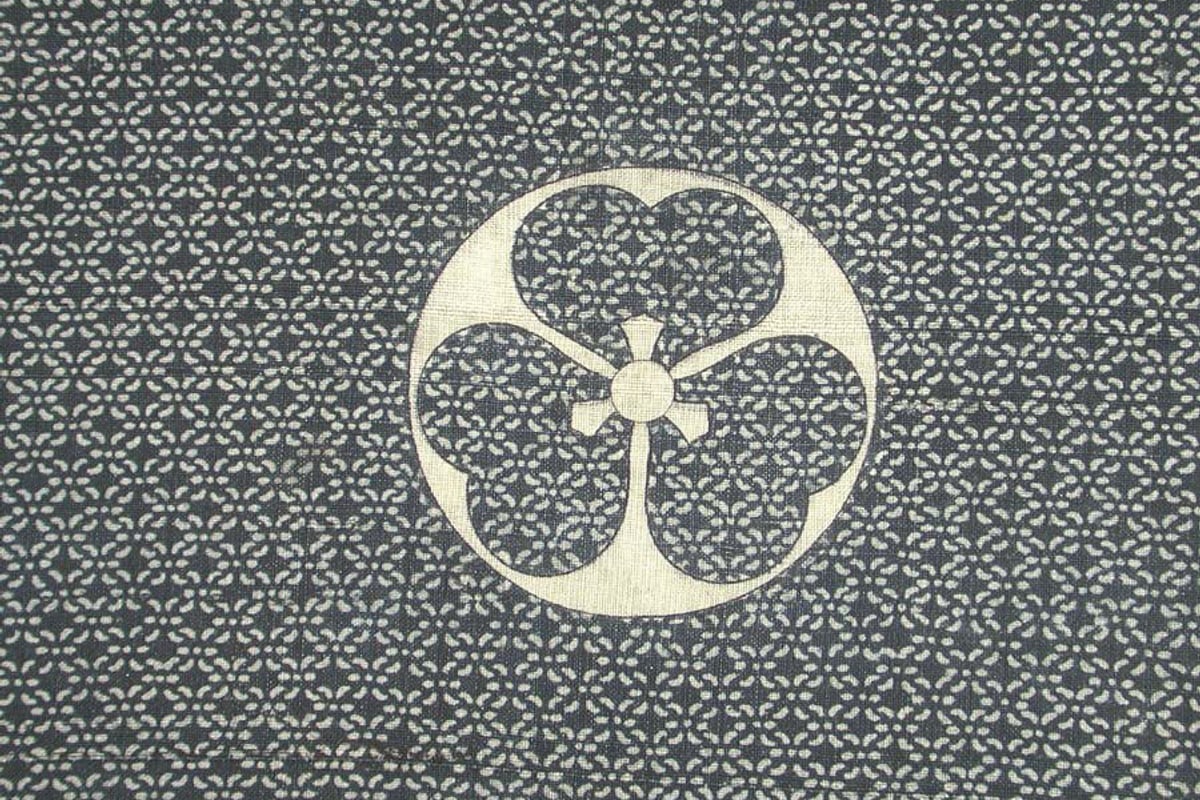
Tokyo Some Komon is a stencil-dyeing technique born in Edo that uses finely carved Ise katagami (stencil paper) to dye minute patterns onto fabric with a single-color rice-paste dye. The development of komon (fine-patterned dyeing) itself is said to date back to the Muromachi period, but the technique flourished in the early Edo period, when the various daimyo houses began dyeing fine, house-specific patterns onto the kamishimo (formal attire) worn at their Edo residences. Because daimyo from across the country gathered in Edo, demand for komon grew rapidly, and the patterns once reserved for samurai kamishimo eventually spread among the common people, blossoming as a dyeing tradition beloved in townsman culture from the mid-Edo period onward. The three representative patterns -- same (shark skin), gyogi (proper conduct), and kaku-doshi (square lattice) -- are considered especially prestigious and are known as the 'Edo Komon Sanyaku' (three most prestigious Edo Komon patterns). The patterns are made up of extremely small dots and lines, roughly 0.5 to 1mm in size, and their defining feature is an intricacy so fine that the goku-same (ultra-fine shark-skin) pattern can contain a thousand dots within a 3-centimeter square, each placed without the slightest deviation. Appearing plain from a distance but revealing delicate patterns up close, it embodies the aesthetic of Edo 'iki' (chic refinement) and has long been cherished as an adornment for women's kimono; it was designated a Traditional Craft Designated by the Minister of Economy, Trade and Industry in 1976 (Showa 51).
Origin
The development of komon is said to date back to the Muromachi period, but the direct roots of Tokyo Some Komon lie in the early Edo period. Edo was home to the Edo residences of daimyo houses from across the country, and dyeing fine patterns onto the kamishimo worn as samurai formal attire became widespread. As each daimyo house adopted its own specific pattern, demand for finely detailed stencil dyeing grew rapidly.
History
By the mid-Edo period, komon, once a pattern reserved for samurai kamishimo, spread among the common people alongside the growth of townsman culture and became cherished as everyday attire. From the Meiji era onward, it also became established as a pattern for women's kimono, coming to be regarded as 'the flower of women's kimono.' In June 1976 (Showa 51), it was designated a Traditional Craft Designated by the Minister of Economy, Trade and Industry under the name 'Tokyo Some Komon,' by the then Minister of International Trade and Industry (now the Minister of Economy, Trade and Industry), and it continues to be passed down by artisans today, mainly in Shinjuku, Setagaya, and Nerima wards.
Features
The defining feature of Tokyo Some Komon is the intricacy of its patterns, made up of extremely small dots and fine lines roughly 0.5 to 1mm in size. In the representative goku-same (ultra-fine shark-skin) pattern, as many as a thousand dots are dyed within a mere 3-centimeter square without blurring. Among the patterns, same, gyogi, and kaku-doshi are considered especially prestigious and are known as the 'Edo Komon Sanyaku.' Though dyed in a single color, the fabric looks plain from a distance and reveals its intricate pattern only up close -- a dyeing tradition that embodies the Edo aesthetic of 'iki.'
Techniques
Stencil carving (Ise katagami)
Washi paper laminated with persimmon tannin is used as the base, and patterns are carved into it using techniques such as kiribori (punch carving), tsukibori (thrust carving), hikibori (pull carving), and dogubori (tool carving). Several sheets are carved together to produce a durable, finely detailed stencil.
Stencil printing (katatsuke)
White fabric is stretched over a dyeing board about 7 meters long, and the stencil is aligned and moved along the fabric while a spatula spreads rice-paste dye over it. The paste adheres only where the stencil has been cut through, and that area becomes the dyed pattern.
Shigoki-zome and hikizome (ground dyeing)
In this ground-dyeing process, two methods are used: shigoki-zome, in which paste dye is spread evenly across the whole fabric by hand, and hikizome, in which the fabric is dyed by drawing a brush across it.
Materials Used
Production Process
- 1
Stencil carving
Artisans in Ise carve patterns into persimmon-tannin washi paper, preparing the stencils used for Tokyo Some Komon.
- 2
Stencil printing
The stencil is placed on white fabric stretched over a dyeing board, and a spatula spreads rice-paste dye across it, transferring the pattern.
- 3
Ground dyeing
The whole fabric is dyed evenly to its ground color using either shigoki-zome or hikizome.
- 4
Steaming and washing (mizumoto)
The dyed fabric is steamed to fix the color, then washed (mizumoto) to rinse away excess paste and dye.
- 5
Finishing
The fabric is dried, its width adjusted, and it is inspected before being finished as a single bolt of cloth.
| Main Production Areas |
|
|---|
Artisans & Workshops
富田染工芸
Founded in 1914 (Taisho 3), this dye house has a workshop along the Kanda River in Nishi-Waseda, Shinjuku Ward. It carries on the techniques of Tokyo Some Komon and Edo Sarasa (patterned cotton dyeing), and part of its workshop is open to the public as the 'Tokyo Some Monogatari Museum.'
Official site →江戸小紋染工房 小林染芸
An Edo Komon dye workshop in Takashimadaira, Itabashi Ward. Artisan Yoshikazu Kobayashi handles all the hand-dyeing work himself and also regularly holds Edo Komon experience sessions for beginners.
Official site →How to Buy
- 東京染ものがたり博物館(富田染工芸)
- A museum attached to the workshop in Nishi-Waseda, Shinjuku Ward. In addition to exhibits introducing the techniques of Edo Komon and Edo Sarasa, visitors can purchase small dyed items such as scarves. Admission is free.Where to buy →PR
Hands-on Experiences
東京染ものがたり博物館(富田染工芸)
東京都新宿区西早稲田3-6-14
About a 2-minute walk from Omokagebashi Station on the Toden Arakawa Line. Offers dyeing experiences and workshop tours by reservation; the third-Saturday workshop session costs around 2,000 yen and lets visitors dye a handkerchief or scarf.
View details →江戸小紋染工房 小林染芸
東京都板橋区高島平7-40-5
A beginner Edo Komon experience session is held twice a year for around 5,500 yen. Using a mixed-pattern Ise katagami stencil, participants can experience the full dyeing process over about 3 hours (maximum 6 participants).
View details →FAQ
Q. What is the 'Edo Komon Sanyaku'?
A. It refers to the three patterns considered especially prestigious among Tokyo Some Komon designs: same, gyogi, and kaku-doshi. Same is made of overlapping fan-shaped dots, gyogi consists of dots arranged neatly at a 45-degree diagonal, and kaku-doshi consists of dots arranged in a regular vertical and horizontal grid.
Q. Are Tokyo Some Komon and Edo Komon the same thing?
A. The names are used almost interchangeably. The official name for the Tokyo Metropolitan traditional craft is 'Tokyo Some Komon,' but because of its historical background rooted in samurai kamishimo patterns, the name 'Edo Komon' is also widely established.