Image: Wikimedia Commons
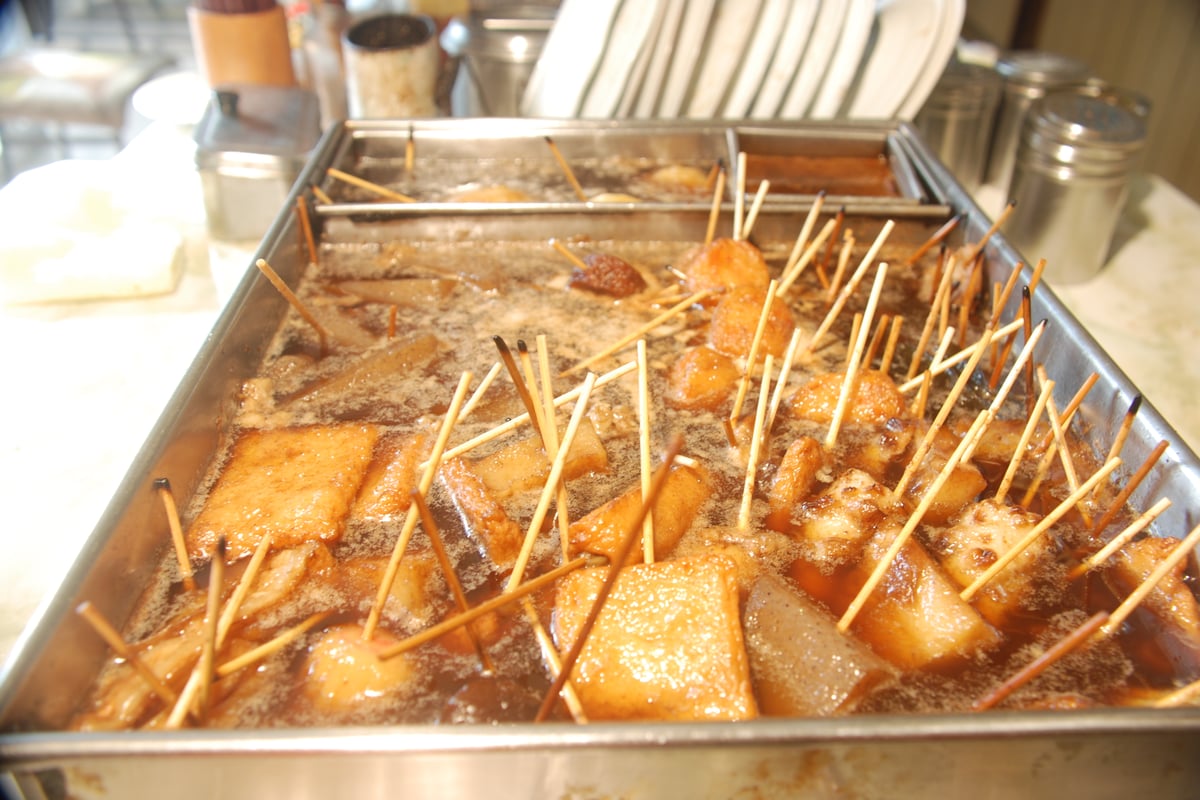
Shizuoka oden is a local dish of Shizuoka City in which skewered ingredients are simmered in a dark broth made from beef tendon and other ingredients. Ingredients include kuro hanpen, beef tendon, daikon radish, konnyaku, and eggs. A distinctive feature is the generous sprinkling of dashi-ko (powdered fish flakes), made by grinding dried fish shavings into powder, and aonori (green laver) just before eating. Because the broth uses dark soy sauce and is simmered while being topped up over and over, it takes on a blackish color. It is said to have begun in the Taisho period, and after the war it grew in popularity when beef tendon and pork offal, which had been discarded, began to be used as ingredients. A very Shizuoka touch is that oden can be bought one skewer at a time not only at specialty shops and izakaya but also at delis and at dagashiya (old-fashioned penny-candy shops). Children have grown up eating oden at dagashiya as an afternoon snack. After the war, a large number of oden stalls lined the streets near Shizuoka City Hall. Their successors, Aoba Oden-gai and Aoba Yokocho, are still lined with oden shops today.
Origin
Shizuoka oden is said to have begun in the Taisho period. A distinctive feature is that it was sold at dagashiya from the start, and it was also a snack that children could buy one skewer at a time. Fish-paste products (nerimono) such as kuro hanpen, made from fish landed in Suruga Bay, have also been used as oden ingredients. During the food shortages after World War II, it is said that simmering beef tendon and pork offal, which had been discarded, increased the savory flavor and made the dish popular.
History
After the war, as many as 200 oden stalls are said to have lined the area around Aoba-dori near Shizuoka City Hall. Snacking on oden at a stall on the way home from work is said to have been a small pleasure for the city's residents. Later, urban development made it impossible to continue operating as stalls. Some of the stalls moved to nearby alleys, becoming today's Aoba Oden-gai and Aoba Yokocho. Small shops that keep the atmosphere of the Showa era line these alleys, which are still busy with locals and tourists.
Features
As a rule, all ingredients are put on skewers and simmered. Because dark soy sauce is added to a broth made from beef tendon and the broth is topped up and reused, it turns blackish. Kuro hanpen is an essential ingredient of Shizuoka oden, and beef tendon, daikon radish, konnyaku, eggs, and shinoda-maki (rolls of deep-fried tofu pouch) are also standard. Once served in a bowl, the oden is sprinkled with dashi-ko and aonori and eaten with mustard on the side if desired.
Main Ingredients
Food Culture
In Shizuoka City, skewered oden can be bought one skewer at a time even at dagashiya and delis. Many people have eaten it at dagashiya as a snack since childhood, and some shops serve oden together with shaved ice in summer. It is a familiar taste that is also made at home.
How It Differs from Home Cooking
At home, prepared beef tendon is added together with its cooking liquid, and the oden is simmered for about two to three hours with sugar, mirin, soy sauce, and other seasonings. Many specialty shops use a broth that has been topped up for many years, and some still keep recipes from their days as stalls. The types of ingredients and the flavor of the broth differ from shop to shop, so comparing them is also part of the fun.
Famous Shops
三河屋
静岡県静岡市葵区常磐町1-8-7 青葉横丁内
A shop in Aoba Yokocho said to have started as a stall in 1948 (Showa 23). It keeps the same recipe as in its stall days, topping up and using a broth made only from beef tendon and dark soy sauce. Beef tendon and shinoda-maki are popular, and kuro hanpen costs about 120 yen per skewer.
名代 静岡おでん おがわ
静岡県静岡市葵区馬場町38
A shop on Sengen-dori, the approach to Shizuoka Sengen Shrine, said to have a history of more than 70 years. It retains the atmosphere of a dagashiya, and customers choose skewers one by one and eat them sprinkled with dashi-ko and aonori. Ingredients include fish-paste products from Yaizu, and kuro hanpen costs about 90 yen per skewer.
FAQ
Q. Why is the broth of Shizuoka oden black?
A. It is said that the color becomes dark because dark soy sauce is used and the broth is simmered while being topped up every day. Simmering beef tendon to draw out savory flavor is also said to be one reason for the blackish color. Some shops have kept topping up and using the same broth since their days as stalls.
Q. What is 'dashi-ko'?
A. It is made by grinding shavings of dried fish such as sardine and mackerel into powder. With Shizuoka oden, the standard way to eat it is to sprinkle plenty of dashi-ko and aonori over the oden in your bowl. The aroma and savory flavor of fish are added, giving a taste different from the beef tendon broth.
Q. Are there conditions for being called 'Shizuoka oden'?
A. Locally, 'five articles' are introduced as the characteristics of Shizuoka oden. They are: the broth is black, the ingredients are skewered, kuro hanpen is included, dashi-ko and aonori are sprinkled on top, and it is also sold at dagashiya. Ingredients and broth differ by shop, but these are regarded as a guide to what makes oden Shizuoka-style.