Image: Wikimedia Commons
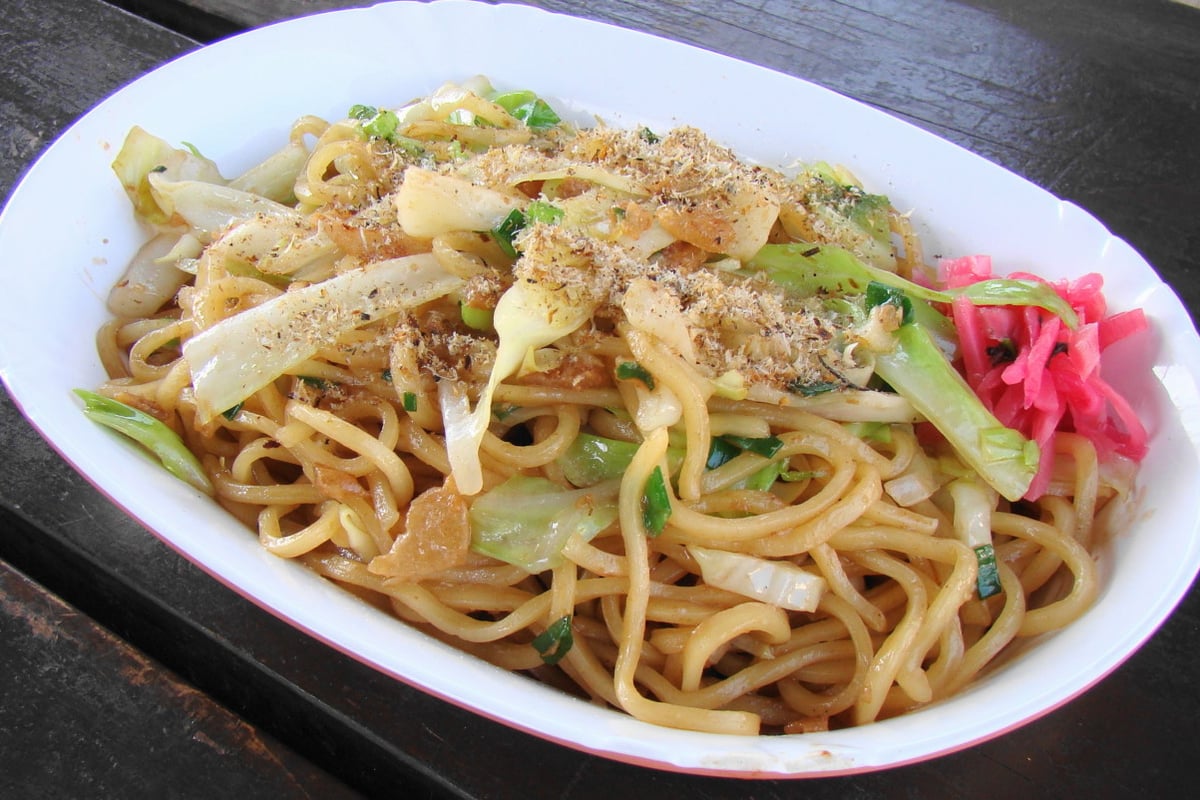
Fujinomiya Yakisoba is a local style of yakisoba enjoyed in Fujinomiya City, Shizuoka Prefecture. It uses firm, chewy steamed noodles made by designated noodle makers in the city, with 'nikukasu' (pork cracklings left after rendering lard) added as an ingredient. A distinctive finishing touch is a sprinkle of shaved sardine or mackerel flakes (dashi-ko). The unique steamed noodles are said to have been born during the postwar food shortage, in the course of efforts to recreate the rice noodles (bifun) eaten on the battlefield. In 2000 (Heisei 12), volunteer citizens launched the Fujinomiya Yakisoba Society and began revitalizing the town through yakisoba. Its unique, pun-filled promotional activities made it known nationwide, and it won the grand prize at the B-1 Grand Prix two years in a row, in 2006 and 2007. Fujinomiya is the shrine town of Fujisan Hongu Sengen Taisha, and the city is said to have around 150 establishments serving yakisoba. It is an everyday taste for local residents and, at the same time, a dish that tourists come specifically to try.
Origin
The steamed noodles used for Fujinomiya Yakisoba were born during the postwar food shortage. They are said to have been created by 望月晟敏, the founder of マルモ食品工業, while trying to recreate the rice noodles (bifun) eaten on the battlefield. It is also thought that the noodles were devised so as not to spoil easily, in an era when refrigeration technology was scarce. Fujinomiya Yakisoba is said to have started when okonomiyaki restaurants and other eateries in the city began frying these noodles on teppan griddles and serving them.
History
Prompted by a Junior Chamber workshop in 1999 (Heisei 11), the Fujinomiya Yakisoba Society was established by volunteer citizens in 2000. Members known as 'Yakisoba G-men' researched yakisoba shops in the city and made maps, promoting Fujinomiya as a yakisoba town. Their pun-filled messaging, such as the 'Three-Country Noodle Alliance' (Sangoku Domen Kyotei) concluded with Yokote City in Akita Prefecture and Ota City in Gunma Prefecture, also attracted attention. Fujinomiya Yakisoba won the grand prize at both the first B-1 Grand Prix in 2006 and the second event in 2007. The second event, held in Fujinomiya City itself, is said to have drawn about 250,000 visitors.
Features
The noodles are steamed noodles made by designated noodle makers in the city. Ordinary yakisoba noodles are boiled once after steaming, but these noodles are rapidly cooled without boiling and coated with oil on the surface. As a result, they contain little moisture and have a distinctively firm, chewy texture. The basic ingredients are nikukasu and cabbage; after stir-frying with sauce, the dish is finished with a sprinkle of shaved sardine or mackerel flakes. It is eaten with red pickled ginger (beni shoga) on the side, according to preference.
Main Ingredients
Food Culture
In Fujinomiya, yakisoba has long been enjoyed as a casual local taste at teppanyaki and okonomiyaki restaurants. Tourists increased as a result of the town revitalization efforts, and yakisoba shops have also opened in Omiya Yokocho, located at the entrance to the approach of Fujisan Hongu Sengen Taisha.
How It Differs from Home Cooking
At home, yakisoba is often made with ordinary yakisoba noodles, but Fujinomiya Yakisoba is basically made with steamed noodles from designated noodle makers, nikukasu, and dashi-ko. Specialty shops cook it on large teppan griddles, and each shop has its own touches in the sauce blend and spiciness. Souvenir shops and mail-order services also sell home-use sets that include the noodles, nikukasu, and dashi-ko.
Famous Shops
富士宮やきそばアンテナショップ
静岡県富士宮市宮町4-23 お宮横丁内
A shop run directly by the Fujinomiya Yakisoba Society, located in Omiya Yokocho at the entrance to the approach of Fujisan Hongu Sengen Taisha. In addition to the classic basic flavor, it also offers menu items with a choice of spiciness. Yakisoba starts from about 600 yen for a regular serving, making it easy to try the authentic local taste.
富士宮やきそば専門店 すぎ本
静岡県富士宮市宮町4-23 お宮横丁内
Considered one of the long-established yakisoba shops with the oldest history in Fujinomiya, it has its shop in Omiya Yokocho. Its original blended sauce defines its flavor. In addition to yakisoba, teppan dishes such as okonomiyaki are also available.
うるおいてい
静岡県富士宮市淀師415-2
A popular Fujinomiya Yakisoba restaurant known for its constant lines. Watching the food being cooked on the teppan griddle right in front of you is part of the appeal, and its seasoning, which blends several sauces, is well regarded. Its crispy negiyaki (green onion pancake) and yakisoba wrapped in egg are also popular.
お好み食堂 伊東
静岡県富士宮市淀師468-2
An okonomiyaki and yakisoba restaurant long loved by locals. Its most popular dish is the gomoku yakisoba (yakisoba with mixed ingredients), packed with shredded cabbage, and a regular serving costs about 800 yen. The sauce has a light, gentle flavor, and the restaurant is also known for appearing in the anime 'Laid-Back Camp' (Yuru Camp△).
| マルモ食品工業 'Fujinomiya Yakisoba' | A home-use set from マルモ食品工業, the noodle maker in the city said to have created the steamed noodles for Fujinomiya Yakisoba. It includes steamed noodles, sauce, nikukasu, and dashi-ko, so you can easily recreate the authentic taste at home. Besides its online shop, it is also sold at places such as expressway service areas. |
|---|
FAQ
Q. What is the 'nikukasu' in Fujinomiya Yakisoba?
A. It is the residue left after rendering lard (pork fat), and it is locally called nikukasu. When stir-fried, it releases umami and a distinctive richness, blending well with the firm, chewy steamed noodles. The Fujinomiya Yakisoba Society names the designated steamed noodles, nikukasu, and dashi-ko as the three main characteristics of Fujinomiya Yakisoba.