Image: Wikimedia Commons
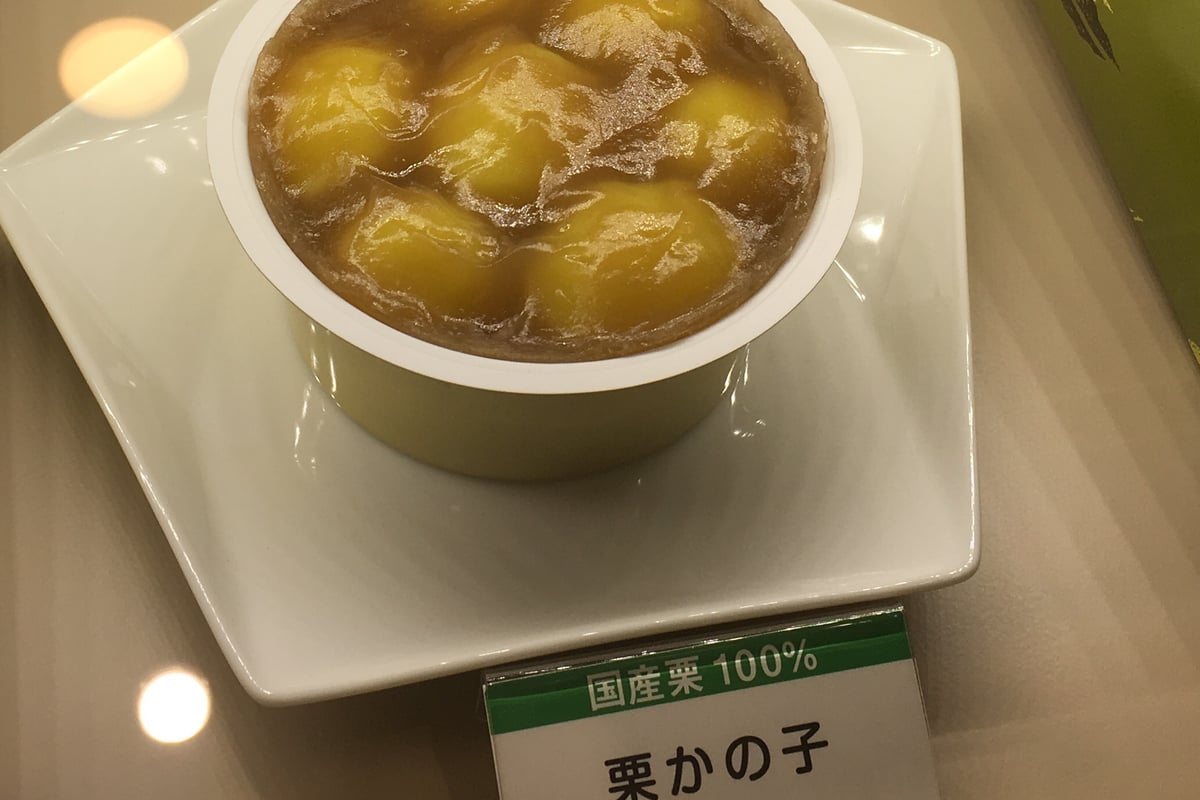
Obuse Chestnut Confections is the collective term for wagashi (Japanese confections) made with local chestnuts in Obuse Town, Kamitakai District, in northern Nagano Prefecture. Chestnut cultivation in Obuse is said to date back to the Muromachi period, and the acidic soil of the well-drained alluvial fan suited the growth of chestnuts. In the Edo period, high-quality chestnuts were made 'kenjo-guri' (chestnuts presented as tribute) to the shogun's family, and the name 'Obuse-guri' (Obuse chestnuts) spread. Chestnut confections began in 1808 (Bunka 5), when 桜井幾右衛門, the founder of Sakurai Kanseido, is said to have been the first to make 'kuri rakugan' (pressed chestnut sweets). Later, kuri yokan (chestnut yokan) and kuri kanoko (chestnut paste studded with candied chestnuts) were created, and in the Meiji period canning technology made them available all year round. Even today, long-established chestnut confectioners line the center of town, and you can also enjoy new chestnut flavors such as kuri okowa (chestnut sticky rice) and Mont Blanc. In the season of new chestnuts in autumn, the town bustles with many tourists.
Origin
Chestnut cultivation in Obuse is said to have begun in the Muromachi period. It is said to have originated when a person named 荻野常倫 brought in chestnuts from Tanba Province (present-day parts of Kyoto Prefecture and Hyogo Prefecture) and planted them. Obuse is a well-drained alluvial fan, and because the soil is acidic it was unsuitable for many crops, but it was well suited to growing chestnuts. In the Edo period their reputation grew, and carefully selected chestnuts were made 'kenjo-guri,' presented as tribute to the shogun's family.
History
The history of chestnut confections is said to have begun in 1808 (Bunka 5), when 桜井幾右衛門, the founder of Sakurai Kanseido, made kuri rakugan. In 1819 (Bunsei 2), kuri yokan made only with chestnuts was created. In 1892 (Meiji 25), kuri kanoko, chestnut paste with candied chestnuts added, was made. In the Meiji period canning technology was introduced, making it possible to sell chestnut confections all year round.
Features
Kuri rakugan is a higashi (dry confection) made by grinding chestnuts into powder, packing it into wooden molds, and pressing it firm. Kuri yokan is made with chestnuts, sugar, and kanten (agar), and the flavor of chestnut comes through strongly. Kuri kanoko consists of chestnut paste with pieces of candied chestnut inside, and some long-established shops prepare the chestnut paste with only chestnuts and sugar. A feature of every confection is that it brings out the flavor of the chestnuts themselves.
Main Ingredients
Food Culture
In Obuse, long-established shops dating back to the Edo and Meiji periods are concentrated in the center of town, and chestnut confections have become established as the town's specialty. Many shops have a sweets cafe or restaurant attached, where you can also enjoy kuri okowa, chestnut paste shiruko (sweet soup), and seasonal chestnut snacks. Every autumn, in the season of new chestnuts, many people visit in search of limited-edition confections.
How It Differs from Home Cooking
A distinctive feature of Obuse's long-established shops is that they prepare in-house the chestnut paste that is the heart of their chestnut confections. Each has its own policy, such as shops that knead their chestnut paste with only chestnuts and sugar, or shops committed to in-house preparation using 100% domestic chestnuts. Because the chestnut flavor and sweetness differ from shop to shop, comparing them is also enjoyable.
Famous Shops
桜井甘精堂 本店
長野県上高井郡小布施町小布施774
A long-established shop said to have been the first in Obuse to make chestnut confections, having created kuri rakugan in 1808. It sells traditional chestnut confections such as kuri rakugan, kuri yokan, and kuri kanoko, and its Jun Kuri Kanoko costs about 1,620 yen per can. It also has a directly run restaurant and sweets cafe nearby.
View details →竹風堂 小布施本店
長野県上高井郡小布施町小布施973
A chestnut confectioner founded in 1893 (Meiji 26), committed to in-house preparation using 100% domestic chestnuts. In its attached dining space, you can enjoy the '栗おこわ山家定食' (a chestnut sticky rice set meal), a staple since 1972 (Showa 47), for about 2,310 yen. Its chestnut paste shiruko and 'どら焼山,' a dorayaki filled with chestnut paste, are also popular.
View details →小布施堂 本店
長野県上高井郡小布施町小布施808
A long-established shop whose predecessor was the Masuichi-Ichimura Sake Brewery, founded in 1755 (Horeki 5), and which began making chestnut confections in the Meiji period. Its Kuri Kanoko (栗鹿ノ子), made with chestnut paste prepared with only chestnuts and sugar, costs about 1,728 yen for the small size. It also has a Japanese cuisine restaurant attached.
View details →| Kuri Kanoko (小布施堂) | Obusedo's signature chestnut confection, made by adding whole chestnut pieces to chestnut paste kneaded with only chestnuts and sugar. Packed in a can, it keeps well and is also chosen as a gift. The small size costs about 1,728 yen and can be purchased at Obusedo's main store and elsewhere. |
|---|---|
| Jun Kuri Kanoko (桜井甘精堂) | The kuri kanoko of Sakurai Kanseido, said to have been the first to make chestnut confections in Obuse. It comes in a can and costs about 1,620 yen per can. In addition to its main store in Obuse Town, Sakurai Kanseido also has shops in places such as the station building at Nagano Station. |
FAQ
Q. Since when have Obuse's chestnut confections been made?
A. They are said to have begun in 1808 (Bunka 5), when 桜井幾右衛門, the founder of Sakurai Kanseido, made kuri rakugan. Later, kuri yokan was created in 1819 and kuri kanoko in 1892. They are confections with a history of more than 200 years.
Q. What kind of confection is kuri rakugan?
A. It is a higashi (dry confection) made by grinding chestnuts into powder, packing it into wooden molds, and pressing it firm. It was devised in 1808 by the founder of Sakurai Kanseido and is said to be the first confection made with Obuse chestnuts. It is a confection with a distinguished history, the starting point of the history of Obuse's chestnut confections.
Q. How is it different from the Kuri Kinton of Gifu Prefecture?
A. The Kuri Kinton of places such as Nakatsugawa City in Gifu Prefecture is a confection made by straining steamed chestnuts, mixing them with sugar, and shaping them by twisting in a chakin (cloth). Obuse's chestnut confections come in many varieties, such as kuri rakugan, kuri yokan, and canned kuri kanoko, and a feature is that many of them keep well.