Image: Wikimedia Commons
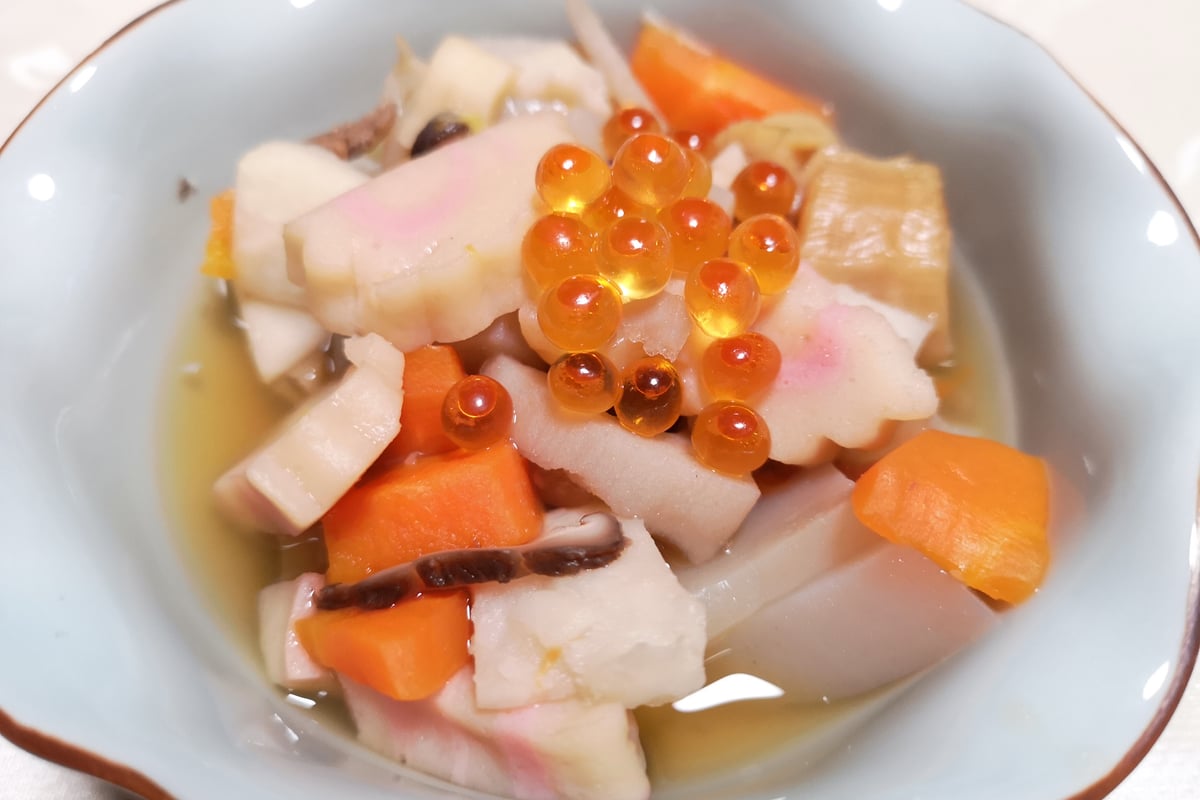
Noppe is a representative local dish of Niigata Prefecture in which taro takes center stage, simmered in a light broth with carrot, konnyaku, dried shiitake mushroom, bamboo shoots, and other ingredients. Thickened by the natural sliminess of taro or by potato starch, Niigata's Noppe is characterized by being closer to a simmered dish than a soup. The broth is made from dried ingredients such as dried scallops and dried shiitake, and it is finished colorfully with scallops, ginkgo nuts, salmon, salmon roe, and more. As well as being a staple on New Year's Eve and New Year's Day, it has long been considered indispensable at gatherings such as festivals, memorial services, and weddings. It is delicious both warm and chilled, and not a few households prefer cold Noppe. The ingredients, cutting style, and method of thickening vary by area and household, and its name also changes from place to place, such as 'konimo' or 'kokusho.' Each household's recipe has been handed down from mother to child, and it is also enjoyed in school lunches, restaurants, and ekiben (station bento).
Origin
Dishes similar to Noppe are found across Japan, from Kyushu and San'in to Aomori, under names such as 'noppei-jiru' and 'nuppe.' In Niigata, a distinctive food culture developed among them, and it became established as a simmered dish with little liquid. Because of the heavy snow that made shopping difficult, it is said that people made large batches at once and set the whole pot in the snow in place of a refrigerator. This is said to have led to the custom of eating Noppe chilled.
History
Niigata's Noppe appears even in Edo-period records. In the 4th year of the Bunsei era in the late Edo period, the name 'notsuhei' appears in a menu of the Hasegawa family, village headmen in what is now Joetsu City. In the Kashiwazaki Nikki (Kashiwazaki Diary), written between 1839 and 1848 by Watanabe Katsunosuke, a samurai of the Kuwana domain, 'noppei' appears in more than 40 places, with taro, konnyaku, burdock root, grilled tofu, and dried squid recorded as ingredients. In the early Showa period, it was also taught in cooking classes at girls' higher schools.
Features
The main ingredient is taro, simmered with carrot, konnyaku, dried shiitake, bamboo shoots, kamaboko (fish cake), and other ingredients cut into small, uniform pieces. Some areas thicken it with the sliminess of taro, while others use potato starch. In the northern part of the prefecture, salmon fillets and 'totomame' (salmon eggs, i.e., salmon roe) are added. Around Niigata City, chicken or salmon is often included, whereas many in Nagaoka say they do not add them, so the ingredients also differ by area.
Main Ingredients
Food Culture
Noppe has always been made for the toshitori (year-end meal) on New Year's Eve, for New Year, for 'sawagigoto' (gatherings for ceremonial occasions such as weddings and funerals), and to serve to guests. Around Niigata City, customs suited to the occasion have also been handed down, such as changing the number of ingredients to seven for celebrations and six for occasions of mourning.
Famous Shops
わっぱ飯 田舎家 新潟古町本店
新潟県新潟市中央区古町通9番町1457
A local cuisine restaurant founded in 1956 (Showa 31) and known as the originator of wappa-meshi (rice steamed in a bentwood container). Noppe is served under the name 'のっ平 (Noppe),' a traditional version with salmon and chicken topped with cooked salmon roe called 'totomame,' and costs around 700 yen (excluding tax) as a single dish.
View details →須坂屋そば 新潟駅前店
新潟県新潟市中央区弁天1-4-29 IMAビル1F〜3F
A soba restaurant within walking distance of the Bandai Exit of Niigata Station, offering Hegi Soba along with local dishes and local sake. Its Noppe is soy sauce-flavored with a rich dried-shiitake broth, topped with fresh salmon roe, and costs around 640 yen (tax included).
View details →FAQ
Q. Are Noppe and noppei-jiru different?
A. Noppei-jiru is a thickened soup found in many parts of Japan. Compared with it, Niigata's Noppe has less liquid and is said to be closer to a simmered dish than a soup. Being enjoyable both warm and chilled is another feature unique to Niigata's Noppe.