Nankan-age (Long-Keeping Fried Tofu)
Nankan-age (Long-Keeping Fried Tofu of Nankan)
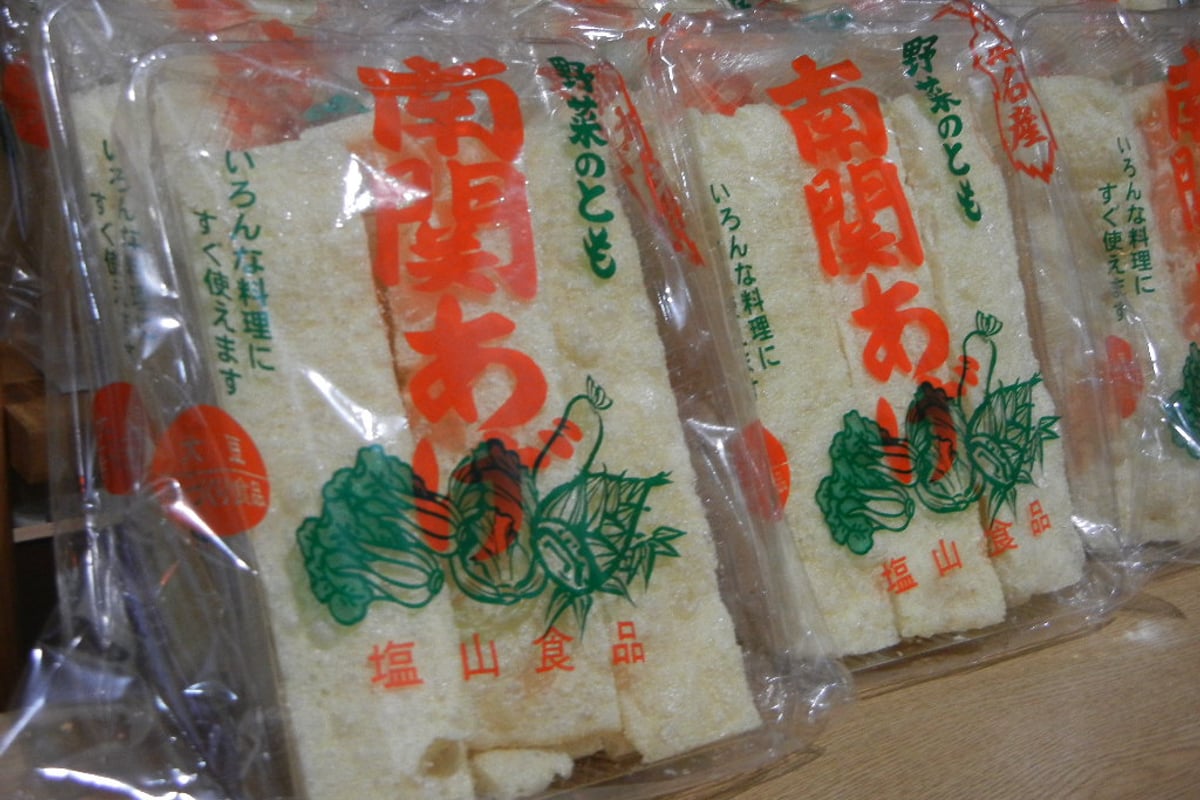
Image: Wikimedia Commons
Nankan-age is a type of aburaage (deep-fried tofu) that has been handed down since the Edo period in Nankan Town (Nankan-machi), Tamana District, in northern Kumamoto Prefecture. According to the Ministry of Agriculture, Forestry and Fisheries (MAFF), it is about 25 cm on each side, larger than ordinary aburaage, and has a crisp texture. Because it contains little moisture, it can be kept at room temperature for about two to three months. It is made by strongly pressing thinly sliced tofu and frying it twice at different temperatures to remove the moisture. The method is said to have been brought by people who migrated from the Iyo-Matsuyama area of Shikoku after the Shimabara Rebellion. Besides everyday miso soup, it is used in Nankan nishime (a simmered dish) for celebrations and memorial services, and in Nankan-age makizushi, where it is used in place of nori. Today the main manufacturer is Shioyama Foods (塩山食品) in the town, and the Kumamoto Nichinichi Shimbun reported in 2025 that it holds a 90% share. The company also produces a Gokujo (premium) series made only with domestic soybeans.
Origin
According to MAFF, the method of making Nankan-age is said to have been introduced after the Shimabara Rebellion (1637–1638). According to this theory, people moved from the Iyo-Matsuyama area of Shikoku to Shimabara, whose population had declined, and the method was brought at that time. In Shikoku, aburaage of the same lineage survives as 'Matsuyama-age.' The manufacturer Shioyama Foods also states that Nankan-age is said to have come from Ehime Prefecture.
History
According to MAFF, it is also said that Nankan-age in the Taisho era was narrower and thicker. A version improved so that it could be kept even longer is thought to be the prototype of its current form. Shioyama Foods began production in 1981 (Showa 56) and moved to its current factory in 1997. It opened a direct sales outlet in 2007, and 'Shioyama no Nankan-age' (塩山の南関あげ) became a registered trademark in 2019.
Features
The ingredients are soybeans and oil. Soybeans soaked in water are ground to make soy milk, and a coagulant is added to make tofu. According to MAFF, this is cut to about 5–6 mm thick, strongly pressed, and fried twice, changing the temperature from low to high. Because the moisture is thoroughly removed, it does not spoil easily and can be stored for a long time. The Kumamoto Nichinichi Shimbun also highlights as one of its merits that it becomes moist when it absorbs broth and seasonings.
Main Ingredients
Food Culture
According to MAFF, besides being added to everyday miso soup, Nankan-age is used in 'Nankan nishime,' which has been made for celebrations and memorial services. 'Nankan-age makizushi,' rolled in Nankan-age instead of nori, is also popular in lunch boxes for school sports days. It has been handed down throughout the prefecture, centered on Nankan Town and the Tamana area.
How It Differs from Home Cooking
Shioyama Foods suggests ways to enjoy it at home, such as in miso soup, in inarizushi, as a topping for kitsune udon, as an ingredient in hot pots, and on pizza toast. The company explains that because it is a dried type with almost no moisture, it absorbs flavors easily and can be stored at room temperature for a long time.
Famous Shops
特産品センター なんかんいきいき村
熊本県玉名郡南関町関町419-1
A directly managed local products shop run by Shioyama Foods, lined with specialty products such as Nankan-age. At the adjacent 'Oshokujidokoro Ikiiki' (お食事処いきいき), new menu items using Nankan-age were introduced in 2025. According to a 2025 guide, it is open from 9:00 to 18:00 and closed on the first Wednesday of every month.
十割そば 関庵
熊本県玉名郡南関町関外目293-2
A local TV station introduced it in 2021 as a shop serving 'Nankan-age soba' topped with Nankan-age. It is said to be open from 11:00 a.m. to 6:30 p.m., closing when sold out, and closed on Wednesdays. Please check its operating status before visiting.
View details →| Shioyama no Nankan-age (塩山の南関あげ) | A product of Shioyama Foods, available in large (oban), small (koban), and shredded (kizami) versions, among others. As of November 2026, its official online shop lists two bags of three large sheets for 2,700 yen. It is also sold at supermarkets in Kyushu and on Rakuten Ichiba. Prices are subject to change.Where to buy →PR |
|---|---|
| Nankan-age Gokujo (Premium) Series | A series made by Shioyama Foods using only domestic soybeans. It is described as blending Fukuyutaka soybeans from Fukuoka Prefecture with Nakasennari soybeans from Nagano Prefecture and hand-frying each sheet one at a time in low- and high-temperature fryers. Please check the official information for availability and prices.Where to buy →PR |
FAQ
Q. Was Nankan-age born in Nankan Town?
A. The method itself is said to have come from outside. MAFF introduces the theory that it was brought by people migrating from the Iyo-Matsuyama area after the Shimabara Rebellion. However, this is a tradition. The current form of Nankan-age is thought to have been developed through repeated improvements to make it keep longer.