Image: Wikimedia Commons
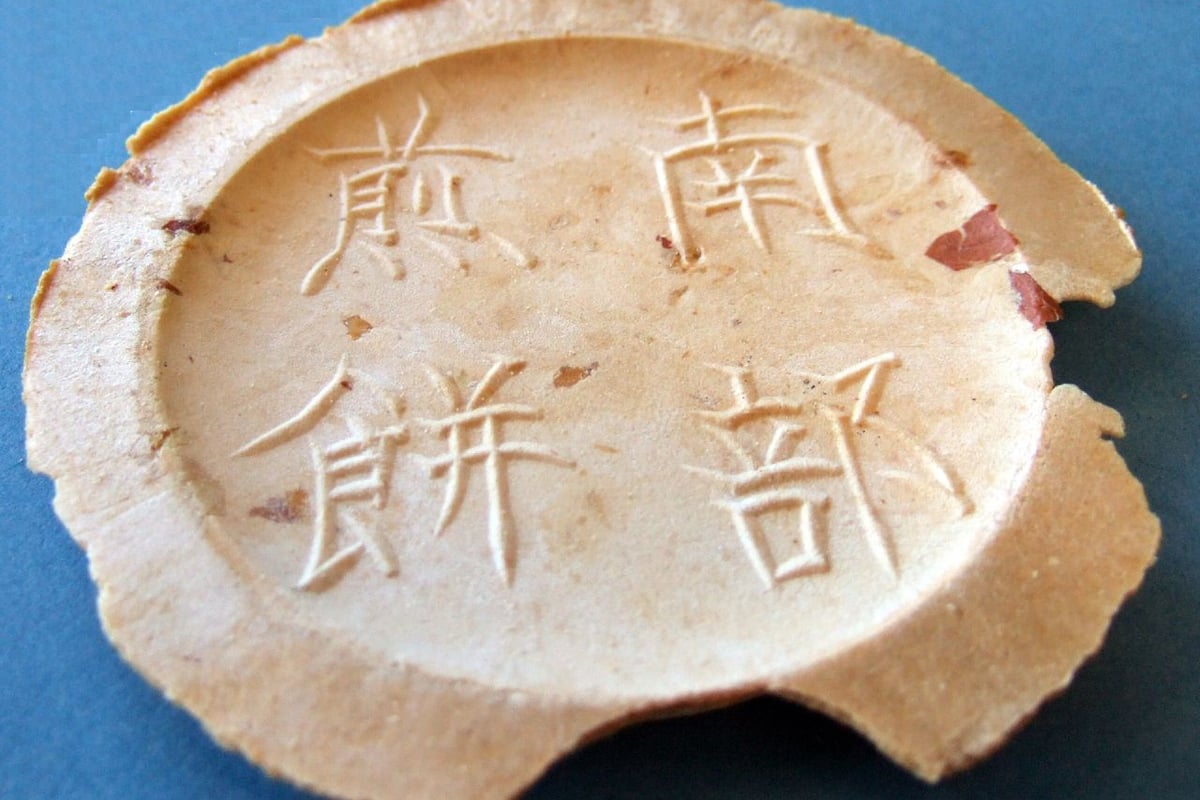
Nanbu senbei is a wheat-flour cracker that has long been made in the former Nanbu domain, spanning the southeastern part of Aomori Prefecture and the northern part of Iwate Prefecture. Dough made from wheat flour, salt, and water is sandwiched between round iron molds engraved with patterns such as cranes and turtles or pine, bamboo, and plum, then baked crisp on both sides. There are various theories about its origin, but the best-known legend holds that during the Nanboku-cho period, when Emperor Chokei of the Southern Court visited the Nanbu region, his retainer Akamatsu Sukezaemon used his iron helmet in place of a pot to bake buckwheat flour and sesame and presented it to the emperor. In the Nanbu region, where cold-weather crop damage was frequent and rice harvests were unstable, senbei made from long-lasting wheat and buckwheat flour became a valued preserved food and staple, and by the Meiji era it is said there were as many as 140 manufacturers just around Hachinohe, showing how deeply it took root in daily life. There is a wide variety, including "mame senbei" bean crackers kneaded with sesame or peanuts, and it is also an indispensable main ingredient in the local dish "senbei-jiru" (senbei hot pot), in which it is simmered in soup.
Origin
There are various theories about its origin, but the most widely known legend holds that during the Nanboku-cho period, when Emperor Chokei of the Southern Court visited the foot of Mt. Nakui (present-day Nanbucho, Sannohe District), his retainer Akamatsu Sukezaemon baked buckwheat flour and sesame in his iron helmet and presented it to the emperor. The emperor is said to have been delighted with the flavor and permitted the Akamatsu family's crest, the "sankai matsu" (three-tiered pine), to be used as a branding stamp. While there is little historical evidence to support this, the tale is passed down as a symbol of the grain-based food culture that has long been rooted in the Nanbu region.
History
In the late Edo period (Bunka-Bunsei era), the Nanbu domain encouraged the cultivation of buckwheat and barley, which were resistant to cold damage, and it is said that senbei made by baking wheat and buckwheat flour in iron molds spread alongside the udon and soba noodle food culture. By the Meiji era, it is said there were as many as 140 senbei shops just around Hachinohe, and molds were kept in nearly every household, showing how deeply the food took root in daily life. In the Nanbu region, where rice did not grow easily, it was valued as a long-lasting, indispensable preserved food and staple.
Features
Dough made from wheat flour, salt, and water is sandwiched between round iron molds and baked on both sides. There is a wide variety, including "mame senbei" bean crackers kneaded with sesame or peanuts, and it is eaten both on its own and simmered in soup as the main ingredient of "senbei-jiru." Its crisp texture and toasty aroma are characteristic, and the protruding rim, called "mimi" (ear), is also a favorite part to eat.
Main Ingredients
Food Culture
In the cool Nanbu region where rice did not grow easily, senbei made from wheat and buckwheat flour became established as an everyday staple and preserved food. A distinctive food culture of eating it simmered in soup, as in "senbei-jiru," also developed, making it a food that symbolizes the identity of the Nanbu region.
Famous Shops
川越せんべい店
青森県上北郡おいらせ町下明堂30-11
Founded in 1873, the oldest existing Nanbu senbei shop in Japan. Established by descendants of Hachinohe domain samurai, it still hand-bakes each senbei one at a time today.
小山田せんべい店
青森県三戸郡三戸町同心町古間木平38-2
A long-established shop founded in 1917 that represents Sannohe Town. Its signature product is "mimi-tsuki senbei," which retains the protruding rim, and a product consisting of only the rim pieces sells for 250 yen.
南部せんべい本舗 八戸屋
青森県むつ市新町47-3
A manufacturer popular as a tourist spot where visitors can observe the production process. It offers a wide range of products, including senbei for senbei-jiru and creative variations.