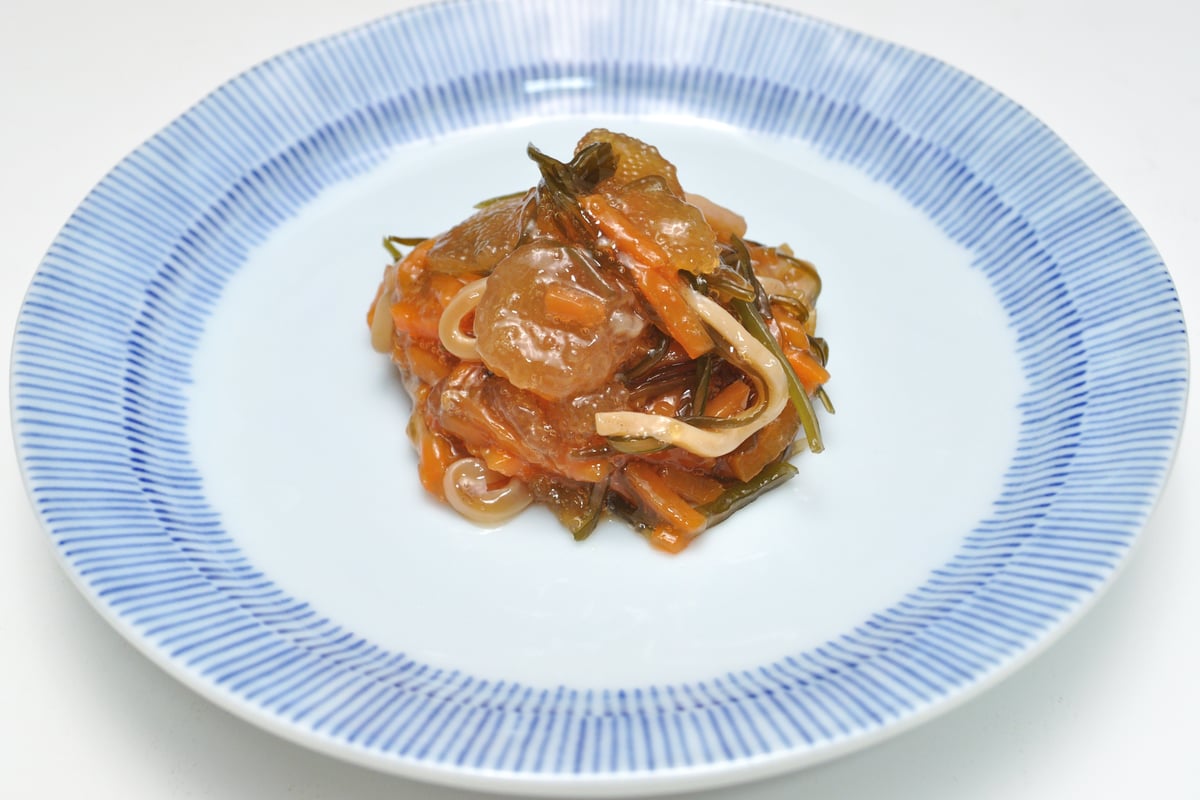
Image: Wikimedia Commons
Matsumae-zuke is a preserved dish from the Matsumae region of Hokkaido, made by thinly slicing dried squid (surume) and kelp and pickling them in a soy sauce-based marinade. Herring roe (kazunoko) is traditionally added as a finishing touch, giving the dish its characteristic sticky, stringy texture from the kelp, a satisfying crunch from the roe, and layers of umami flavor. The name is said to derive from Matsumae, the former castle town of the Matsumae domain (now Matsumae Town, Matsumae District), where the local kelp was known as 'Matsumae kelp.' During the Edo period, the Matsumae and Fukushima areas thrived on herring fishing, and locals combined the abundant kazunoko, dried squid, and kelp into a pickle that later became a staple of New Year's cuisine and a classic Hokkaido souvenir known throughout Japan. Today, several producers in Matsumae Town still make this pickle, and its simple, home-style flavor—varying slightly from household to household—continues to be passed down.
Origin
Matsumae-zuke is believed to have originated as a preserved food in the area around present-day Matsumae Town, Matsumae District, in the southern part of Ezo (Hokkaido) governed by the Matsumae domain during the Edo period. At the time, the region was known for producing dried squid and kelp, and households began combining these with kazunoko—a byproduct of herring fishing—to make a long-lasting pickle. However, there is also a differing account: when the Matsumae domain was relocated to Yanagawa in Mutsu Province (present-day Date City, Fukushima Prefecture) in 1807, a retainer is said to have encountered the local dish 'ika-ninjin' (squid and carrot), and after the domain returned to Ezo in 1821, recreated it using locally produced kelp.
History
During the Edo period, this pickle was known by names such as 'kobu-ika' or 'ika no shoyu-zuke' (soy-pickled squid), and the name 'Matsumae-zuke' is said to have become established only in the Showa era. One account holds that a merchant in Hakodate commercialized and popularized it in the early Showa period. Before the war, while herring fishing flourished, it was a luxurious pickle made generously with kazunoko. After the war, as poor herring catches made kazunoko expensive, the recipe shifted to being centered on dried squid and kelp, with only a small amount of kazunoko added for color—establishing the style of Matsumae-zuke known today.
Features
Its defining feature is a soy sauce-based, sticky pickle in which the umami of dried squid, the viscosity of kelp, and the crunchy texture of kazunoko come together as one. Thinly sliced squid and kelp are marinated in a sauce of soy sauce, mirin, and sake, and left for several days so that the kelp's stickiness spreads throughout, creating its distinctive texture. Many households also add carrot for color, and in Matsumae Town, the balance of sweetness, spiciness, and amount of kazunoko varies from family to family, making it a cherished, simple regional flavor.
Main Ingredients
Food Culture
In the Matsumae and Fukushima areas, which once thrived on herring fishing, this preserved dish was made in each household using the abundant kazunoko, dried squid, and kelp available. Today it remains a beloved part of New Year's osechi cuisine and a dish served to guests, symbolizing Hokkaido's food culture.
How It Differs from Home Cooking
At home, it is often prepared quickly using store-bought sauce, but long-established producers in Matsumae Town use premium air-dried squid and carefully selected kazunoko, preparing it with their own blend of seasonings to bring out the kelp's stickiness and allowing it to mature properly—resulting in a more authentic, refined flavor.
Famous Shops
蝦夷松前 龍野屋
北海道松前郡松前町字福山74
A long-established producer specializing in Matsumae-zuke. Sold by weight from around 580 yen per 100g, with tasting sets available in several flavors.
View details →竹田食品(直売店「竹田屋」)
北海道函館市浅野町3-10
Produces Matsumae-zuke combining large kazunoko, dried squid, and ma-kombu or gagome kelp. Squid sashimi-style Matsumae-zuke starts from around 1,512 yen.
View details →| 松前漬(数の子入り) | At seafood shops in Hokkaido, Matsumae-zuke generously mixed with kazunoko is sold as a souvenir. It comes in frozen vacuum packs for a longer shelf life and is also chosen as a gift item, priced from around 720 yen for 110g.Where to buy →PR |
|---|
FAQ
Q. Where does the name 'Matsumae-zuke' come from?
A. It is said to derive from the fact that the dish originated around present-day Matsumae Town, the former castle town of the Matsumae domain, and that the local kelp was known as 'Matsumae kelp.' However, during the Edo period it was called 'kobu-ika' and similar names, and the term 'Matsumae-zuke' only became widespread in the Showa era.