Image: Wikimedia Commons
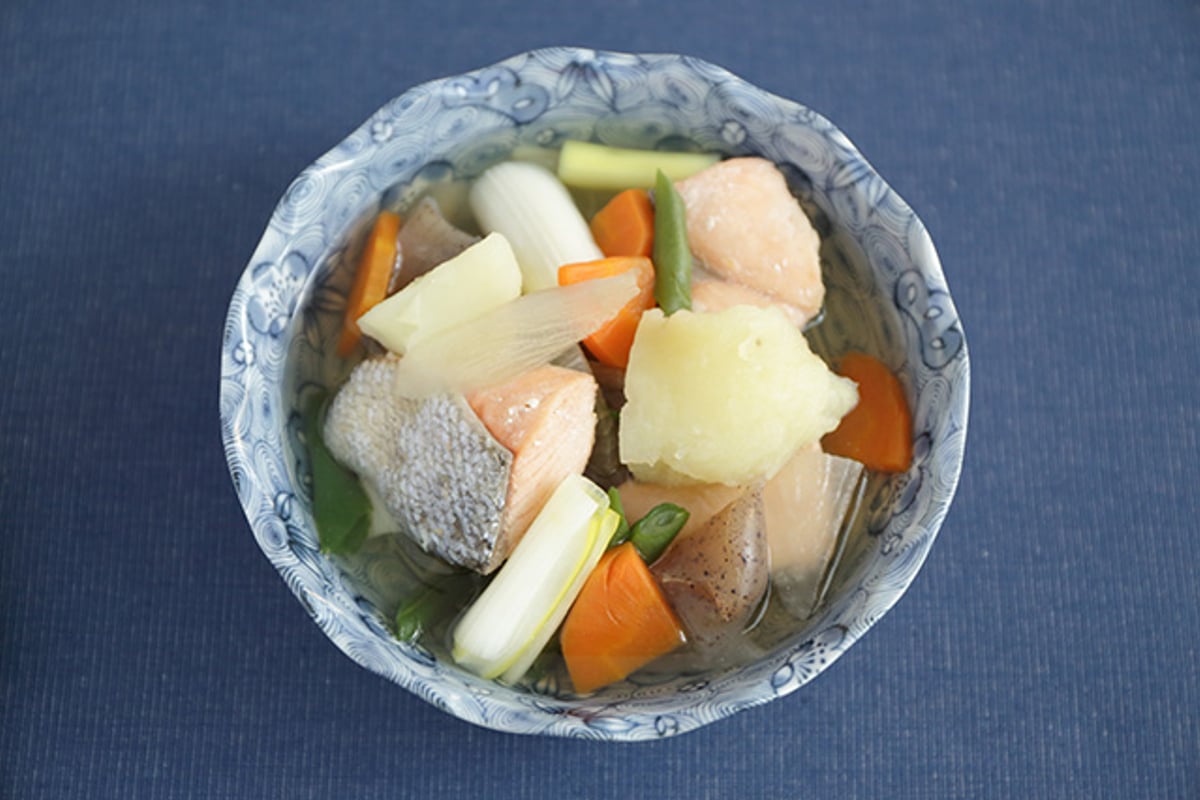
Sanpei-jiru is a classic salt-seasoned soup of Hokkaido, made by slowly simmering salted fish—such as salted salmon or nuka-zuke herring—together with root vegetables like daikon radish, carrot, and potato in a kelp-based dashi. Its defining feature is that the seasoning relies almost entirely on the salt naturally contained in the fish, with little to no miso or soy sauce added, giving it a simple yet deeply flavorful character. The name is already recorded in a late Edo-period travel account, showing that this dish has been eaten in Hokkaido households for over 200 years. Several theories exist about the origin of the name, including one linking it to a fisherman named Saito Sanpei who served the dish to the Matsumae domain's lord, and another tracing it to a deep Arita-ware dish called 'sanpei-zara.' No theory is definitively established. Unlike Ishikari-nabe, which is seasoned with miso and uses fresh salmon, Sanpei-jiru is fundamentally based on the combination of salted fish and root vegetables, and the types of fish used and preparation style vary by region.
Origin
The origins of Sanpei-jiru are said to date back to the Edo period, and the name already appears in a travel account from the late Edo period. Several theories surround the origin of the name: one holds that when the lord of the Matsumae domain went hunting, he was served a soup made from whatever fish and vegetables were on hand at the home of a fisherman named Saito Sanpei, enjoyed it, and the dish came to bear his name; another traces it to the fact that it was served in a deep Arita-ware dish called 'sanpei-zara.' However, no theory has been firmly established. In Okushiri Town, a local tradition regarding the origin of Sanpei-jiru has been independently compiled and is used to promote regional revitalization.
History
Sanpei-jiru emerged from the everyday wisdom of using salted fish as a preserved food, and has been enjoyed in households across Hokkaido for over 200 years. In an era without refrigeration, salted or nuka-pickled salmon, herring, and cod kept well, and simmering them together with root vegetables made for a soup that provided easy nutrition. It remains widely passed down today as a winter household dish and is also served at regional revitalization events.
Features
Its most distinctive feature is that it is seasoned using almost no miso or soy sauce, relying instead solely on the salt released from the salted fish. Fish such as salted salmon, nuka-zuke herring, or salted cod are added to a kelp-based dashi along with root vegetables like daikon, carrot, and potato, and simmered slowly. The type of fish used varies by region: salted salmon is common in central and eastern Hokkaido, while salted cod is also used in the north. In the Hiyama region, two versions are passed down: 'shio-sanpei,' made with salted cod, and 'miso-sanpei,' which combines salted salmon with miso.
Main Ingredients
Food Culture
In an era without refrigerators, salted fish was a valuable preserved food, and Sanpei-jiru, simmered together with root vegetables, took root in households as a wise way to gain nutrition from few ingredients during winter. Even today, it is a dish deeply tied to daily life in Hokkaido, served at family tables and winter events alike.
How It Differs from Home Cooking
At home, Sanpei-jiru is often confused with the miso-based Ishikari-nabe, but Sanpei-jiru is originally characterized by using no miso or soy sauce, with flavor determined solely by the salt in the fish. The fish and vegetables used, as well as the strength of seasoning, vary by household and region, and in areas such as Hiyama, both a salt-based and a miso-based version are made and used separately.
FAQ
Q. How is it different from Ishikari-nabe?
A. Ishikari-nabe is a hot pot dish made with fresh salmon and vegetables seasoned with miso, whereas Sanpei-jiru is seasoned using only the salt from salted fish such as salmon or herring. The condition of the salmon used and the presence or absence of added seasoning are the main points that distinguish the two.
Q. Where does the name 'Sanpei-jiru' come from?
A. There are several theories, including one that traces it to a fisherman named Saito Sanpei who served the dish to the lord of the Matsumae domain, and another linking it to a deep Arita-ware dish called 'sanpei-zara' used to serve it. No theory is definitively established.