Image: Wikimedia Commons
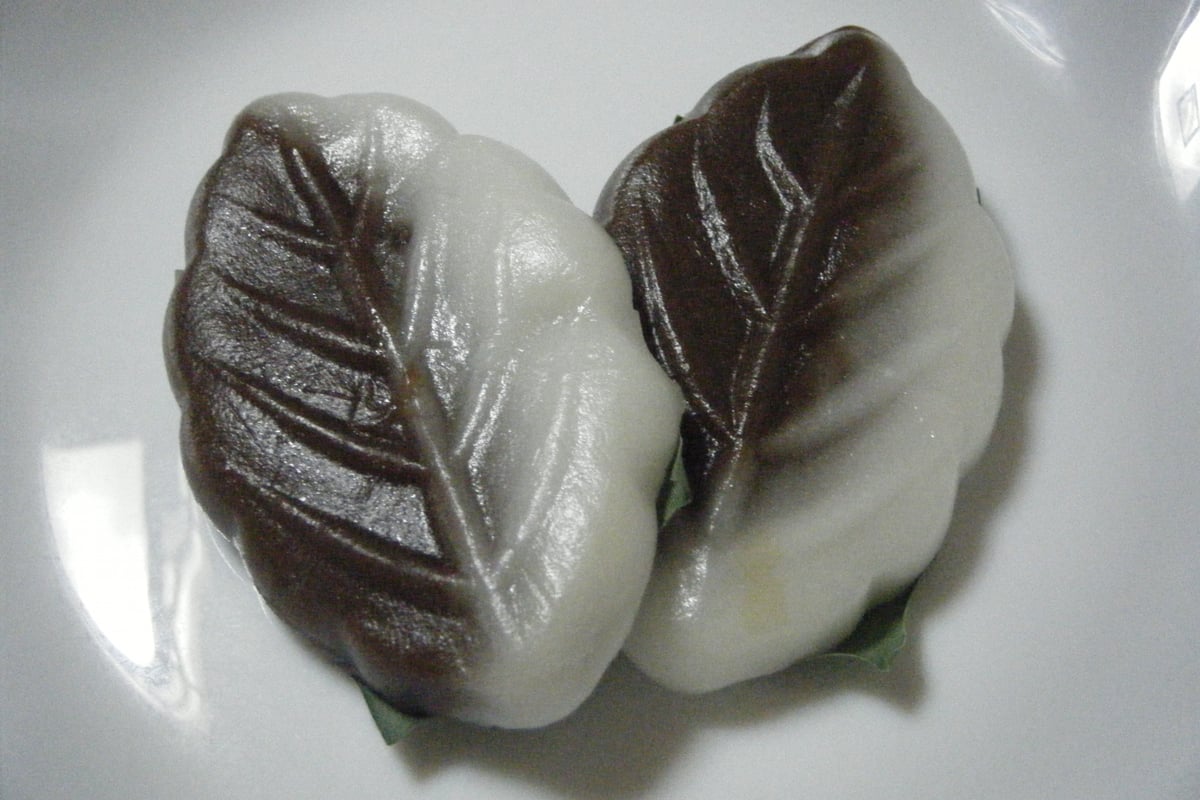
Bekomochi is a regional confectionery of Hokkaido made by combining white and black (or brown) dough, typically shaped to resemble a leaf. A dough of joshinko (non-glutinous rice flour) or shiratamako (glutinous rice flour) mixed with sugar is combined with a dough colored with brown sugar, shaped, and then steamed. Its appeal lies in its soft, chewy texture and the gentle sweetness of the brown sugar. In Hokkaido, it is customarily eaten mainly around Tango no Sekku (Boys' Festival, May 5), and it has been especially popular in the Dounan (southern Hokkaido) region. Several theories exist about the origin of the name: one holds that the black-and-white coloring resembles a Holstein dairy cow, leading to the name 'beko' (a dialect word for cow); another traces it to the resemblance of the brown-sugar portion's color to tortoiseshell (bekkou); and yet another suggests it derives from rice flour (beiko) being the main ingredient—though no theory is firmly established. Centered on the Dounan region, shops produce a wide variety of distinctive bekomochi beyond the classic leaf shape, including green dough mixed with mugwort and versions filled with sweet red bean paste.
Origin
The origin of bekomochi is not entirely clear, and several theories have been passed down. The most widely supported theory holds that 'kujira mochi,' a regional confectionery from Yamagata Prefecture, was brought to Hokkaido and independently evolved into the leaf shape. Indeed, in parts of the Dounan region, bekomochi is still sometimes called 'kujira mochi' today, suggesting a cultural connection with the Tohoku region. It is thought that confectionery culture was brought to Hokkaido through exchange with mainland Japan, including via the Kitamae-bune trading ships, and developed its own unique form there.
History
In Hokkaido, a custom has long taken root of making bekomochi at Tango no Sekku (May 5) to pray for children's healthy growth. It has traditionally been handmade in individual households, especially in the Dounan region, and has also been offered as a seasonal staple item at local Japanese confectionery shops. Over time, variations beyond the classic leaf shape emerged, including single-color dough made only with brown sugar, green dough mixed with mugwort, and brightly colored versions using artificial coloring, and a diverse range of bekomochi continues to be passed down today, centered on the Dounan region.
Features
The basic method is to layer or knead together a white dough of shiratamako or joshinko mixed with sugar and a black dough mixed with brown sugar, shape it into a leaf form, and steam it. It is characterized by a soft, chewy texture and the rich sweetness of brown sugar; versions made with joshinko tend to have a slightly firmer bite. While the leaf shape is standard, shops also offer distinctive variations such as round or flower shapes, a soy-flavored dough kneaded with walnuts, and versions filled with sweet red bean paste.
Main Ingredients
Food Culture
Made to pray for children's healthy growth at Tango no Sekku, bekomochi is a home-style flavor that has been passed down across generations, mainly in the Dounan region. Come May, it lines the shelves of Japanese confectionery shops and is cherished as a seasonal tradition.
How It Differs from Home Cooking
At home, it is often prepared simply by mixing shiratamako with brown sugar, but long-established Japanese confectionery shops expand the range of flavors and colors by filling it with sweet red bean paste or adding walnuts and mugwort, finishing it to a quality suitable as a gift item.
Famous Shops
北洋堂
北海道松前郡松前町字松城64
Founded in 1937. A Japanese and Western confectionery shop located in the shopping district of the castle town of Matsumae; bean-paste-filled bekomochi costs around 300 yen for two pieces.
View details →栄餅本店
北海道函館市栄町5-13
Founded in 1900, a Hakodate confectionery shop with over 100 years of history specializing in mochi sweets; bekomochi costs around 170 yen (before tax) per piece.
FAQ
Q. Where does the name 'beko' come from?
A. Several theories exist: one holds that the black-and-white coloring evokes a Holstein dairy cow, leading to the name 'beko' (a dialect word meaning cow); another traces it to the resemblance of the brown-sugar portion's color to tortoiseshell (bekkou); and another suggests it derives from rice flour (beiko) being the main ingredient. No theory is firmly established.