Image: Wikimedia Commons
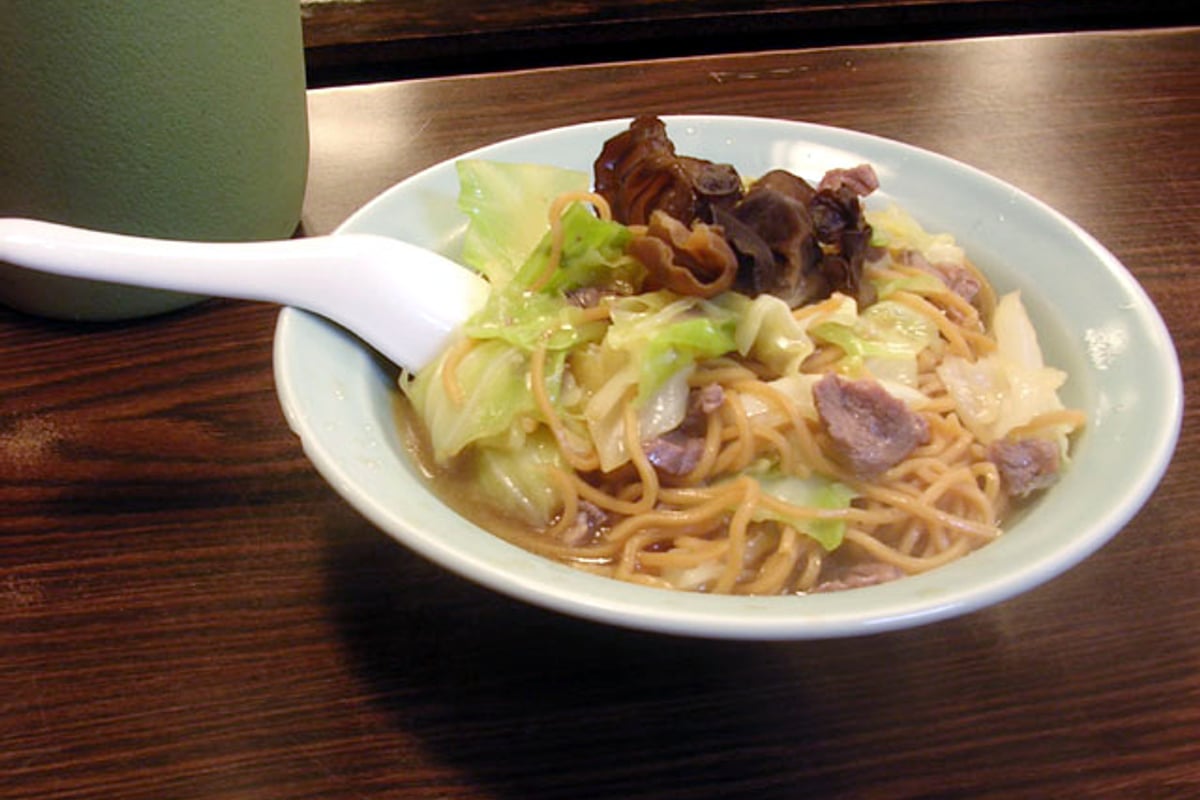
Romen is a noodle dish born in Ina City, Nagano Prefecture, made with steamed Chinese-style noodles, mutton (sheep meat), and cabbage. It was devised in 1955 (Showa 30) by Ito Waichi, the owner of 'Banri' (萬里), a Chinese restaurant in Ina City. It is said to have begun with steaming the noodles to make them keep longer at a time when refrigerators were not yet widespread. It is described as 'neither ramen nor yakisoba,' and there are soup versions in which the noodles are immersed in broth as well as soupless versions in the style of yakisoba. Another characteristic is that diners pour sauce, vinegar, sesame oil, and other condiments from the table over it to finish it to their own taste. About 90 restaurants in and around Ina City serve it, and it also appears in school lunches. It is a soul food that has long been loved by local people.
Origin
Romen was completed in 1955 (Showa 30) at the Chinese-style restaurant 'Banri' in Ina City, with the cooperation of a local noodle maker. Refrigerators were not yet widespread at the time, and steaming was devised as a way to keep leftover fresh noodles until the next day. For the meat, mutton was used, obtained from the sheep raised for wool, which was thriving in this area at the time. Combining this with locally grown cabbage was its original innovation.
History
When it was first devised, it was named 'Char Romen' (炒肉麺), and eventually the character for 'char' (炒) was dropped and it came to be called 'Romen' (肉麺). Because the creator allowed the name to be used freely, it spread to many shops in the city. In 1997 (Heisei 9), the 'Ina Romen's Club' was founded, and it has designated June 4 as 'Romen Day,' a play on words reading 6 as 'mu' and 4 as 'shi'.
Features
Basically, steamed Chinese-style noodles are stir-fried and simmered in broth together with mutton and cabbage. Banri's broth is made from chicken bones, aromatic vegetables, and pig's heads, and it is characteristically seasoned lightly. Steamed noodles are said to resist getting soggy and to absorb flavor as time passes. Depending on the shop, there are many varieties, such as soup versions, yakisoba-style versions, curry-flavored versions, and chilled Romen.
Main Ingredients
Food Culture
Romen is eaten daily in the Kamiina area centered on Ina City, and it almost disappears from menus once you leave the area. The amount of broth and the seasoning differ greatly from shop to shop, so comparing shops is also enjoyable. It also appears in school lunches and has become a local flavor that people have been familiar with since childhood.
How It Differs from Home Cooking
At shops, the noodles, mutton, and cabbage are stir-fried and simmered in a homemade broth made from chicken bones and other ingredients, and finished in each shop's own style before serving. The way to enjoy it at shops is 'table cooking,' in which diners finish the served Romen themselves by adding sauce, vinegar, sesame oil, shichimi togarashi, grated garlic, and other condiments from the table.
Famous Shops
中国風菜館 萬里
長野県伊那市坂下3308
The original shop that created Romen in 1955, within walking distance of Inashi Station on the JR Iida Line. Its soup-style Romen simmered in broth is characteristic. Romen starts from about 850 yen, and the shop also serves dishes of pig's head meat.
うしお
長野県伊那市荒井3460-1
A shop a few minutes' walk from Inashi Station that serves yakisoba-style Romen made with mutton. Its cooking method is said to carry on a flavor that a relative of the owner learned in Manchuria (present-day Northeast China).
FAQ
Q. How is Romen different from ramen or yakisoba?
A. Romen uses steamed Chinese-style noodles, which are stir-fried and simmered in broth together with mutton and cabbage. The amount of broth varies from shop to shop, ranging from versions with plenty of broth like ramen to yakisoba-style versions. Another characteristic is that the flavor is finished with condiments from the table.
Q. How should Romen be seasoned?
A. At Banri, the original shop, the broth is seasoned lightly, and diners eat it with sauce, vinegar, sesame oil, shichimi togarashi, grated garlic, and other condiments from the table added to taste. It is said that adding sauce and the like makes it easier to eat even for people who do not care for mutton.