Image: Wikimedia Commons
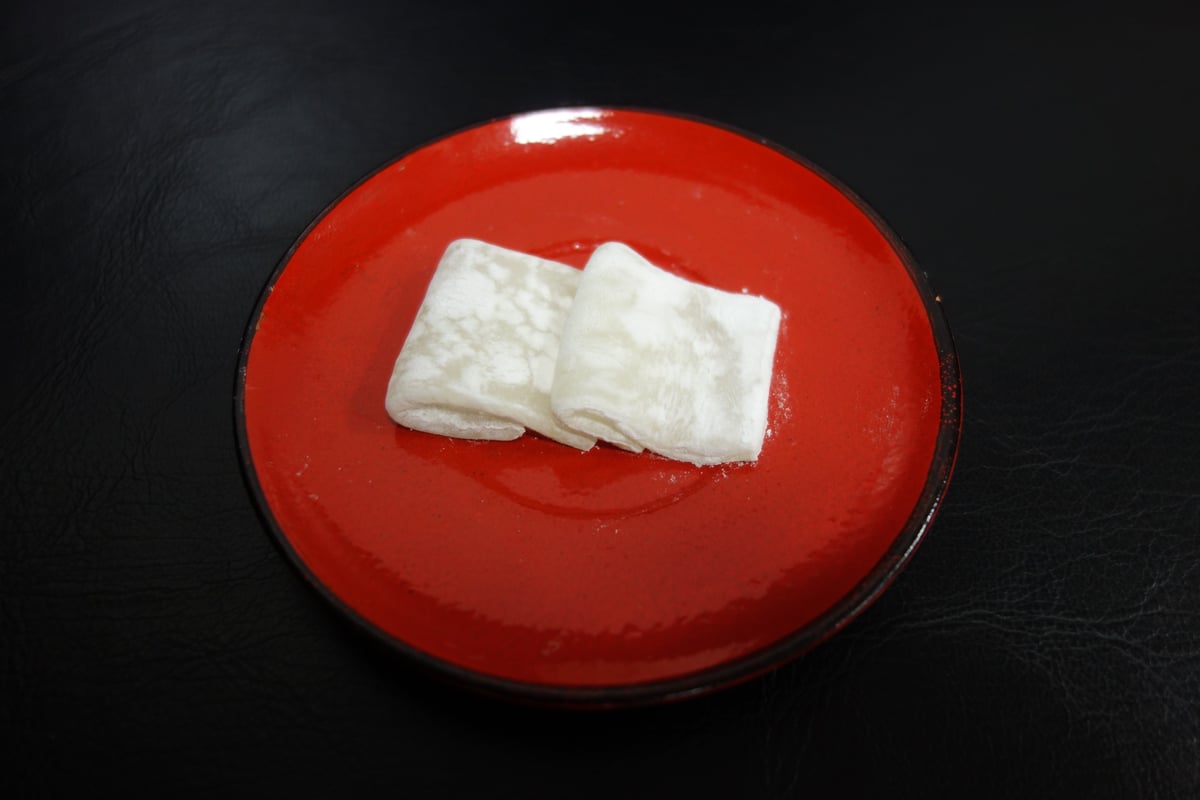
Habutae Mochi is a local confection of Fukui Prefecture made by steaming glutinous rice flour (mochiko), kneading it with sugar and starch syrup (mizuame), spreading it thin, and cutting it into squares. It is a simple mochi sweet whose basic ingredients are just three: mochiko, sugar, and mizuame. Its name comes from habutae, a silk fabric that has represented Fukui since the Meiji era. Habutae is a high-grade plain-weave silk with a smooth, lustrous finish. Habutae Mochi expresses the whiteness and fine, delicate feel of that fabric in the form of a mochi sweet. Its hallmark is a soft, airy texture that seems to melt in the mouth. It is said to have been created in the Meiji era, and the Ministry of Agriculture, Forestry and Fisheries dates the appearance of a sweet named 'Habutae Mochi' to 1905 (Meiji 38). However, several shops are known as its originator, and there are various theories about its origin. Today it is a classic Fukui souvenir, made by many confectioners, each with its own recipe. There are also many derivative sweets, such as versions dusted with kinako (roasted soybean flour), versions wrapped around sweet bean paste, and versions sandwiched in monaka wafers.
Origin
Silk weaving has flourished in Fukui Prefecture since the Edo period, and in the Meiji era habutae weaving for export spread throughout the prefecture. In the early 1890s, Fukui Prefecture ranked first in Japan in the value of silk fabric production, and habutae became the product that represented Fukui from the Meiji era onward. Habutae Mochi was born as a Japanese confection modeled on the color and texture of this fabric. It embodies the wish to create a local specialty named after the textile that represented the region.
History
According to the Ministry of Agriculture, Forestry and Fisheries, a sweet named 'Habutae Mochi' appeared in 1905 (Meiji 38), when habutae weaving was at its peak. Matsuokaken, founded in 1897 (Meiji 30), states that it launched the original Habutae Mochi, devised by its founder, in 1905. Meanwhile, Kinbaido, founded in 1847 (Koka 4), is also known as the originator of Habutae Mochi. Partly because records were lost in the war, the details of how it was devised remain unclear.
Features
Mochiko is kneaded with water and steamed, then kneaded again with sugar and mizuame. The mixture is poured onto a board, spread to a thickness of a few millimeters, and cut into bite-sized squares. The proportions of ingredients and the thickness vary from shop to shop, giving each its own texture and sweetness. It is characterized by a silky smoothness and a softness that melts on the tongue. Many products are individually wrapped, making them easy to carry as souvenirs.
Main Ingredients
Food Culture
In the Meiji era, it is said to have become known nationwide as textile merchants and trading companies bought it as a souvenir. Today it is a classic Fukui souvenir. Many sweets derived from Habutae Mochi are also made, such as versions wrapped around seasonal fruit or with walnuts kneaded in.
Famous Shops
羽二重餅総本舗 松岡軒 本店
福井県福井市中央3丁目5-19
Founded in 1897 (Meiji 30) by Awashima Tsune, who had trained in Tokyo for ten years. The shop relates that the founder's father was a textile merchant dealing in white hosho tsumugi (a silk fabric), and that the founder worked repeatedly to recreate the smooth feel of habutae in a confection. Habutae Mochi costs from around 108 yen for a pack of two.
View details →錦梅堂
福井県福井市順化1丁目7-7
A long-established shop founded in 1847 (Koka 4), known as the originator of Habutae Mochi. It also sells Japanese and Western-style sweets derived from Habutae Mochi, as well as mizu yokan, and its individually wrapped Habutae Mochi is a classic souvenir.
村中甘泉堂 本店
福井県福井市中央1丁目21-24
A Japanese confectionery shop founded in 1910 (Meiji 43), whose Habutae Mochi has won awards at the National Confectionery Exposition. Its habutae sweets made with seasonal fruit, such as the winter-to-spring 'Habutae Ichigo' (strawberry), are also popular.
| Habutae Kurumi (はや川) | A sweet from Hayakawa, a confectioner in Katsuyama City founded in 1926. Habutae Mochi kneaded with Japanese walnuts simmered in syrup (kanroni) is sandwiched between fragrant choux pastry. A box of six costs from around 840 yen. |
|---|
FAQ
Q. What is 'habutae'?
A. It is a smooth, lustrous, high-grade plain-weave silk fabric. It has been Fukui Prefecture's representative product since the Meiji era, and in the mid-Meiji era Fukui Prefecture ranked first in Japan in the value of silk fabric production. Habutae Mochi was named by likening the mochi sweet to the whiteness and soft feel of this fabric.