Image: Wikimedia Commons
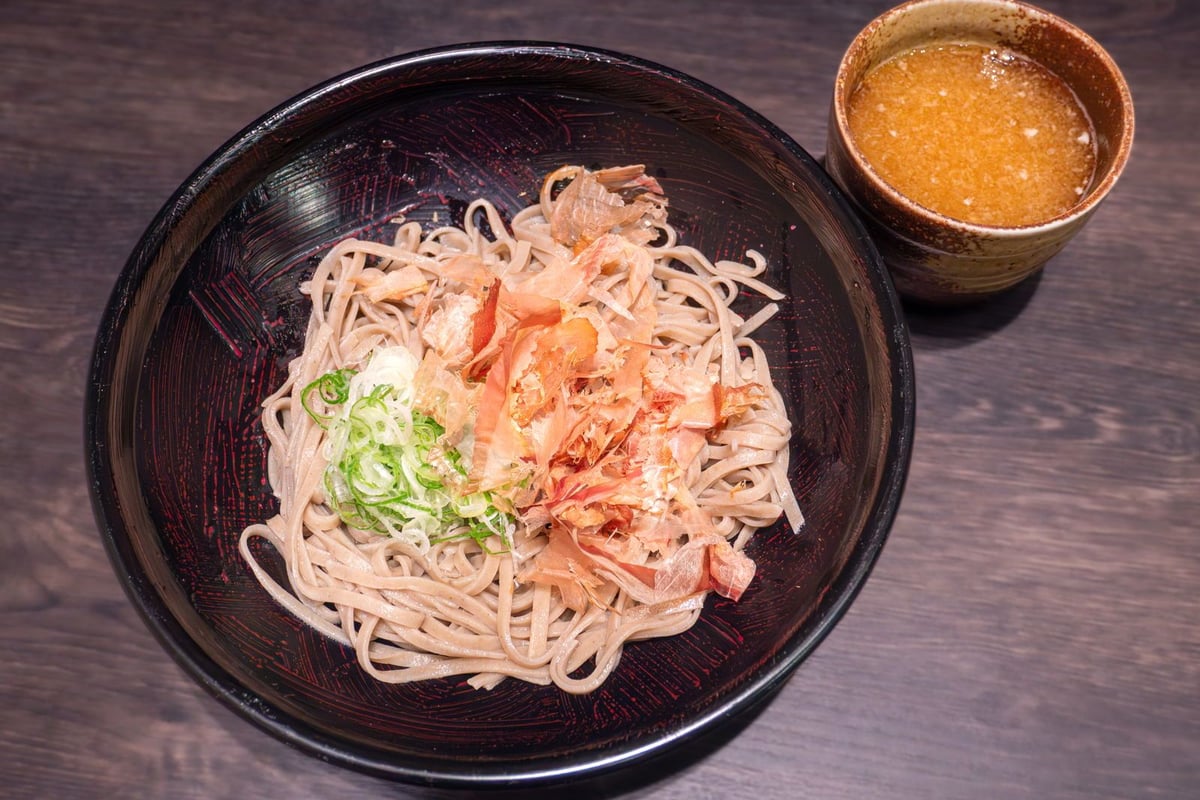
Echizen Oroshi Soba is a local dish of Fukui Prefecture in which cold soba noodles are eaten with grated daikon radish and dashi broth. It is commonly topped with bonito flakes and chopped green onions, and depending on the season, spicy karami daikon is also used. The mainstream soba in Fukui is inaka soba (country-style soba), cut somewhat thick from dark buckwheat flour ground in a stone mill together with the inner husk. Many native buckwheat varieties remain in the prefecture, and although their grains are small, they are said to have a rich flavor and an excellent aroma. Buckwheat cultivation is said to have been started by the Asakura clan in the Sengoku period, and at the beginning of the Edo period, 'soba-kiri' (soba in noodle form) was introduced. Later, the practice of eating it with grated daikon spread and has been handed down to the present day. The name 'Echizen Soba' is said to derive from an anecdote about Emperor Showa, who visited Fukui in 1947 (Showa 22). The way the grated daikon and dashi are combined differs from shop to shop, so comparing them is part of the fun.
Origin
Buckwheat cultivation in Fukui is said to have been started by Asakura Takakage, a Sengoku-period feudal lord who built a castle at Ichijodani in 1471 (Bunmei 3). According to tradition, buckwheat, which can be harvested in a short time, was grown between battles and used as food for sieges. At first it was eaten as sobagaki (buckwheat dough) or buckwheat dumplings. Soba in noodle form appeared in 1601 (Keicho 6). This is said to have come about when Honda Tomimasa, lord of the castle at Fuchu (present-day Echizen City), took up his post accompanied by a soba craftsman from Fushimi in Kyoto.
History
It is said that under Honda Tomimasa, 'oroshi soba', thin soba topped with grated daikon, was born. An introduction by the Ministry of Agriculture, Forestry and Fisheries also relates that Tomimasa had doctors and soba craftsmen make soba with grated daikon poured over it. In 1947 (Showa 22), Emperor Showa visited Fukui and asked for a second helping of soba. Because he later recalled it fondly as 'that soba of Echizen,' it came to be called 'Echizen Soba,' and soba eaten with grated daikon spread under the name 'Echizen Oroshi Soba.'
Features
The typical way to eat it is to pour cold tsuyu over soba that has been boiled and rinsed in cold water, then top it with grated daikon, bonito flakes, and green onions. There are variations in how the grated daikon is used: adding it separately from the dashi, mixing it into the dashi, or adding only the juice of the grated daikon to the dashi. Every milling company in the prefecture produces its buckwheat flour for Echizen Soba by stone-milling. Because the flour is 'hikigurumi', with the buckwheat ground together with its inner husk, the noodles are dark and rich in sweetness and aroma.
Main Ingredients
Food Culture
Fukui Prefecture is said to have 22 lines of native buckwheat, including 'Ono Zairai,' 'Maruoka Zairai,' and 'Imajo Zairai.' In November, new-soba festivals are held in various places. Efforts are made to pass on soba culture through soba-making skill competitions, a championship for high school students, hands-on workshops, and more.
How It Differs from Home Cooking
At specialty shops, many serve juwari soba (100 percent buckwheat soba) made solely from locally grown buckwheat flour and cut somewhat thick. Each shop also has its own approach to the spiciness of the daikon, the blend of the dashi, and the way the grated daikon is combined, so even the same oroshi soba can taste very different.
Famous Shops
うるしや
福井県越前市京町1-4-26
A soba shop in the former Takefu City (present-day Echizen City), said to have been founded in 1861 (Bunkyu 1). It passes down the anecdote that Emperor Showa asked for a second helping of soba during his visit to the prefecture in 1947. Its signature Nadai Oroshi Soba is from about 960 yen.
越前そば 見吉屋
福井県福井市順化1丁目11-3
A soba shop about a five-minute walk from JR Fukui Station. It prides itself on firm, handmade soba using stone-milled buckwheat flour. Age Oroshi Soba is from about 1,250 yen, and Oroshi Mochi Soba is also popular.
| Echizen Soba no Sato (Takefu Seimen) | A complex in Echizen City run by Takefu Seimen, a company founded in the Taisho era. Visitors can tour the soba factory, which makes about 50,000 servings a day, and soba-making experiences are from about 2,200 yen. There is also a souvenir corner offering Fukui specialties and original products.Where to buy →PR |
|---|
FAQ
Q. Since when has the name 'Echizen Soba' been used?
A. It is said to have originated with Emperor Showa's visit to the prefecture in 1947 (Showa 22). Because the Emperor later recalled it fondly as 'that soba of Echizen,' Fukui's soba came to be called 'Echizen Soba.' Soba eaten with grated daikon became established as 'Echizen Oroshi Soba.'