Image: Wikimedia Commons
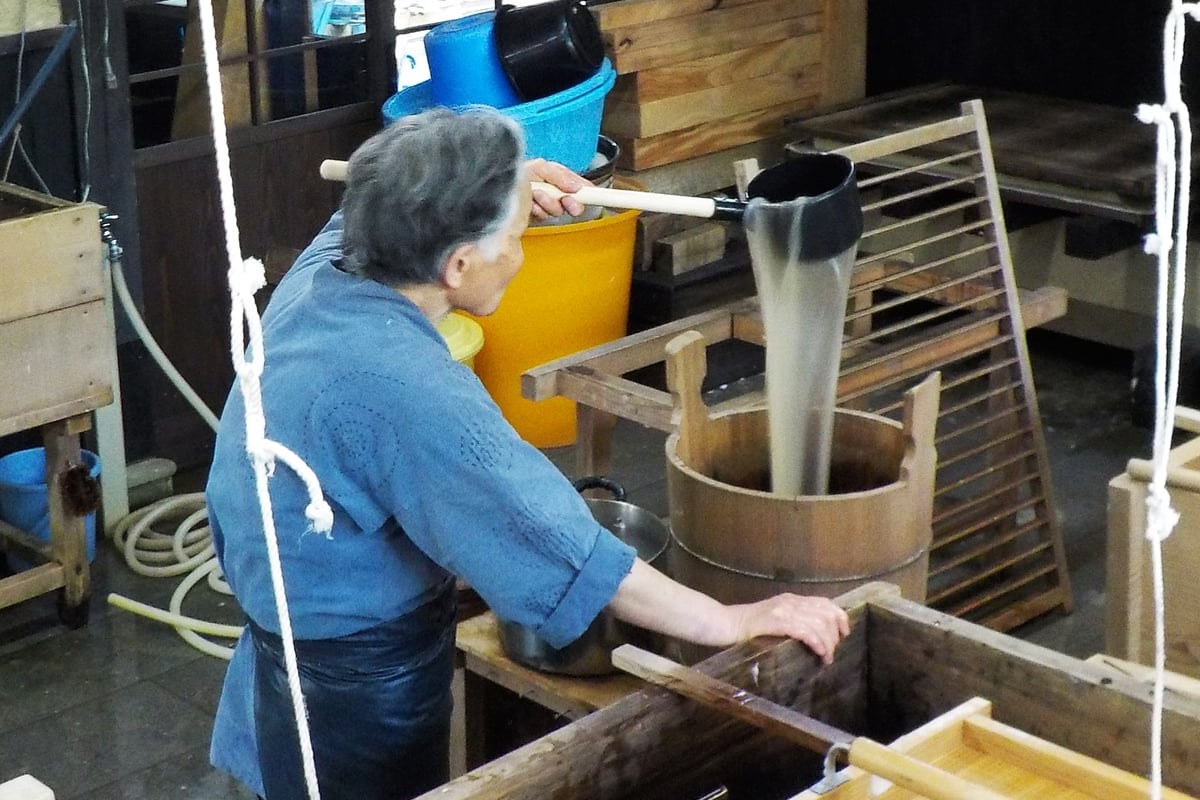
Echizen Washi is handmade Japanese paper that has long been made in the Imadate district of Echizen City, Fukui Prefecture. The production area consists of five villages, Otaki, Iwamoto, Furo, Shinzaike and Sadatomo, collectively known as 'Goka' (the Five Villages). According to legend, about 1,500 years ago a goddess named Kawakami Gozen appeared upstream on the Okamoto River and taught the villagers how to make paper, and she is enshrined at Okamoto Shrine as the goddess of papermaking. In the Nara period the paper was used for copying sutras, and in time it gave rise to 'Echizen Hosho,' a high-grade paper prized by the samurai class. The paper for the Fukui Domain's banknotes in the Edo period and for the Dajokan-satsu notes of the new Meiji government was also made here. Using kozo, mitsumata and gampi as raw materials, papermakers produce a wide variety of papers for different uses, such as hosho paper, torinoko paper and fusuma (sliding door) paper. In 1976 it became a Traditional Craft Designated by the Minister of Economy, Trade and Industry. At Echizen Washi Village, visitors can watch and try papermaking.
Origin
The beginnings of Echizen Washi are told through the legend of Kawakami Gozen (the goddess of papermaking). When Emperor Keitai was still living in Echizen as Prince Odo (Odo no O), a beautiful woman appeared upstream on the Okamoto River. She told the villagers, 'You have little farmland, but you are blessed with pure water, so you should make paper,' and taught them the art of papermaking. The villagers revered this goddess as Kawakami Gozen and built Okamoto Shrine to enshrine her.
History
Paper was already being made in Echizen by around the end of the 5th century, and it is thought that at first it was mainly paper for copying sutras. Records of Echizen paper also remain in the Shosoin documents of the Nara period. As the samurai class came to use paper in large quantities, techniques advanced, and 'Echizen Hosho' received the protection of the shogunate and feudal lords. The paper for the Fukui Domain's banknotes, considered the oldest domain banknotes in Japan, and for the Dajokan Kinsatsu notes of the new Meiji government was also made in the Goka area. In 1976 it was designated a national Traditional Craft.
Features
Echizen Washi combines a natural off-white color, a warm texture and durability. Kozo, with its thick, long fibers, makes strong paper, while mitsumata produces paper with a smooth, glossy surface. Gampi is resistant to insect damage and is suited to uses that require long-term preservation. With a wide range of papers such as hosho, torinoko and fusuma paper, it is one of Japan's leading production areas in quality, variety and volume. Echizen Hosho and Echizen Torinoko paper are designated as national Important Intangible Cultural Properties.
Techniques
Nagashi-zuki (Flowing Method)
A papermaking method in which pulp solution is scooped into a sugeta (a bamboo screen set in a wooden frame) and rocked back and forth and side to side, letting excess liquid flow off so that the fibers intertwine. Because the scooping is repeated many times to build up layers, the finished paper is strong even when thin.
Tame-zuki (Retention Method)
A papermaking method in which the pulp solution scooped into the sugeta is not rocked vigorously, and the water is simply allowed to drain away to form a layer of paper. Both nagashi-zuki and tame-zuki have been handed down in Echizen, and papermakers use them according to the type and purpose of the paper.
Materials Used
Production Process
- 1
Shajuku (Boiling)
The bark used as raw material is boiled in a cauldron to soften the fibers.
- 2
Dust Removal and Washing
While the bark is soaked in water, dust and blemishes are carefully removed by hand.
- 3
Kokai (Beating)
The fibers are beaten and loosened so that they blend well as pulp.
- 4
Shozo (Papermaking)
The pulp is scooped up with the sugeta and formed into sheets using nagashi-zuki or tame-zuki.
- 5
Pressing
Pressure is applied to the stacked wet sheets to squeeze out the water.
- 6
Hegiwake (Separating) and Drying
The wet sheets are peeled off one by one, dried and finished with a sheen.
| Main Production Areas |
|
|---|
Artisans & Workshops
九代 岩野市兵衛
The ninth head of the Iwano family, which makes Echizen Hosho in Echizen City. As the holder of the national Important Intangible Cultural Property 'Echizen Hosho' (a Living National Treasure), he carries on the traditional making of hosho paper from kozo.
長田製紙所
A handmade washi workshop in Otaki-cho, Echizen City, founded in 1909 (Meiji 42). It has long produced handmade fusuma paper. Its adjoining shop sells small washi goods and washi materials, and its gallery displays washi interior pieces and art that make use of its own techniques.
福井県和紙工業協同組合
The production-area cooperative for Echizen Washi, with its office inside the Papyrus House. It shares information on the legend of Kawakami Gozen, the history of the area and the types of washi, and works to promote Echizen Washi.
Official site →How to Buy
- 和紙処えちぜん
- An Echizen Washi shop inside the Papyrus House. It carries products made with Echizen Washi, such as letter paper, envelopes, folding fans and uchiwa fans. Open until 16:30; closed every Tuesday and during the year-end and New Year holidays.Where to buy →PR
- 長田製紙所
- A shop attached to the workshop in Otaki-cho, Echizen City. It sells small handmade washi goods and washi materials, and Japanese-style envelopes made with handmade fusuma paper are available from around 550 yen.
Hands-on Experiences
越前和紙の里 パピルス館
福井県越前市新在家町8-44
Papermaking in shikishi (square card) size or postcard size (2 sheets) starts from around 700 yen. It takes about 20 to 40 minutes and can be enjoyed by everyone from small children to adults. Optional activities such as making uchiwa fans require a reservation at least 2 days in advance. Closed every Tuesday.
View details →越前和紙の里 卯立の工芸館
福井県越前市新在家町9-21-2
A facility converted from a papermaking house of the mid-Edo period, where visitors can watch certified traditional craftsmen making paper with traditional tools. Admission is a combined ticket with the Paper and Culture Museum, about 300 yen for adults and free for high school students and younger.
View details →FAQ
Q. Who is Kawakami Gozen?
A. She is the goddess said to have brought papermaking to the Goka villages, and she is revered by the paper industry throughout Japan as the goddess of papermaking. She is enshrined at Okamoto Shrine and Otaki Shrine, and the buildings of the Satomiya (village shrine), rebuilt in the late Edo period, are a national Important Cultural Property. Every year from May 3 to 5, the spring festival 'Kami to Kami no Matsuri' (Festival of the Gods and Paper) is held.
Q. What kind of paper is Echizen Torinoko paper?
A. It is a handmade washi made from gampi and is said to have been made since the Nara period. It is characterized by a pale color like an eggshell and a smooth texture. In December 2025, it was added to the UNESCO Intangible Cultural Heritage inscription 'Washi, craftsmanship of traditional Japanese hand-made paper.'