Image: Wikimedia Commons
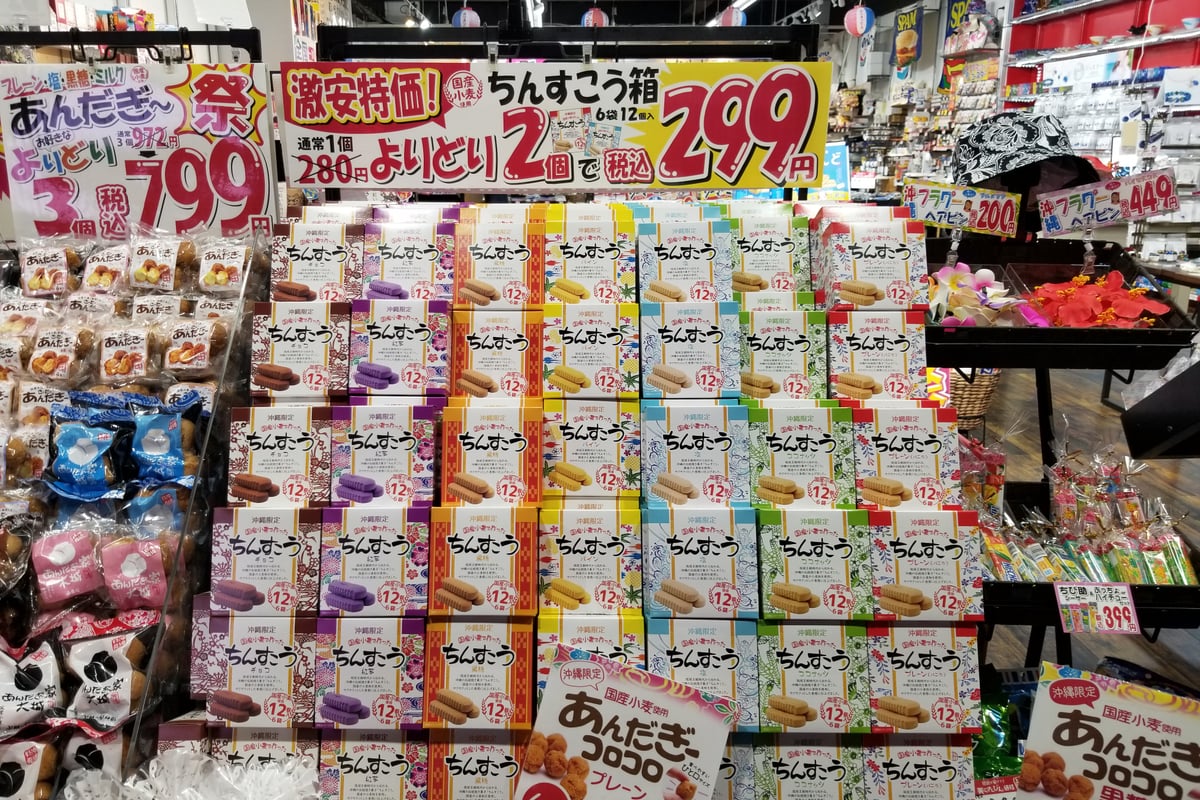
Chinsuko is a classic Okinawan confection made mainly from wheat flour, sugar, and lard. Known for its distinctively crumbly texture and the rich, savory flavor that lard imparts, it is one of the best-known Okinawan souvenirs nationwide in Japan. Its roots lie in a court confection of the Ryukyu Kingdom era, said to have been a special treat served only to royalty, nobility, and investiture envoys from China. Several theories exist for the origin of its name — one holds that it comes from 'chin-so-ko,' meaning 'rare confection,' another from 'kin-so-ko,' meaning 'expensive confection' — but the true origin remains unclear. Originally shaped as round pieces resembling a chrysanthemum flower, it was later remade into bite-sized sticks, giving it the familiar shape known today. Beyond the plain version, many variations have emerged using ingredients such as purple sweet potato, brown sugar, and Yukishio salt, and it continues to be beloved by visitors to Okinawa.
Origin
Chinsuko is said to have its roots in a court confection made during the Ryukyu Kingdom era by cooks who served the royal family within Shuri Castle. It is said to have been created by adapting Chinese confectionery techniques learned in order to entertain investiture envoys visiting from Qing-dynasty China, and at the time it was a precious treat that only a limited circle, such as royalty and nobility, could taste. Several theories surround the origin of its name, including one holding that it derives from 'chin-so-ko,' meaning 'rare confection,' and another from 'kin-so-ko,' meaning 'expensive confection,' but no definitive record remains.
History
From the Meiji era onward, the recipe was passed down by the descendants of confectionery makers, and it gradually came into the hands of ordinary people as well. Originally shaped as round chrysanthemum-shaped pieces, after the war the mold was changed to produce bite-sized sticks, making it easier to carry, and this is said to be how the shape familiar today became established. Today, a number of shops in the Arakaki family lineage — from long-established shops in Shuri that carry on the direct line to factories handling mass production — each preserve their own methods while spreading the confection nationwide as a souvenir sweet.
Features
Despite its simple composition of wheat flour, sugar, and lard kneaded together and baked, the flavor of the lard gives it rich body and a savory aroma, and its hallmark is a distinctive texture that crumbles delicately in the mouth. Okinawa has long had a thriving hog-raising tradition and a food culture that makes use of every part of the pig, and using good-quality lard is considered key to the flavor. Beyond the plain version, a wide range of variations using local ingredients such as purple sweet potato, brown sugar, and salt are also produced.
Main Ingredients
Food Culture
Okinawa has long had a thriving hog-raising tradition, with a food culture said to use every part of the pig except its cry, and the idea of using good-quality lard in confectionery making grew out of this culture. Given its history as a court confection of the Ryukyu Kingdom, it still holds a special place today as a gift for celebratory occasions and a classic souvenir.
Famous Shops
本家 新垣菓子店
沖縄県那覇市首里赤平町1-3
A long-established shop that directly preserves the recipe handed down since the Ryukyu Kingdom era. Fully reservation-based with limited quantities; booking one to ten days in advance is recommended.
新垣ちんすこう本舗 牧志店
沖縄県那覇市牧志1-3-68
A classic souvenir shop located on Kokusai-dori. Sold at affordable prices, such as 810 yen for a small box (20 pieces) and 1,350 yen for a medium box (36 pieces).
| 塩ちんすこう(御菓子御殿) | A classic souvenir made by Okashigoten in Yomitan Village. Featuring a pronounced saltiness, it is sold in different sizes, including a 7-piece pack for 420 yen (453 yen tax included). |
|---|
FAQ
Q. What is the origin of the name 'chinsuko'?
A. Several theories exist, including one that it derives from 'chin-so-ko,' meaning 'rare confection,' and another from 'kin-so-ko,' meaning 'expensive confection,' but no definitive record remains.