Image: Wikimedia Commons
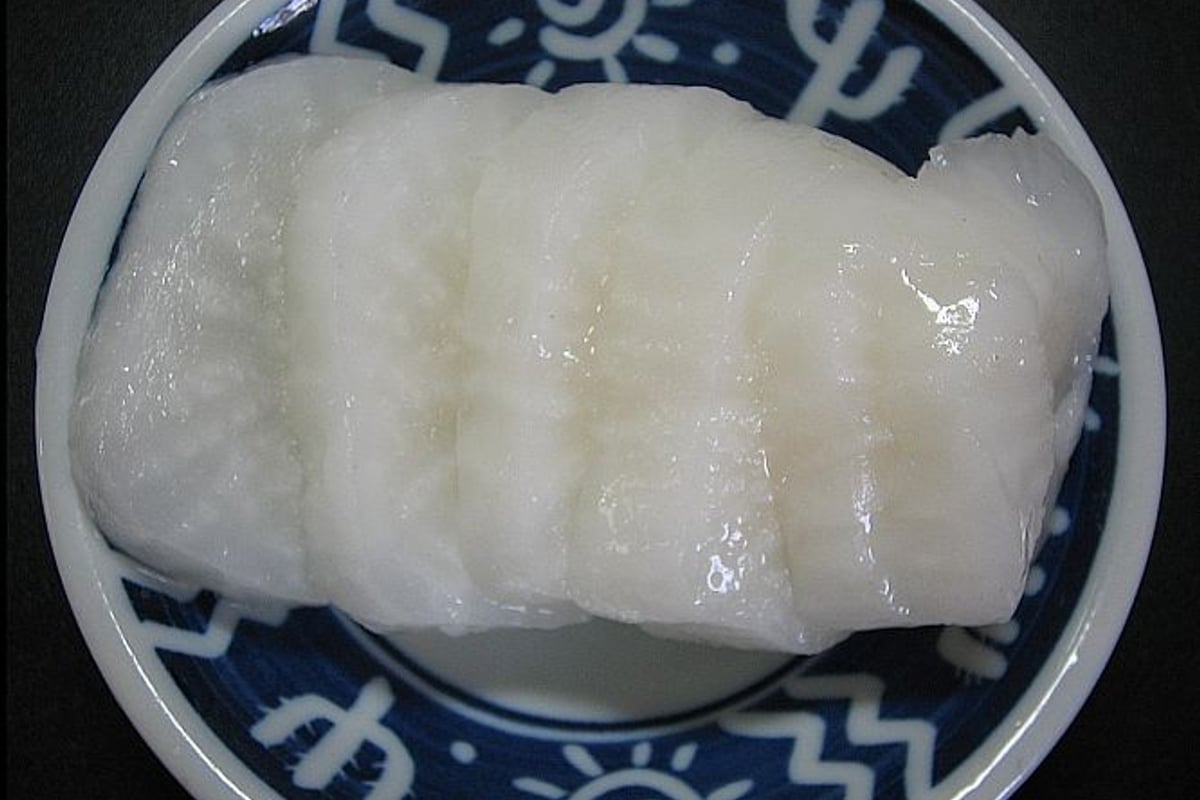
Bettarazuke is a traditional Tokyo pickle known for its sweetness and gentle tartness, made by first salting fresh daikon radish and then curing it further in rice malt (koji) and sugar to ferment. It became known nationwide under this name from the mid-Edo period, when it was sold every October 19 and 20 at the Bettara Ichi (Bettara Market) held at Takarada Ebisu Shrine in Odenmacho, Nihonbashi. There are two theories about the origin of the name: one holds that it came from the way rice malt from the curing bed stuck ('betta-betta') to the surface of the daikon, and another that street vendors would call out 'bettara, bettara' while playfully trying to press the malt onto customers' kimono sleeves. In an era when salty pickles were the norm, this lightly cured style with the natural sweetness of rice malt won popularity among the people of Edo, and the Bettara Ichi remains a beloved autumn tradition in Nihonbashi to this day, carried on since the Edo period. It is now sold year-round at specialty shops and pickle stores around Nihonbashi and has become a classic Tokyo souvenir.
Origin
In the mid-Edo period, the origin is said to trace back to a market held on October 19, the day before the annual Ebisu-ko festival at Takarada Ebisu Shrine in Odenmacho, Nihonbashi, where farmers began selling daikon cured with malted rice syrup and rice malt as 'lightly pickled daikon.' The market itself took hold as people flocked there seeking fish and vegetables to offer at the Ebisu-ko festival the following day, October 20.
History
Because of the way rice malt stuck to the surface of the daikon, the pickle came to be called 'bettarazuke,' and along with this name, the market itself became known and loved among the people of Edo as the 'Bettara Ichi.' Ever since, the market held every October 19 and 20 around Odenmacho, Nihonbashi has been passed down to this day as an autumn tradition dating back to the Edo period.
Features
Fresh daikon is first cured in salt and then cured again with sugar and rice malt, producing a natural sweetness from fermentation along with a crisp texture. Amid a landscape of mostly salty pickles, its gentle sweetness and distinctive aroma from the rice malt stand out, making it a year-round favorite as an accompaniment to plain rice or a snack with tea.
Main Ingredients
Food Culture
Owing to its history of being sold at the Bettara Ichi, a beloved autumn tradition, it is cherished as a pickle that heralds the arrival of the season, and today it has also become established as a classic Tokyo souvenir.
How It Differs from Home Cooking
At home, bettarazuke is often prepared as a simplified lightly-pickled style using salted rice malt (shio-koji), whereas long-established shops carry out the salt curing and the rice-malt curing as two separate stages, drawing out a deeper richness through fermentation.
Famous Shops
東京新高屋(にいたか屋)
東京都中央区日本橋大伝馬町
A long-established shop known as the largest bettarazuke maker in Nihonbashi. A 1kg boxed set of Tokyo bettarazuke sells for around 2,484 yen.
View details →FAQ
Q. What is the origin of the name 'bettarazuke'?
A. It is said to come from the way rice malt from the curing bed stuck ('betta-betta') to the surface of the daikon. Another theory holds that it comes from vendors at the Bettara Ichi calling out 'bettara da' while selling.