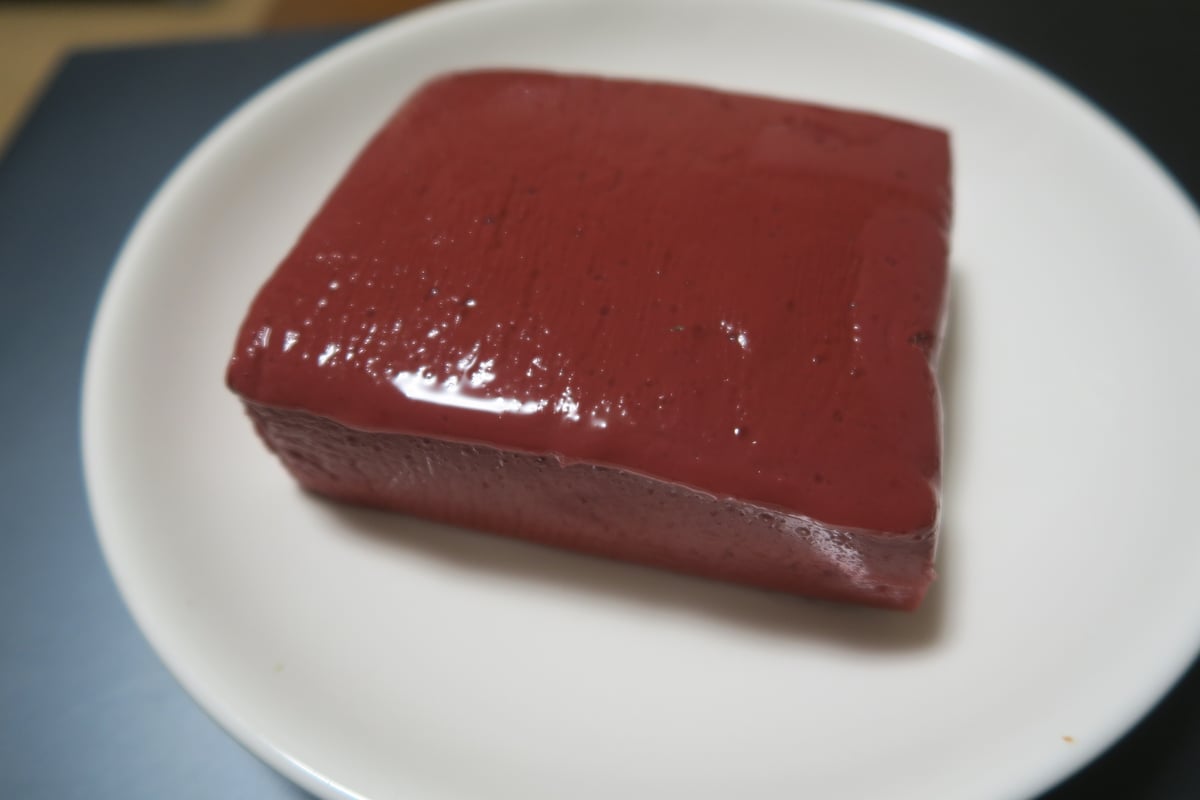
Image: Wikimedia Commons
Aka-konnyaku is a vividly red-colored konjac known as a specialty of Omihachiman City in Shiga Prefecture. It is colored with iron sesquioxide, a food additive that resists fading even when cooked, and it has a distinctively firm, chewy texture. Several stories are told about its origin, including that Oda Nobunaga, said to have loved flamboyant things, had even the konjac dyed red, or that the color was inspired by Nobunaga's red battle surcoat, but no story has been reliably confirmed. The 1940 'History of Hachiman Town, Shiga Prefecture' includes an account from an elderly resident that the color was once produced by boiling down corn husks; from the Meiji era onward, food dye was used, and once the use of iron sesquioxide was approved in 1971, the production method used today became established. It is used in a wide range of dishes, from simmered dishes and dengaku (skewered and grilled with miso) to sashimi-style preparations, and it remains a classic souvenir for visitors to Omihachiman.
Origin
Several stories are told about the origin of aka-konnyaku: that Oda Nobunaga, said to have loved flamboyant things, had even the konjac dyed red; that the color was inspired by Nobunaga's red battle surcoat; and that Omi merchants got the idea while traveling the country on business. None of these stories, however, is backed by reliable historical documentation, and the true origin remains unclear.
History
The 1940 'History of Hachiman Town, Shiga Prefecture' includes an account from an elderly resident stating that the color was once produced by boiling down the husks of corn kernels. From the Meiji era onward, food dye came to be used for coloring, and in 1971 the use of iron sesquioxide, a food additive, was approved for konjac produced in Shiga Prefecture, establishing the production method that continues to this day.
Features
Because it is colored with iron sesquioxide, an iron-based coloring agent, it resists losing its color even after being cooked. It has a firmer, chewier texture than ordinary konjac and readily absorbs seasoning, which is why it is used in a wide range of dishes such as simmered dishes, dengaku, oden, and sashimi-style konjac.
Main Ingredients
Food Culture
Aka-konnyaku is an everyday ingredient used regularly in Omihachiman households and at festivals, and locally it is regarded not as anything special but simply as part of daily side dishes. Its distinctive red color has become one of the symbols of Omihachiman's food culture.
Famous Shops
乃利松食品 吉井商店
滋賀県近江八幡市為心町上21
A long-established shop founded in 1891 (Meiji 24), producing and selling Hachiman aka-konnyaku made by its own traditional method.
View details →| 味付き赤こんにゃく | Aka-konnyaku pre-seasoned for use in simmered dishes. It is sold at souvenir shops and roadside stations and is one of the classic souvenirs of sightseeing in Omihachiman. |
|---|
FAQ
Q. Is aka-konnyaku really connected to Oda Nobunaga?
A. The story linking it to Oda Nobunaga, said to have loved flamboyant things, is widely told, but it is not backed by reliable historical documentation and is considered just one of several traditions. As for records of the coloring itself, there is a Showa-era account describing dyeing with corn husks.