Image: Wikimedia Commons
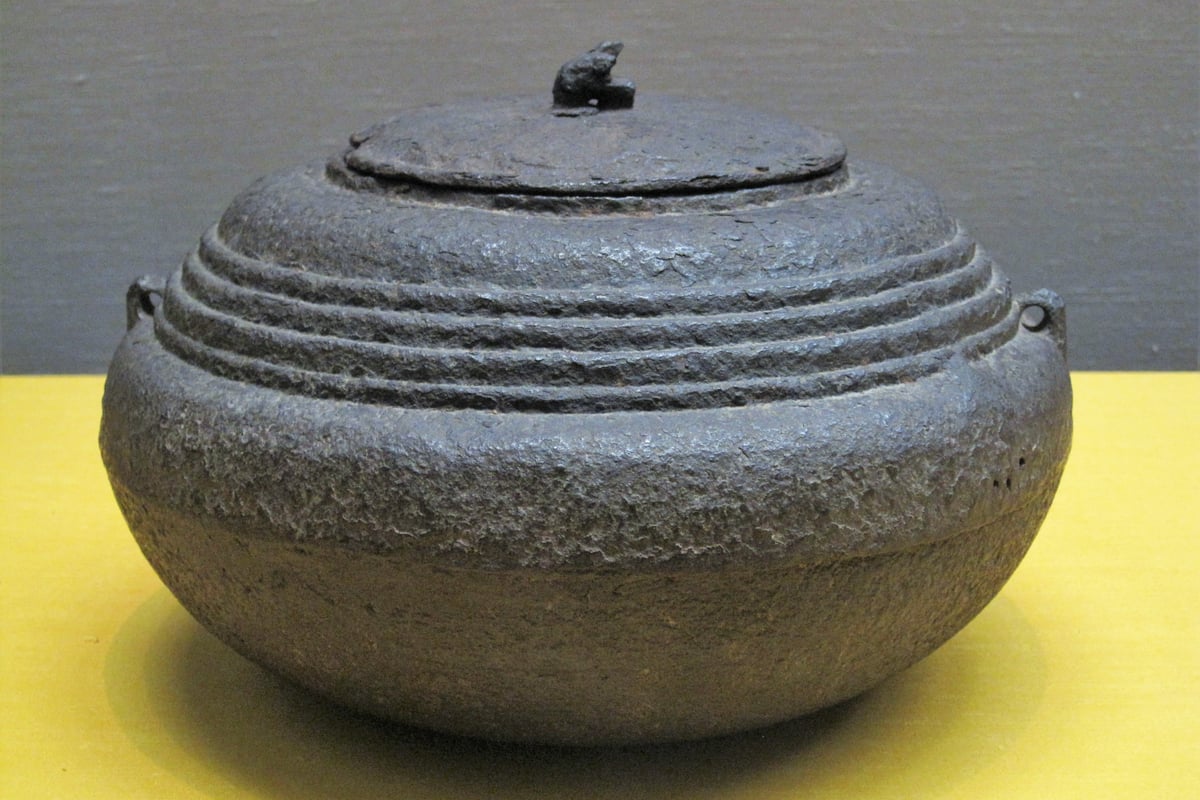
Temmyo Imono is a traditional cast-metal craft passed down in Sano City, Tochigi Prefecture. According to tradition, it began during the Tengyo era (938-947), when five casters who had relocated from Kawachi Province cast weapons on the order of Fujiwara no Hidesato, making it one of the oldest surviving casting centers in Japan with a history of over a thousand years. By the end of the Kamakura period, everyday cast-iron pots such as rice-porridge cauldrons and water-boiling kettles were being widely produced, and as the tea ceremony grew popular, tea kettles with a rustic, rough-textured surface became prized by tea masters, earning Temmyo the nickname 'Ashiya in the west, Temmyo in the east' alongside the Ashiya kettles of Fukuoka. Sen no Rikyu, Oda Nobunaga, and Toyotomi Hideyoshi are all said to have used Temmyo tea kettles. Today, casters in Sano still preserve the sand-mold casting technique much as it was in the Edo period, hand-finishing wind chimes, tea kettles, and temple bells one at a time. In March 2024, 'Tools and Products of Sano's Temmyo Casting' was designated an Important Tangible Folk Cultural Property, drawing renewed attention to its value.
Origin
According to tradition, the origin of Temmyo Imono dates back to the Tengyo era (938-947), when five casters relocated from Taho Village, Sayama District, Kawachi Province (present-day Mihara Ward, Sakai City, Osaka Prefecture) to Sano in Shimotsuke Province, where they cast weapons on the order of Fujiwara no Hidesato. According to the Tochigi Prefectural History, the casters first settled in Tomita Village, Ashikaga District (present-day Teraoka-cho, Ashikaga City), then moved to the northern part of Inubushi-juku around 1023 (Jian 3), and to the west of Kasuga-yama in Sano around 1081 (Eiho 1).
History
By the end of the Kamakura period, production of practical everyday cast-iron pots, such as rice-porridge cauldrons and water-boiling kettles, flourished. As the tea ceremony grew popular from the Muromachi period into the early Edo period, Temmyo tea kettles, with their rustic and rough-textured surface, became favored by tea masters and came to be called 'Ashiya in the west, Temmyo in the east,' alongside Fukuoka's Ashiya kettles. Sen no Rikyu, Oda Nobunaga, and Toyotomi Hideyoshi are all said to have used Temmyo tea kettles, and 39 Temmyo casters are said to have taken part in casting the great bell of Hoko-ji Temple in Kyoto.
Features
A defining feature of Temmyo Imono is that it preserves, to this day, the sand-mold casting technique used since the Edo period. Because the mold is broken every time a piece is cast, multiple copies cannot be mass-produced from a single mold, and each item has its own unique character as a one-of-a-kind piece. Its rustic, powerful surface texture is used not only for tea kettles and temple bells but, in recent years, also for products such as wind chimes. On March 21, 2024, 'Tools and Products of Sano's Temmyo Casting' (1,522 production tools and 34 products) was designated an Important Tangible Folk Cultural Property.
Materials Used
Production Process
- 1
Making the pattern
A wooden or other pattern is made based on the shape of the product.
- 2
Making the mold
Molding sand, a mixture of river sand and clay, is used to make the female and male mold halves from the pattern.
- 3
Assembling the mold
The upper and lower, inner and outer mold parts are assembled, and a channel for pouring the metal is created.
- 4
Melting
Pig iron, copper, and other metal materials are melted at high temperature in a cupola furnace.
- 5
Pouring
The molten metal is poured into the mold.
- 6
Removing the mold and finishing
Once the metal has cooled and hardened, the mold is broken and removed, then the piece is polished and colored to complete it.
| Main Production Areas |
|
|---|
Artisans & Workshops
若林鋳造所(若林秀真)
A long-established Temmyo Imono foundry founded in 1846, now carried on by fifth-generation caster Wakabayashi Shushin. It has produced the 'Great Buddha Kettle' for Todai-ji Temple's Great Buddha Hall and a temple bell for Sanzen-in Temple in Kyoto, and its head also serves as vice-representative of the Temmyo Imono Preservation Society.
Official site →栗崎鋳工所
A foundry in Kameicho, Sano City, carrying on the traditional techniques of Temmyo Imono. In addition to traditional items such as tea kettles, it makes many wind chimes prized for their cool, clear sound, and also sells them by mail order.
Official site →How to Buy
- 若林鋳造所
- A long-established foundry that makes and sells Temmyo Imono products, including 'Temmei kettles.' Purchase inquiries can be made by phone or email.Where to buy →PR
- 栗崎鋳工所オンラインショップ
- An online mail-order site where Temmyo Imono wind chimes and other items can be purchased over the internet.Where to buy →PR
- 佐野市郷土博物館
- Alongside a permanent exhibit on Temmyo Imono, holds product sales and casting workshops timed with special exhibitions.Where to buy →PR
Hands-on Experiences
唐澤山神社 風鈴参道~天明鋳物 涼音の杜~
栃木県佐野市富士町1409
Held for a limited period each year from mid-July to late August, when several hundred Temmyo Imono wind chimes are displayed on the shrine grounds. Visiting and viewing are free of charge.
View details →佐野市郷土博物館「伝統×夏休み!~とびこもう天明鋳物の世界へ~」
栃木県佐野市大橋町2047
A hands-on program themed around Temmyo Imono, held during summer vacation. Dates and fees vary by year, so inquiries are recommended.
View details →FAQ
Q. How does Temmyo Imono differ from Ashiya kettles?
A. Ashiya kettles are known for their elegant style decorated with pictorial patterns, while Temmyo kettles are characterized by a plain, powerful surface without patterns, which is why the two came to be paired as 'Ashiya in the west, Temmyo in the east.'
Q. Why are there few Temmyo Imono products with the same shape?
A. Because the traditional sand-mold casting technique breaks the mold with every casting, multiple copies cannot be produced from the same mold, and each piece becomes a unique, one-of-a-kind item.