Image: Wikimedia Commons
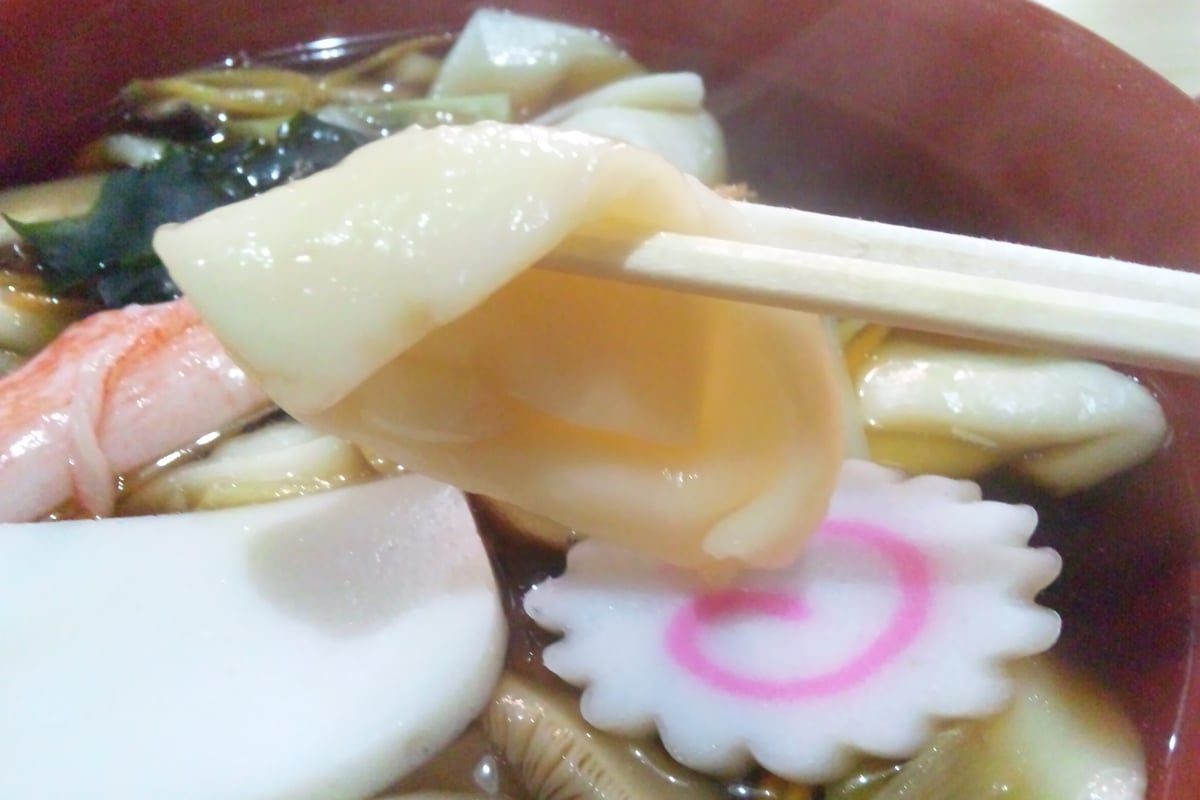
Mimi Udon is a local dish from the Kuzuu district of Sano City and the Shiroyama district of Utsunomiya City in Tochigi Prefecture, made by shaping kneaded wheat-flour dough into an ear shape and boiling it. It is said to have originated in the late Edo period, and by the Taisho era had spread as a dish believed to ward off evil. Modeled after the ears of a demon, the custom of eating it at New Year is rooted in the belief that eating the demon's ears wards off misfortune and prevents unwanted rumors or bad luck, praying for good health and harmonious neighborhood relations. In the Kuzuu district of Sano City, the custom continues today of making a large batch of Mimi Udon at year's end, keeping it soaked in cold water for preservation, and serving it to guests who visit over the New Year. Its distinctive shape comes from kneading wheat flour with lukewarm water and salt, rolling it flat, cutting it into matchbox-sized rectangles, then folding each piece in half and pinching the open edges closed; it is typically served in a soy-sauce-based broth.
Origin
Mimi Udon is a local dish handed down in the Kuzuu district of Sano City and the Shiroyama district of Utsunomiya City in Tochigi Prefecture, said to have originated toward the end of the Edo period. By the Taisho era, it came to be eaten as a lucky charm to ward off evil, based on the belief that eating noodles shaped like a demon's ears would spare one from hearing the demon's curses or malicious rumors; it became established in households as a New Year dish.
History
In the Kuzuu district of Sano City, a custom has been passed down for generations of making a large batch of Mimi Udon at year's end, keeping it soaked in cold water for preservation, and serving it to guests who visit over the New Year. A similar custom is also found in the Shiroyama district of Utsunomiya City, with recipes and lore passed down orally within families and community gatherings. It is now featured by the Ministry of Agriculture, Forestry and Fisheries in its 'Our Regional Cuisines' collection as a Tochigi dish worth passing on to future generations.
Features
The dough, kneaded from wheat flour with lukewarm water and salt, is rolled flat and cut into matchbox-sized rectangles, then folded in half while the inner edges are pinched together, giving the dish its distinctive ear-like shape. The thick dough has a chewy, satisfying texture, and it is typically simmered in a soy-sauce-based broth together with root vegetables such as daikon, taro, and fried tofu, making it a beloved warming dish for winter.
Main Ingredients
Food Culture
Eating Mimi Udon at New Year has been cherished as a lucky-charm dish believed to bring good health and harmonious neighborhood relations for the year ahead. The custom of making a large batch at year's end and serving it to guests is also tied to the region's culture of hospitality.
How It Differs from Home Cooking
At home, each family has its own preferences, passed down for generations, for how the dough is made and shaped as part of New Year traditions, whereas specialty restaurants serve it year-round, often as part of a set menu paired with other local noodle dishes such as daikon soba.
Famous Shops
野村屋本店
栃木県佐野市相生町2819
Founded in 1907. Mimi Udon starts at around 800 yen, and its popular signature set combining it with daikon soba starts at around 1,130 yen. Conveniently close to Sano Station and City Hall.
View details →佐野SA(下り)そば・うどん 栃乃木
栃木県佐野市多田町 東北自動車道佐野サービスエリア(下り線)内
Located inside the Sano Service Area on the Tohoku Expressway, allowing travelers to easily enjoy a taste of local cuisine mid-drive. Mimi Udon is served starting at around 950 yen.