Image: Wikimedia Commons
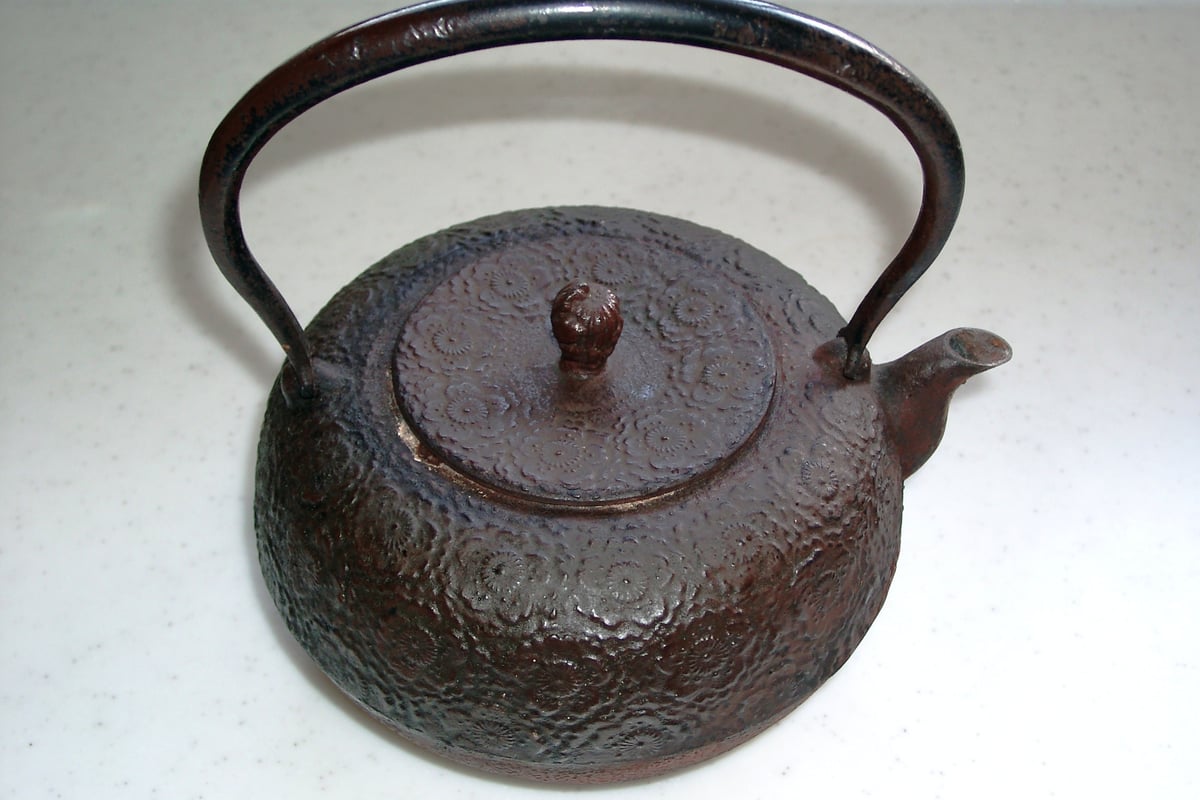
Nanbu Tekki is cast ironware produced mainly in Morioka City and the Mizusawa district of Oshu City, Iwate Prefecture, with a history of around 400 years. In Morioka, the craft is said to have begun in the mid-17th century when a lord of the Nanbu domain invited kettle-makers from Kyoto to produce tea-ceremony kettles, while in Mizusawa it is said to trace back to the late Heian period, when the Oshu Fujiwara clan invited casters from Omi Province. Both areas were rich in resources well suited to casting, such as iron sand, river sand, clay, and charcoal, and casting has flourished there since ancient times. In 1975 Nanbu Tekki was designated a Traditional Craft by the Minister of Economy, Trade and Industry. Prized for its solid, sturdy build and its ability to transmit heat evenly while retaining warmth, it is used to make iron kettles, teapots, pots, and wind chimes, and in recent years has become highly popular overseas as teaware. The handcrafted 'yakigata' (baked-mold) technique continues to be passed down today.
Origin
Nanbu Tekki in Morioka is said to have begun in the mid-17th century, when a lord of the Nanbu domain invited kettle-makers from Kyoto to produce tea-ceremony kettles. Meanwhile, casting in Mizusawa (present-day Oshu City) is said to originate from the late Heian period, when the Oshu Fujiwara clan, who ruled the Tohoku region from their base in Hiraizumi, invited casters from Omi Province - a history of roughly 950 years. Both areas are said to have developed as production centers because they were rich in resources well suited to casting, such as iron sand, river sand, clay, and charcoal.
History
In Morioka, the craft developed from making tea-ceremony kettles, and in the late Edo period the smaller 'tetsubin' iron kettle for boiling water was devised and spread among ordinary people. In Mizusawa, the production of everyday cast-iron goods such as pots and farm tools has flourished since ancient times. Although the two areas developed independently, they came to be known collectively as 'Nanbu Tekki,' and on February 17, 1975, the craft was designated a Traditional Craft by the Minister of International Trade and Industry (now the Minister of Economy, Trade and Industry). Today the production area comprises around 74 workshops and about 730 craftspeople.
Features
Nanbu Tekki is known for its solid, substantial cast surface, often described as 'sturdy, durable, and built to last.' The 'arare' (hailstone) pattern often applied to the surface, together with a coloring process using lacquer and 'ohaguro' (an iron acetate solution), gives pieces a deep black-rust finish with excellent durability and rust resistance. Water boiled in a tetsubin is said to take on a mellow taste as iron dissolves into it, and the practicality of being usable directly over an open flame is another appeal. The traditional 'yakigata' (baked-mold) technique, in which each piece is handcrafted individually, coexists with the 'namagata' (green-sand mold) technique used for mass production.
Materials Used
Production Process
- 1
Making the wooden pattern (kigata)
A vertical half-profile of the design is traced onto a metal plate to create a wooden pattern used for making the mold.
- 2
Making the mold
The wooden pattern is rotated while casting clay is applied in layers - coarse clay, then medium clay, then fine surface clay - to build up the outer mold.
- 3
Baking the mold (yakigata)
The surface of the completed mold is fired and hardened at a high temperature of around 900°C.
- 4
Making the core
A core slightly smaller than the mold is made from river sand and clay and left to dry. The gap between the core and the mold determines the thickness of the finished piece.
- 5
Pouring and finishing
Molten iron is poured into the mold, and once it has cooled the mold is broken open to remove the piece. It is then colored with lacquer or ohaguro to complete the finish.
| Main Production Areas |
|
|---|
Artisans & Workshops
及源鋳造(OIGEN)
A long-established Nanbu Tekki workshop based in Mizusawa, Oshu City. It runs an adjoining factory shop where visitors can watch the production process for tetsubin kettles, frying pans, pots, and more up close.
Official site →How to Buy
- 岩鋳鉄器館
- A museum and direct-sales shop run by Iwachu, a Nanbu Tekki maker in Morioka City. Visitors can tour the workshop and purchase a wide range of products, including tetsubin kettles and teapots.Where to buy →PR
Hands-on Experiences
及源鋳造(OIGEN)工房見学
岩手県奥州市水沢羽田町字堀ノ内45
Reservation required (by phone). Tours are available Mondays, Thursdays, and Fridays, and the 1st and 3rd Tuesdays, from 1:30 p.m. to 4:00 p.m. Closed Wednesdays and the 2nd and 4th Tuesdays.
View details →