Taketa Hime Daruma (Princess Daruma Dolls)
Taketa Hime Daruma (Princess Daruma Dolls of Taketa)
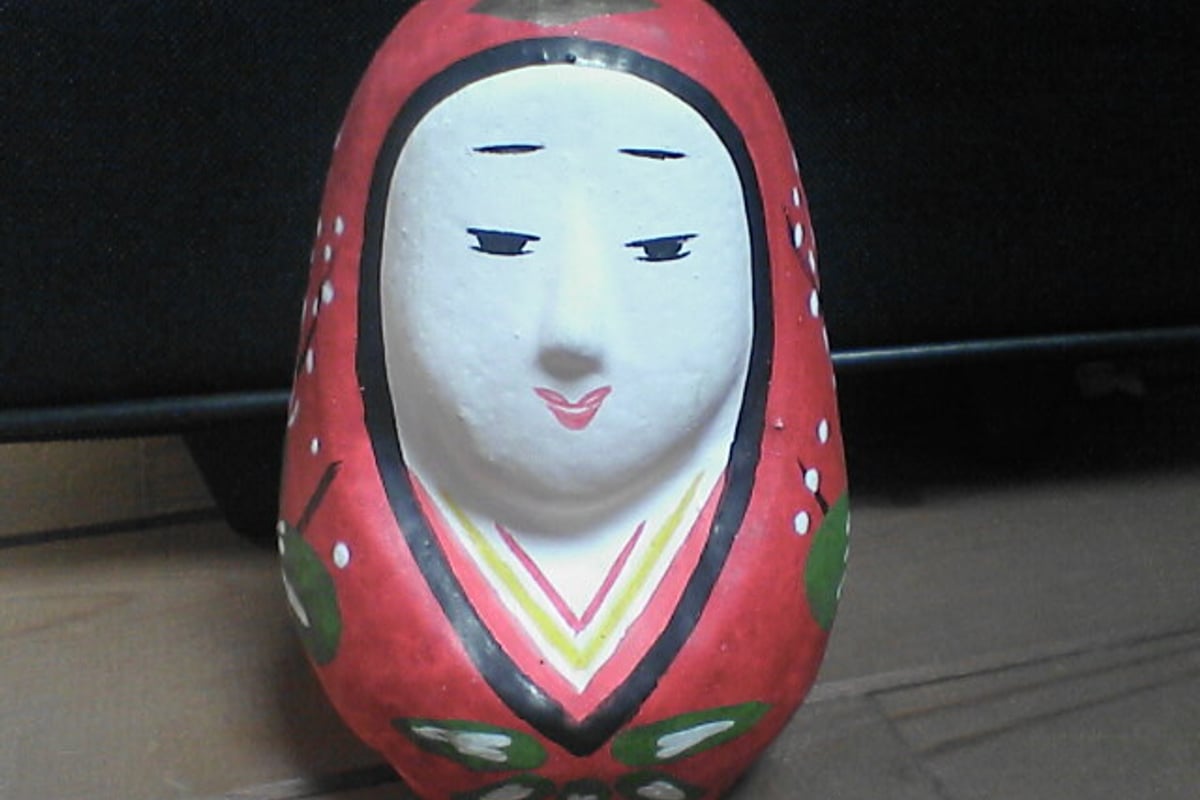
Image: Wikimedia Commons
Taketa Hime Daruma are daruma dolls in the form of a woman, handed down in Taketa City, Oita Prefecture. They have a white face, wear a vermilion kimono, and are painted with pine, bamboo and plum (shochikubai) and a hoju (sacred jewel). According to the Japan Tourism Agency's multilingual commentary, their origins go back to the Edo period, when they were good-luck charms thrown into people's homes at New Year. Because the bottom is round and heavy, they right themselves when knocked over. They are said to be modeled on Ayajo, the wife of a low-ranking samurai of the former Oka domain. The craft once died out, but in 1952 (Showa 27) 後藤恒人 resolved to revive it, and in 1956 he named the dolls 'Hime Daruma'. Today they are handmade only at ごとう姫だるま工房 (Goto Hime Daruma Kobo) in Yoshida, Taketa City. They are hariko (papier-mâché), made by layering newspaper and washi paper over a wooden mold, and each one takes from one week to 10 days. It is reported that, depending on the size, it can take several years from order to delivery.
Origin
According to the workshop's introduction, Hime Daruma derive from 'okiagari', female daruma dolls that were made in the castle town of the former Oka domain. There is also a theory that they were made as side work by low-ranking samurai. The figure they are said to be modeled on is Ayajo, the wife of a low-ranking samurai. A story has been handed down that Ayajo, sent away from her home, endured the bitter cold, and that her family came together again and recovered. A travel information website presents this as an event of 1649 (Keian 2). Including its date, it is a story passed down as a legend.
History
Until the early Showa period, Taketa had a custom called 'nagekomi' (throwing in), in which young people threw okiagari into each house on the night of New Year's Day. The households that received them rejoiced the next morning that good fortune had come in, and are said to have enshrined them on their household altar (kamidana). Production later died out. After the war, 後藤恒人 saw in the dolls, which get back up when knocked over, a reflection of postwar recovery, and in 1952 he resolved to revive them. In 1956 he named them 'Hime Daruma'. The year of the revival differs depending on the source.
Features
The face is painted white, and a kimono in vermilion and yellow is painted on. The pattern on the red part is pine, bamboo and plum, and the gold diamond shape on the head is said to represent the sun. A hoju (sacred jewel) is painted on the white back, and it is said to carry the meanings of warding off misfortune and the prosperity of descendants. Because small stones are placed in the bottom, the doll rights itself even when pushed over. There are five sizes, from No. 4 (about 20 cm tall) to No. 8 (about 50 cm). The workshop's introduction website describes it as an Intangible Folk Cultural Property designated by the city.
Techniques
Hariko (papier-mâché)
Newspaper is layered over a wooden mold, the surface is finished with handmade washi, and then the mold is removed. According to an interview article by Sanwa Shurui (三和酒類), the washi used is Nao handmade washi (名尾手すき和紙) from Yamato Town, Saga City. This is because the washi used previously became hard to obtain.
Base coat of gofun and nikawa
A white base coat of nikawa (animal glue) mixed with gofun, a powder made from seashells, is applied in several layers. The red parts are painted with nikawa mixed with mineral pigments (iwa-enogu). An article in Mynavi News quotes the workshop as saying that the glow of the white skin can only be produced with gofun.
Materials Used
Production Process
- 1
Base layering
Newspaper is layered over the wooden mold. The first sheet is applied with water, and from the second sheet on, with paste.
- 2
Removing the mold and making it self-righting
After drying, the wooden mold is removed, and small stones are placed inside so that the doll rights itself. Handmade washi is pasted on the surface.
- 3
Gofun coating
A white base coat of nikawa mixed with gofun is applied. The workshop's introduction describes this as a process of applying several coats.
- 4
Coloring and painting
Red made from nikawa mixed with mineral pigments is applied, and the face, the hoju and the pine, bamboo and plum are drawn in sumi ink. The diamond shape on the head is painted gold. There are said to be 16 processes in all, from making the wooden mold to painting.
| Main Production Areas |
|
|---|
Artisans & Workshops
ごとう姫だるま工房(後藤姫だるま工房)
Located in Yoshida, Taketa City, it is described as the only workshop that makes Taketa Hime Daruma. It was revived by the first generation, 後藤恒人, and is carried on by the second generation, 後藤明子, and the third generation, 後藤久美子. They divide tasks such as the face and sumi-ink parts and the gofun coating, and family members also help with pasting the newspaper.
Official site →How to Buy
- ごとう姫だるま工房 (Goto Hime Daruma Kobo, telephone orders)
- According to Mynavi News, there are no online sales, and orders are basically placed by telephone. Depending on the size, delivery may take several years. You may be able to buy one by visiting the workshop, but the article recommends checking by phone in advance whether finished pieces are available.
- Workshop goods
- The workshop also carries tenugui hand towels and kinchaku drawstring pouches featuring Hime Daruma. According to listings on travel information websites and elsewhere, they cost about 1,400 to 1,800 yen. The selection and prices are subject to change.
Hands-on Experiences
ごとう姫だるま工房(工房見学)
大分県竹田市吉田889-1
A travel information website says that you can buy goods in addition to touring the workshop. Some introductions say that a telephone reservation is required in advance for tours. No information about making experiences could be confirmed. It is about a 20-minute walk from JR Tamarai Station.
FAQ
Q. Is it the same as the Hime Daruma of Matsuyama, Ehime?
A. They are different. Matsuyama's Hime Daruma are good-luck charms associated with the legend of Empress Jingu. Taketa's Hime Daruma are tied to the story of Ayajo, the wife of a low-ranking samurai of the former Oka domain. Matsuyama's hariko also differ in that an unglazed, bisque-fired face is set into them.
Q. Why are they called 'Hime Daruma'?
A. They were once called names such as 'Okiagari-sama'. It is said that in 1956, 後藤恒人, who revived them, named them 'Hime Daruma'. Their distinctive feature is that they take the form of a woman, whereas most ordinary daruma take the form of a man.