Kiji-uma (Wooden Pheasant Horse Toy)
Kiji-uma (Wooden Pheasant-shaped Toys of Hitoyoshi)
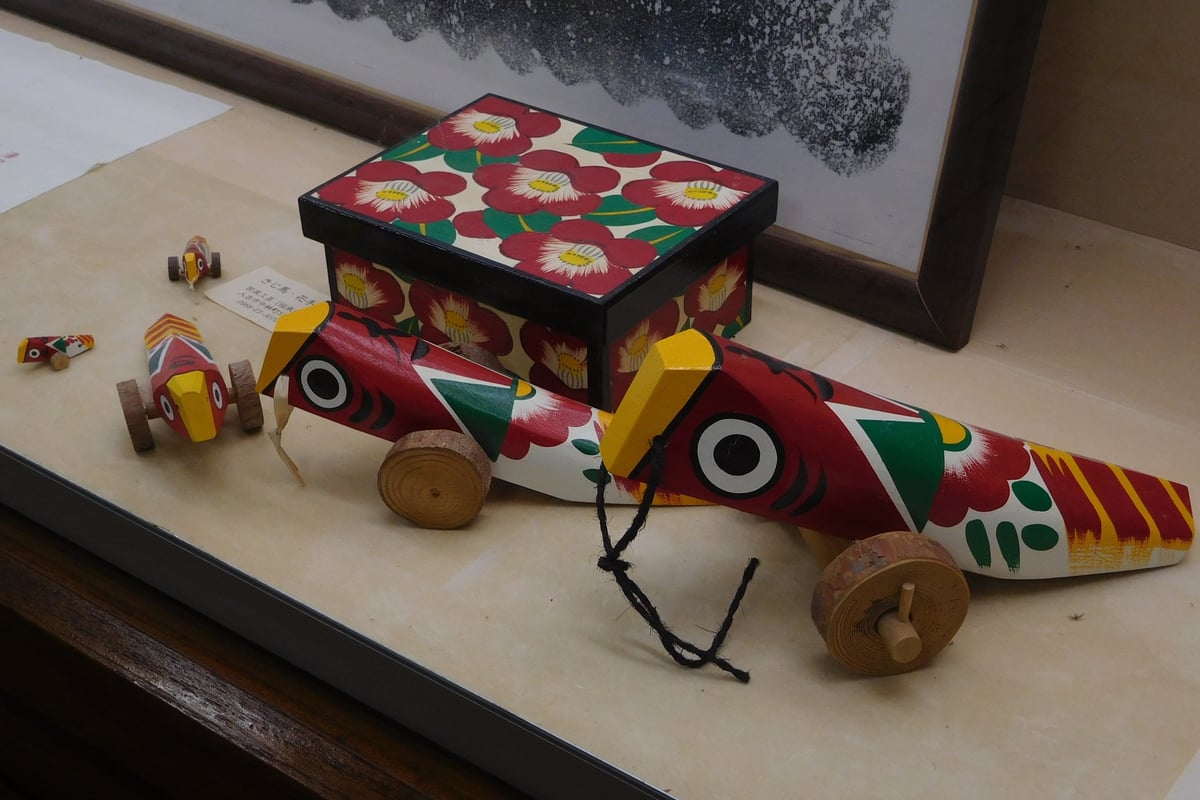
Image: Wikimedia Commons
Kiji-uma is a wooden folk toy handed down in the Hitoyoshi-Kuma region of Kumamoto Prefecture. It is a wheeled toy with a body shaped like a kiji (pheasant), a wild bird, and children play with it by pulling it on a string or riding on top of it. It has been cherished as a good-luck charm wishing for the healthy growth of children. It is said to have first been made more than 800 years ago by fugitives of the Heike clan who missed life in the capital. It is painted mainly in red with yellow and green, and the character 大 ('great') and eyes are drawn on the head in sumi ink. Together with hanatebako (flower hand boxes), which share the same legend, it is a representative toy of Hitoyoshi, and at the spring fair, kiji-uma were bought as souvenirs for boys. In 2025, 'Kiji-uma and Kiji-guruma Making Techniques of the Kyushu Region' was selected as an Intangible Folk Cultural Property for which documentation and other measures should be taken. The number of makers has declined, and a 2025 news report stated that only two businesses, both in Hitoyoshi City, remain in the prefecture.
Origin
According to the Kumamoto Prefectural Traditional Crafts Center, it is said that more than 800 years ago, when Heike fugitives fled to the Kuma region and settled in the remote interior of Hitoyoshi, they began making it out of longing for life in the capital. Hanatebako and hagoita (battledores) are said to share the same origin. Kiji-uma is known as a toy found only in Kyushu, and many are made in the area between the Kuma River and the Chikugo River. The date of its beginnings is based on legend.
History
At Hitoyoshi's spring fair, held every year in the second month of the lunar calendar, there is said to have been a custom of buying kiji-uma as souvenirs for boys and hanatebako for girls. Although the craft once nearly died out, 住岡喜太郎 revived it in the late Meiji period. Products of 住岡郷土玩具製作所 (Sumioka Folk Toy Workshop) were chosen for the Japan Good Toy 100 Selection in 1989 and 1990, and on March 28, 2025, the making techniques received national selection.
Features
The kiji-uma of Hitoyoshi makes use of the natural roundness of miscellaneous woods such as dara (Japanese angelica tree) and wisteria for the back; the head and belly are carved with a hatchet, and two wheels are attached. It is suited to a game in which children ride it and slide down mountain slopes, and its distinctive feature is said to be a sturdy undercarriage with a thick axle built into the body. Only the back is painted. The Kumamoto Nichinichi Shimbun reports that there are three lineages, Hitoyoshi-Kuma, Fukuoka and Oita, which differ in shape and materials.
Techniques
Choosing wood for each part
At 住岡郷土玩具製作所, paulownia is mainly used for the body and pine for the wheels. The wood is left to dry for about five years to prevent cracking. Because the way the wood is cut affects the toy's appearance, the workshop is described as paying close attention to kidori (planning the cut) and cutting out the pieces.
Fitting the wheels
In an interview with 住岡郷土玩具製作所, the wheels are said to be the hardest part of making kiji-uma. It is explained that a bamboo rod is inserted as the core so that they rotate properly, and a groove is cut into the body to fix them in place.
Materials Used
Production Process
- 1
Choosing materials and cutting the wood
According to Cultural Heritage Online, wood that can be gathered in satoyama (village woodlands) is used as the material, and the toys are made mainly with adzes and chisels. At 住岡郷土玩具製作所, wood that has been dried for about five years is cut out.
- 2
Shaping the body
For the kiji-uma of Hitoyoshi, the roundness of the debarked wood is used for the back, and the head and belly are carved with a hatchet. The shape, size and number of wheels are said to vary by locality.
- 3
Painting
The back is colored mainly in red with yellow and green, and the character 大 and eyes are drawn on the head in sumi ink. 住岡郷土玩具製作所 is described as using water-based paints that are harmless even if children lick them.
- 4
Attaching the wheels
A hole is made in the center of a wheel cut as a round slice from a log, and it is attached to the axle. In large ones, an axle that is thick relative to the whole toy is firmly built into the body.
| Main Production Areas |
|
|---|
Artisans & Workshops
住岡郷土玩具製作所
A workshop where the first generation, 住岡喜太郎, revived kiji-uma and hanatebako in the late Meiji period. The second generation, 住岡忠嘉, and his family have shared the woodworking and painting. 住岡孝行 was introduced in the Kumamoto Nichinichi Shimbun in 2025 as a 47-year-old kiji-uma craftsman.
Official site →工房みやはら(旧:宮原工芸)
A workshop in the countryside a little away from Hitoyoshi's hot spring area. 宮原清光 does the woodworking at the back of the shop, and his wife does the painting inside the shop. Besides kiji-uma and hanatebako, it is described as taking on new products such as earrings and chopstick rests.
Official site →How to Buy
- Kumamoto Prefectural Traditional Crafts Center Web Shop
- It carries kiji-uma from 住岡郷土玩具製作所. As displayed in November 2026, size No. 4 is 1,430 yen, No. 6 is 3,300 yen and No. 10 is 6,292 yen (tax included). Stock and prices are subject to change.Where to buy →PR
- 工房みやはら (Kobo Miyahara, Hitoyoshi City)
- Kiji-uma and hanatebako are lined up in the shop. Mapple's listing, under the former name 宮原工芸 (Miyahara Kogei), gives kiji-uma from 400 yen and hanatebako from 450 yen. As the date of the listing is unknown, please check in advance.Where to buy →PR
Hands-on Experiences
人吉クラフトパーク石野公園 民工芸館
熊本県人吉市赤池原町1425-1
A facility at Michi-no-Eki Hitoyoshi (roadside station) where you can try painting kiji-uma and hanatebako. KAB program information from April 2025 introduced the painting experience at 1,500 yen. Prices are subject to change.
View details →工房みやはら(旧:宮原工芸)
熊本県人吉市中林町512-2
Mapple lists, under the former name 宮原工芸, a kiji-uma and hanatebako experience at 600 yen per hour. The date of the listing is unknown, and whether it is currently offered has not been confirmed. Please inquire in advance.
View details →FAQ
Q. What is the relationship between kiji-uma and hanatebako?
A. Both are folk toys handed down in Hitoyoshi and share the same legend that they were first made by Heike fugitives. Hanatebako is a box made of fir, hinoki cypress or cedar boards, painted white and decorated with camellias in red and green. At the spring fair, they were bought as souvenirs for girls.
Q. Does the character 大 on the forehead have a meaning?
A. It is described as expressing wishes for children's growth, and the toys are said to be displayed for Tango no Sekku (the Boys' Festival). According to an interview article with 住岡郷土玩具製作所, large kiji-uma are also welcomed as gifts for new homes and shop openings, as they are said to draw people together.
Q. How does it differ from kiji-uma of other prefectures?
A. The Kumamoto Nichinichi Shimbun cites examples of the Hitoyoshi lineage, the Fukuoka Kiyomizu lineage and the Oita Kitayamada lineage, and reports that they differ in shape and materials. Cultural Heritage Online also explains that there are regional differences in shape, size, number of wheels, colors and patterns.