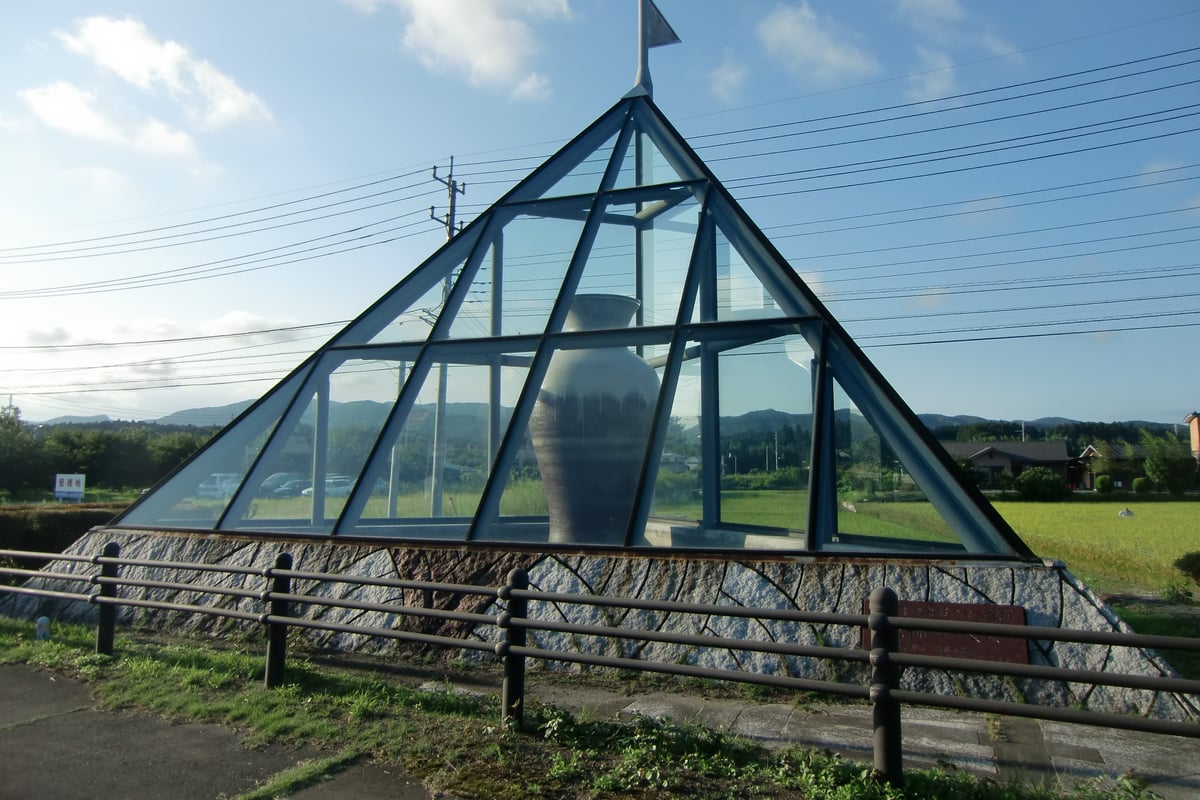
Image: Wikimedia Commons
Kasama ware is pottery produced mainly in Kasama City, Ibaraki Prefecture. Its origins are said to date to the An'ei era (1772-1781) in the mid-Edo period, when Kuno Han'emon of Hakoda village (present-day Hakoda, Kasama City) built a kiln after receiving instruction from Choemon, a potter invited from Shigaraki in Omi Province. From the late Edo period through the Meiji era, taking advantage of its location near Edo, the area developed as a major production center for everyday earthenware such as water jars and sake bottles. Demand fell sharply after World War II with the spread of plastic products, but through joint efforts of government and industry the region shifted from everyday tableware to artistic pottery, and on October 8, 1992, it was designated a METI-designated Traditional Craft Product. Kasama ware is known for its exceptionally free range of styles - so much so that it is said 'having no fixed characteristics is its characteristic' - and today about 300 potters and kilns continue to produce individually distinctive works.
Origin
The origins of Kasama ware are said to trace back to the An'ei era (1772-1781) in the mid-Edo period. Kuno Han'emon of Hakoda village (present-day Hakoda, Kasama City) is said to have begun making pottery and built a kiln after receiving instruction from Choemon, a potter invited from Shigaraki in Omi Province. Under the protection of the Kasama Domain, the production of everyday earthenware using locally sourced Kasama clay spread throughout the area.
History
From the late Edo period through the Meiji era, taking advantage of its proximity to Edo (Tokyo), the region mass-produced coarse earthenware for kitchen use, such as water jars, sake bottles, and grinding bowls, becoming a nationally known production center. After World War II, demand fell sharply with the spread of plastic products, causing a temporary decline, but through joint efforts of government and industry the region shifted from everyday tableware to artistic pottery. It was designated a METI-designated Traditional Craft Product on October 8, 1992, and today it is known as an open production area where potters from both within and outside the prefecture relocate to create their work.
Features
Kasama ware is characterized by a free style not bound to any particular form or technique, often described with the phrase 'having no fixed characteristics is its characteristic.' Kasama clay, composed mainly of kibushi clay and gairome clay derived from decomposed granite, is highly viscous and rich in iron, producing sturdy, stain-resistant vessels once fired. In recent years, a heat-resistant clay called 'Kasama kaki' has also been developed, allowing pieces to be placed directly over an open flame, and it is used to create new types of vessels such as earthenware pots and ceramic griddle plates.
Techniques
Kasama Kaki (Heat-Resistant Ware)
A technique using Kasama clay with enhanced heat resistance, enabling the production of cookware such as earthenware pots and ceramic griddle plates that can be placed directly over an open flame. It draws on the traditional skills of everyday tableware production while opening the way for new product development.
Materials Used
Artisans & Workshops
向山窯
A kiln based in Shimoichige, Kasama City. It produces METI-designated Traditional Craft Product 'Kasama ware,' ranging from everyday tableware such as teacups and rice bowls to gift items. Its Plaza shop near Kasama Station also offers sales and kiln tours.
Official site →How to Buy
- 笠間焼窯元共販センター
- A joint direct-sales facility located along 'Tou no Komichi' (Pottery Path) in Shimoichige, Kasama City. It gathers works from about 150 potters and kilns under one roof, offering everything from affordable everyday items such as teacups, rice bowls, and sake vessels to works by individual artists.Where to buy →PR
Hands-on Experiences
笠間工芸の丘
茨城県笠間市笠間2388-1
A pottery experience facility for Kasama ware. Electric wheel-throwing experience 4,400 yen, hand-building experience 2,640 yen, painting experience 1,650 yen (all include firing fee; reservation required).
View details →いそべ陶苑
茨城県笠間市平町341
A pottery experience class run by a Kasama ware kiln. Electric wheel-throwing experience from 3,000 yen, hand-building experience from 1,200 yen, painting experience from 432 yen (firing fee included, shipping not included).
View details →笠間の陶炎祭(ひまつり)
茨城県笠間市笠間2345(笠間芸術の森公園)
A pottery fair held every year during Golden Week (April 29 - May 5). About 200 kilns and potters set up stalls, with admission of 500 yen (free for high school students and younger, etc.).
View details →