Craft Genre
Glasswork
A cross-regional look at Glasswork from across Japan.
Region(multiple selection allowed)
7 items
Ryukyu Glass
Ryukyu Glass
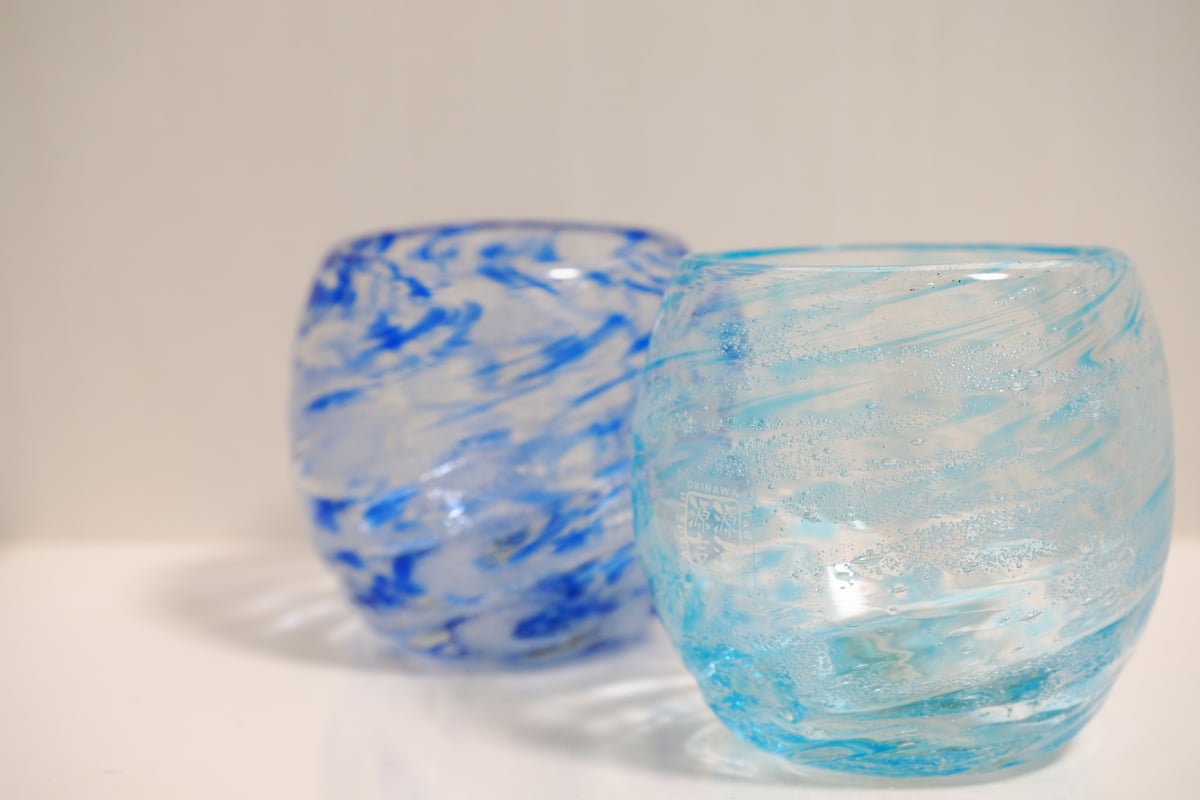
Ryukyu Glass is blown-glass craftware made in Okinawa Prefecture. Glassmaking in Okinawa is said to have begun around 1900, when glassblowers who had come from Kagoshima, Nagasaki, and Osaka set up workshops in Nishimachi, Naha City, producing everyday items such as medicine bottles and lamp chimneys. Much of the industry and its raw materials were lost during World War II, but after the war, artisans turned to empty beer and cola bottles discarded by the occupying US military bases, melting them down to bring glassmaking back to life. Because these discarded bottles contained impurities such as label residue, the finished pieces often contained countless tiny bubbles - a trait that came to be prized as the distinctive texture known as 'awa-garasu' (bubble glass), and together with the soft, muted colors derived from recycled bottles, became one of the defining charms of Ryukyu Glass. In the 1950s, orders from US military personnel increased, and colorful Western-style glass tableware spread as the industry's mainstay product. Today, workshops are scattered around Itoman City, Tomigusuku City, and Nago City, and in 1998 Ryukyu Glass was designated a Traditional Craft of Okinawa Prefecture.

Hizen Biidoro
Hizen Biidoro
Hizen Biidoro is a traditional free-blown glass craft passed down in Saga City. Its roots trace back to 1852 (Kaei 5), in the closing years of the Edo period, when Nabeshima Naomasa, the 10th lord of Saga Domain, established the Seirenkata (a research institute equivalent to a modern institute of chemistry and physics) on the banks of the Tafuse River. Glassmaking was studied there for producing chemical containers needed for cannon manufacturing and medicine development, and the technique was nurtured under the domain's protection. Soejima Genichiro, who had worked at the Seirenkata since childhood, became independent and founded Soejima Glass Manufacturing in 1903 (Meiji 36), carrying the technique forward, and the company has continued making handmade glass ever since, for more than 120 years. Most products are shaped using the 'chubuki' (free-blowing) technique, which relies solely on breath rather than a mold, and among its techniques, 'Jappan-buki,' which uses two blowpipes at once, is known as a rare, advanced technique found almost nowhere else in the world. Today it is designated an Important Intangible Cultural Property of Saga City, and Soejima Glass Manufacturing preserves the tradition as its sole maker.
Izumi Tonbodama (Glass Beads)
Izumi Tonbodama (Glass Beads)
Izumi Tonbodama are glass beads (tonbodama) made in Izumi City and Sakai City. Tonbodama are round glass beads whose surfaces are decorated with patterns in two or more colors of glass. The name is said to come from the resemblance of their dotted patterns to the compound eyes of a dragonfly (tonbo). In Izumi Province (present-day Sakai City and the area to its south), glass beads are said to have been made since before the Nara period. In the Edo period, they were widely known as '泉州玉' (Senshu beads) and 'saka-tonbo.' Production techniques were established in the early Meiji era, and in the Shinoda area of Izumi City, glass-bead making flourished as a side business for farmers. In the Taisho era, the production of artificial pearls, made by coating glass beads, also spread. The beads are formed by winding colored glass rods melted in a flame around a mandrel, and patterns are then added to the surface. The color techniques created by combining multiple kinds of glass are also put to use in restoring National Treasures and repairing cultural properties. In 2002 (Heisei 14), it was designated an Osaka Prefecture-designated Traditional Craft.
Edo Glass
Edo Glass
Edo Glass is a general term for glassware handcrafted piece by piece by artisans, carrying on techniques that developed in the old Edo region (present-day Tokyo). It is said to have begun in the early 18th century, when Kagaya (Minagawa) Kyubei of Nihonbashi Toshiocho made mirrors and eyeglasses, and Kazusaya Tomesaburo of Asakusa made hairpins and wind chimes; by the late 19th century it had grown into one of Tokyo's leading industries. Whereas Edo Kiriko is characterized by decorative cut-glass patterns, Edo Glass centers on plain glassware shaped without molds through 'free-blowing (mold-free glassblowing)' -- using only a blowpipe and molten glass -- or through 'mold-blowing,' in which the glass is blown into a mold, giving it a simple, warm texture. It has produced many everyday items rooted in daily life, such as cups, glass bowls, goldfish bowls, and Edo furin (wind chimes), and, unlike mass-produced imports, is also highly regarded for custom-made items such as wine glasses and sake vessels, thanks to its ability to handle small-batch, many-variety production. It was designated a Traditional Craft Designated by the Tokyo Metropolitan Government in 2002 and a Traditional Craft Designated by the Minister of Economy, Trade and Industry in 2014, and today many small, workshop-style glass studios continue to pass down the technique, mainly in Sumida, Koto, and Edogawa wards.
Edo Kiriko
Edo Kiriko
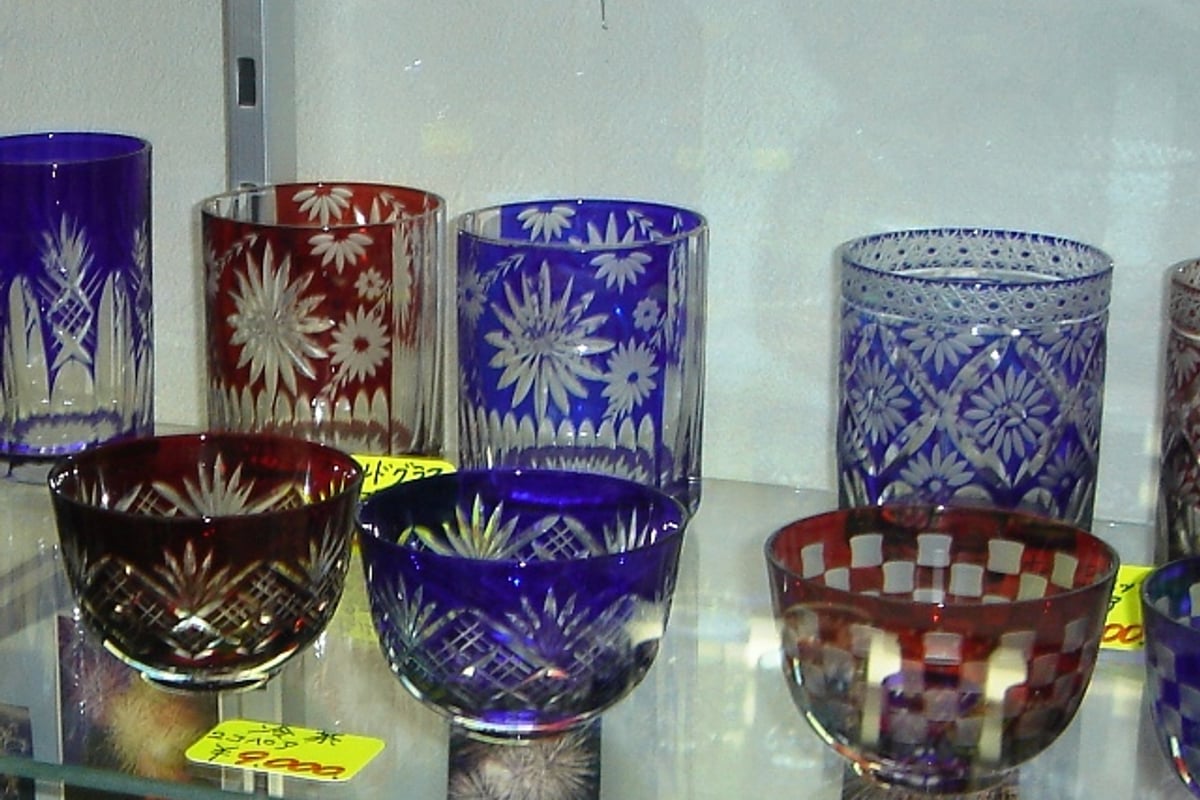
Edo Kiriko is a cut-glass craft born in Edo (present-day Tokyo), made by carving fine patterns into the surface of glass. It is said to have begun in 1834 (Tenpo 5), when Kagaya Kyubei, a glassware dealer in Edo's Odenmacho district, used abrasive sand to engrave patterns onto glass. During the Meiji era, Japanese artisans studied under the British engineer Emanuel Hauptmann, invited by the government, and established the cutting technique still used today. The craft uses 'overlay glass (cased glass)' -- clear glass thinly coated with colored glass -- into which patterns are cut with a blade. Because the colored layer is only about 1mm thick, the boundaries of each cut stand out sharp and crisp. About 20 traditional patterns exist, including nanako (fish-roe pattern), kiku-tsunagi (linked chrysanthemums), asa-no-ha (hemp leaf), and yarai (bamboo fence), and the fine cuts catch the light with delicate brilliance. Whereas Satsuma Kiriko, another well-known cut-glass tradition, has a thicker colored layer that creates a gradated effect, Edo Kiriko is known for its sharp, crisp cuts. It was designated a Traditional Craft Designated by the Tokyo Metropolitan Government in 1985 and a Traditional Craft Designated by the Minister of Economy, Trade and Industry in 2002, and today many artisans continue to pass down the technique, mainly in Koto, Edogawa, and Sumida wards.
Otaru Glass
Otaru Glass
Otaru Glass is a general term for the glass craft that developed in Otaru City, Hokkaido. It began in 1901, when Asahara Hisakichi, who had come to Hokkaido from Kyushu, founded Asahara Glass in Otaru to manufacture kerosene lamps. From 1910, the company also began producing glass floats for fishing, and grew to a scale that included factories in Otaru, Muroran, Asahikawa, Kushiro, and Karafuto (Sakhalin). However, as electric and kerosene stoves spread, demand for lamps declined, and glass floats were gradually replaced by plastic ones, leaving Asahara Glass as the only glass manufacturer in Otaru by 1960. In 1971, Asahara Glass changed its name to Kitaichi Glass, and when it dared to display kerosene lamps, once an everyday necessity, in its storefront, they became popular among travelers as interior décor, marking a shift from industrial glass to glass craft and household goods. Today, multiple workshops and shops, including Kitaichi Glass and Taisho Glass, are clustered around the Otaru Canal, and the area is also known as a tourist destination where visitors can try glassblowing.
Tsugaru Vidro
Tsugaru Vidro
Tsugaru Vidro is a handmade glass craft produced by Hokuyo Glass in Aomori City, Aomori Prefecture. Hokuyo Glass was founded in 1949 (Showa 24) as a factory making glass fishing floats, and became a top domestic producer using the chubuki (free-blown, mold-free) technique it developed for making sturdy floats. However, as the spread of plastic floats reduced demand, the craftsmen applied their skills to making tableware and vases instead, and 'Tsugaru Vidro' was born in 1977 (Showa 52). When sand from Tsugaru's Shichiri-Nagahama beach was added as a raw material, it produced a rich green color, launching full-scale production of colored glass; today the company blends more than 100 varieties of colored glass in-house. In March 1996 (Heisei 8), it was designated a Traditional Craft by Aomori Prefecture, and it remains loved at home and abroad as a glass craft reflecting Aomori's nature.