Image: Wikimedia Commons
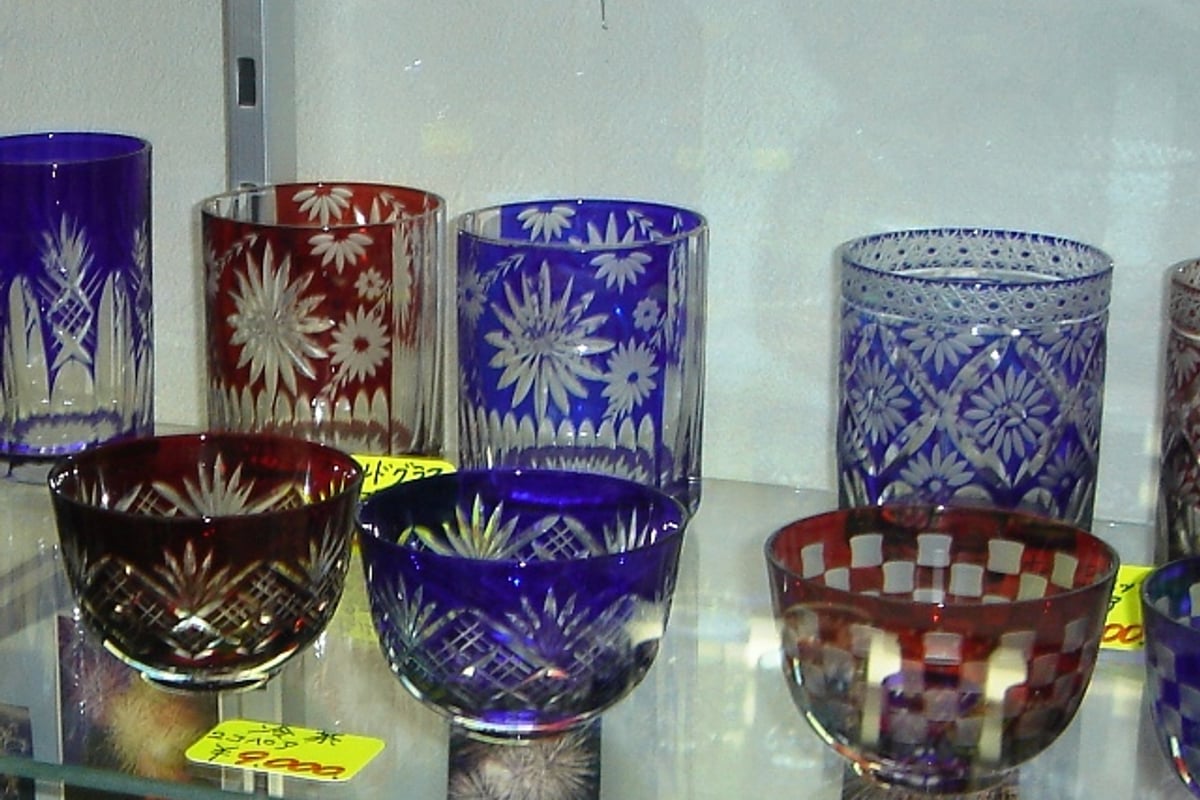
Edo Kiriko is a cut-glass craft born in Edo (present-day Tokyo), made by carving fine patterns into the surface of glass. It is said to have begun in 1834 (Tenpo 5), when Kagaya Kyubei, a glassware dealer in Edo's Odenmacho district, used abrasive sand to engrave patterns onto glass. During the Meiji era, Japanese artisans studied under the British engineer Emanuel Hauptmann, invited by the government, and established the cutting technique still used today. The craft uses 'overlay glass (cased glass)' -- clear glass thinly coated with colored glass -- into which patterns are cut with a blade. Because the colored layer is only about 1mm thick, the boundaries of each cut stand out sharp and crisp. About 20 traditional patterns exist, including nanako (fish-roe pattern), kiku-tsunagi (linked chrysanthemums), asa-no-ha (hemp leaf), and yarai (bamboo fence), and the fine cuts catch the light with delicate brilliance. Whereas Satsuma Kiriko, another well-known cut-glass tradition, has a thicker colored layer that creates a gradated effect, Edo Kiriko is known for its sharp, crisp cuts. It was designated a Traditional Craft Designated by the Tokyo Metropolitan Government in 1985 and a Traditional Craft Designated by the Minister of Economy, Trade and Industry in 2002, and today many artisans continue to pass down the technique, mainly in Koto, Edogawa, and Sumida wards.
Origin
The origins of Edo Kiriko date back to 1834 (Tenpo 5). It is said to have begun when Kagaya Kyubei, a glassware dealer in Edo's Odenmacho district, engraved patterns onto the surface of glass using abrasive sand. At the time it was a simple craft of carving patterns directly into clear glass, but it became a beloved everyday item among the common people of Edo and developed into a distinctive cutting tradition.
History
In the Meiji era, under the guidance of the British engineer Emanuel Hauptmann, invited by the government, a dozen or so Japanese artisans learned Western cut-glass techniques, and this established the Edo Kiriko technique still used today. The craft reached its peak in the early Showa era, and after the war, colorful kiriko made with overlay glass became widespread. It was designated a Traditional Craft Designated by the Tokyo Metropolitan Government in 1985 and a Traditional Craft Designated by the Minister of Economy, Trade and Industry in 2002, and is highly regarded both in Japan and abroad as a craft that embodies Edo chic (iki).
Features
The defining feature of Edo Kiriko is cutting patterns into overlay glass -- clear glass thinly coated with colored glass -- using a rotating grindstone or diamond wheel. Because the colored layer is only about 1mm thick, the boundaries of each cut stand out sharp and crisp, catching the light with a keen sparkle. About 20 traditional patterns, including nanako, kiku-tsunagi, asa-no-ha, and yarai, are combined to create intricate geometric designs. This sharp, crisp brilliance distinguishes it from Satsuma Kiriko, which has a thicker colored layer that produces a gradated effect.
Techniques
Cutting overlay glass
A technique of cutting patterns with a rotating grindstone into glass whose clear surface has been thinly coated with colored glass. Because the colored layer is thin, the boundary between the cut surface and the clear glass stands out sharply, producing the keen brilliance unique to Edo Kiriko.
Combining traditional patterns
About 20 classic patterns -- including nanako (a pattern of linked fish roe), kiku-tsunagi (linked chrysanthemums), asa-no-ha (hemp leaf), and yarai (bamboo fence) -- are arranged precisely to suit the shape of each piece. The patterns carry meanings such as prosperity for descendants and good fortune.
Materials Used
Production Process
- 1
Marking out (sumitsuke)
Vertical and horizontal guide lines and points are marked on the surface of the glass piece with a marker to determine the layout of the pattern.
- 2
Rough grinding
A coarse diamond wheel is applied with water along the marked lines to carve out the rough shape of the pattern.
- 3
Third pass (sanban-gake)
A finer wheel is used to refine the grooves cut during rough grinding and finish the overall outline of the pattern.
- 4
Stone finishing (ishi-gake)
A natural whetstone is used to refine the details of the cut surfaces, smoothing them and sharpening the crispness of the pattern.
- 5
Polishing
The cut surfaces are carefully polished using wooden wheels and polishing compounds to bring out a clear, glossy finish.
| Main Production Areas |
|
|---|
Artisans & Workshops
江戸切子の店 華硝(はなしょう)
Founded in 1946, this long-established Edo Kiriko workshop has over 70 years of history. All processes, from cutting to polishing, are done by hand, producing around 50 patterns ranging from classic designs such as yarai, asa-no-ha, and chrysanthemum to modern motifs. Its work has also been used as gifts for state guests.
Official site →すみだ江戸切子館・川井更造
An Edo Kiriko workshop and direct-sale shop in Taihei, Sumida Ward, certified by the ward. Artisans, including Sumida Meister Kozo Kawai, hand-make kiriko pieces daily; the shop also offers exhibition sales and simple cutting experiences.
Official site →清秀硝子工房
An Edo Kiriko workshop founded in 1970 in Kameido, Koto Ward. About a 5-minute walk from JR Kameido Station, it handles everything from production and sales to hands-on experiences, creating glasses and sake vessels using traditional patterns.
Official site →How to Buy
- 伝統工芸「江戸切子」協同組合 公式通販
- The official online shop run by the Edo Kiriko Cooperative. It carries kiriko glasses and sake vessels from multiple member workshops and artisans, letting shoppers compare the characteristics of each traditional pattern.Where to buy →PR
- 江戸切子の店 華硝
- The directly run shop of the long-established Hanasho workshop offers a wide range of pieces, from traditional patterns to modern designs. Items range from small pieces such as guinomi cups to pair glasses, generally priced from around 10,000 yen to several tens of thousands of yen.
Hands-on Experiences
すみだ江戸切子館
東京都墨田区太平2-10-9
Open Tuesday to Saturday, 10:00-17:00 (reservation required). Edo Kiriko experiences start from around 4,950 yen, allowing visitors to cut patterns into a glass under an artisan's guidance. About an 8-minute walk from Kinshicho Station (JR/subway).
View details →清秀硝子工房
東京都江東区亀戸5-13-11
About a 5-minute walk from JR Kameido Station on the Sobu Line. Offers an Edo Kiriko experience where visitors cut patterns into a glass blank; reservations required in advance. Finished pieces can be taken home the same day.
View details →FAQ
Q. What is the difference between Edo Kiriko and Satsuma Kiriko?
A. In Edo Kiriko, the colored glass layer is only about 1mm thick, so the boundaries of each cut stand out sharply, whereas in Satsuma Kiriko the colored layer is 5mm or more thick, giving the cut surfaces a gradated appearance -- this is the main difference.
Q. What are Edo Kiriko's representative patterns?
A. They include nanako, which represents clustered fish roe; kiku-tsunagi, shaped like chrysanthemum blossoms; and asa-no-ha and yarai. All are classic patterns rooted in the everyday life of Edo commoners and in meanings of good fortune.